Japan
Wood Products Prices
Dollar Exchange Rates of 28th
February
2026
Japan Yen 156.06
Reports From Japan
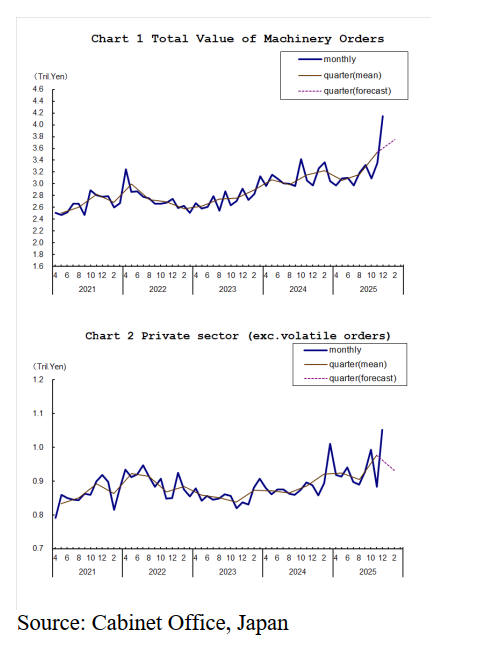
Machinery orders on the rise
Data providing an indication of business activity has been
made available by the Cabinet Office. The latest report
says the total value of machinery orders received by 280
surveyed manufacturers operating in Japan increased by
24% in December from the previous month. In the
October-December period orders increased by 12%
compared with the previous quarter.
Private-sector machinery orders, excluding volatile ones
for ships and those from electric power companies,
increased by 19% in December. In the January-March
period the total amount of machinery orders is forecast to
increase by 6% and private-sector orders, excluding
volatile ones, were forecast to decrease by 5% from the
previous quarter.
See: https://www.esri.cao.go.jp/en/stat/juchu/2025/2512juchu-
e.html
Prioritising domestic investment
Japan’s Prime Minister has sought to reassure markets
after her spending plans unsettled investors. She argued
that the government will adopt a “responsible and
proactive” fiscal policy that balances capital investment
and fiscal restraint. When campaigning for the recent
general election the PM pledged to suspend the 8%
consumption tax on food for two years without issuing
deficit bonds.
The Prime Minister has pledged to prioritise domestic
investment. Despite the weak yen, "the movement of
companies to invest in Japan again is still slow due to
doubts about growth potential," said Daiju Aoki, Chief
Japan Economist for UBS SuMi Trust Wealth
Management.
Low interest rates are a prerequisite for managing the
economy but the current interest rate hike cycle threatens
to undermine that. "Small companies with a high reliance
on debt are more susceptible to the impact of interest rate
hikes," said Naoki Hattori, Senior Japan Economist at
Mizuho Research & Technologies.
See: https://asia.nikkei.com/economy/japanese-companies-
reluctant-to-invest-at-home-despite-weak-yen2
Efforts to reassure investors and stabilise the
yen/dollar exchange rate
During a recent meeting with the media the Prime Minister
sought to explain what she called a “responsible and
proactive” fiscal policy that balances capital investment
and fiscal restraint hoping this would reassure investors
and stabilise the yen /dollar exchange rate. Despite this
statement Japanese government bond (JGB) yields rose
to record highs as investors feared the government may
sell more debt to fund the expansionary programme.
With prices and wages rising the Bank of Japan (BoJ) is
working to normalise monetary policy but an increase in
interest rates will add to household problems.
Will wage increases be large enough to lift real wages
Rising prices are putting increasing pressure on household
finances and the Labour Unions have demanded
substantial worker pay increases at the spring wage
negotiations. Large corporations are expected to present
their responses to the Union requests in mid-March. The
focus will be on whether the firms will raise wages at a
scale that would lead to real wage growth amid the
country’s persistent inflation. Real wages in Japan must
rise after remaining in negative territory for all of 2025.
In January, the consumer price index, excluding fresh
food, rose by just 2% year on year, its lowest level since
January 2024 according to government data. That rate of
increase is in line with the Bank of Japan's target for price
stability.
Government measures against high prices appear to be
working. Gasoline prices were brought down significantly
by a reduction in taxes on the fuel, and eliminating tuition
for public high schools has also contributed to the drop.
Last month, the government also began subsidising
electricity and gas bills These measures may have put real
wages, which declined every month last year, within sight
of positive growth.
Real wages, adjusted for inflation, decreased by 1.3% in
2025 compared to the previous year, according to the
Ministry of Health, Labor and Welfare. Real wages were
down year on year for every month in 2025, never once
entering positive territory.
See: See: https://asia.nikkei.com/economy/japan-s-real-wages-
poised-to-grow-after-a-year-of-decline
and
https://www.nippon.com/en/japan-data/h02698/
Yen exchange rate impacts households
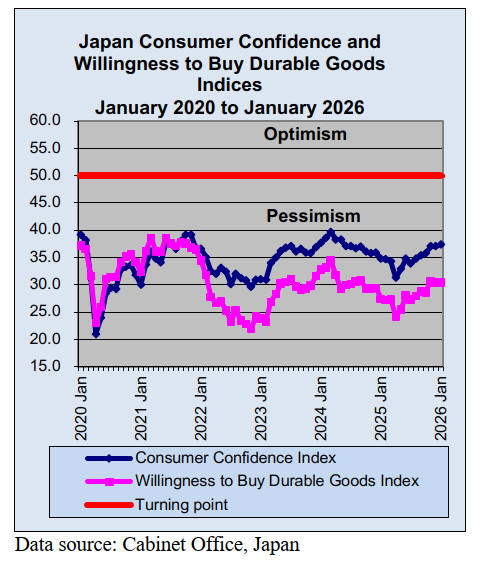
In February the yen/dollar exchange rate hit a 53-year low,
falling to a third of its 1995 peak. This has a major impact
on household purchasing power.
According to the Bank for International Settlements the
Japanese currency's real effective exchange rate as of
January 2026 was 67.73, the lowest level since the
country's transition to a floating exchange rate in 1973.
The yen's real effective exchange rate peaked in April
1995 at 193.95 and has since fallen to roughly a third of
that level.
Japanese house builders expanding presence in the
US
Why are Japanese builders expanding their presence in the
US market through acquisitions? The main reasons are
demographic and structural. Japan’s domestic population
is shrinking and aging, limiting long-term housing growth
and risking a sharp downturn in business for Japanese
homebuilding firms.
The United States, by contrast, continues to
experience
population growth and household formation particularly in
the Sun Belt. The Sun Belt is the region in the United
States that stretches across the southern and southwestern
portions of the country from Florida to California. Major
U.S cities within the Sun Belt include Atlanta, Dallas,
Houston, Las Vegas, Los Angeles, Miami, New Orleans,
Orlando, and Phoenix.
It is here that many big US homebuilders operate. For
Japanese firms seeking stable, long-duration growth, US
homebuilding offers scale and growth prospects.
Import update
Assembled wooden flooring - Import update
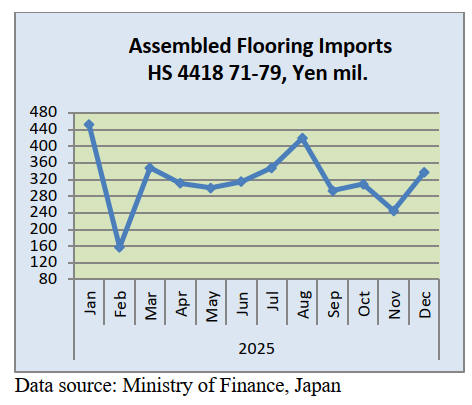
In 2025 Japan imported almost 20% more assembled
flooring panels (HS441871-79) than in 2024. As
anticipated there was an uptick in the value of imports in
December. Year on year the value of December 2025
imports rose around 20% compared to the level in
November.
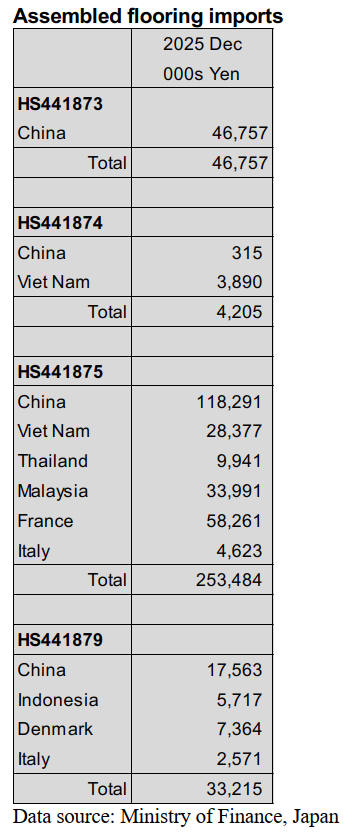
Of the various categories of assembled flooring imports in
November, 75% was of HS4418-75 (62% in November)
with China, France, Malaysia and Vietnam being the top
shippers. The December value of shipments from France
and Malaysia were much higher than in the previous
month and this drove up the overall value of HS4412-75
arrivals.
All imports of HS4418-73 originated in China and
accounted for 14% of December arrivals, down slightly
from a month earlier. For the other categories HS4418-79
accounted for 10% in December (24% in November)
followed by HS4418-74.
Plywood imports
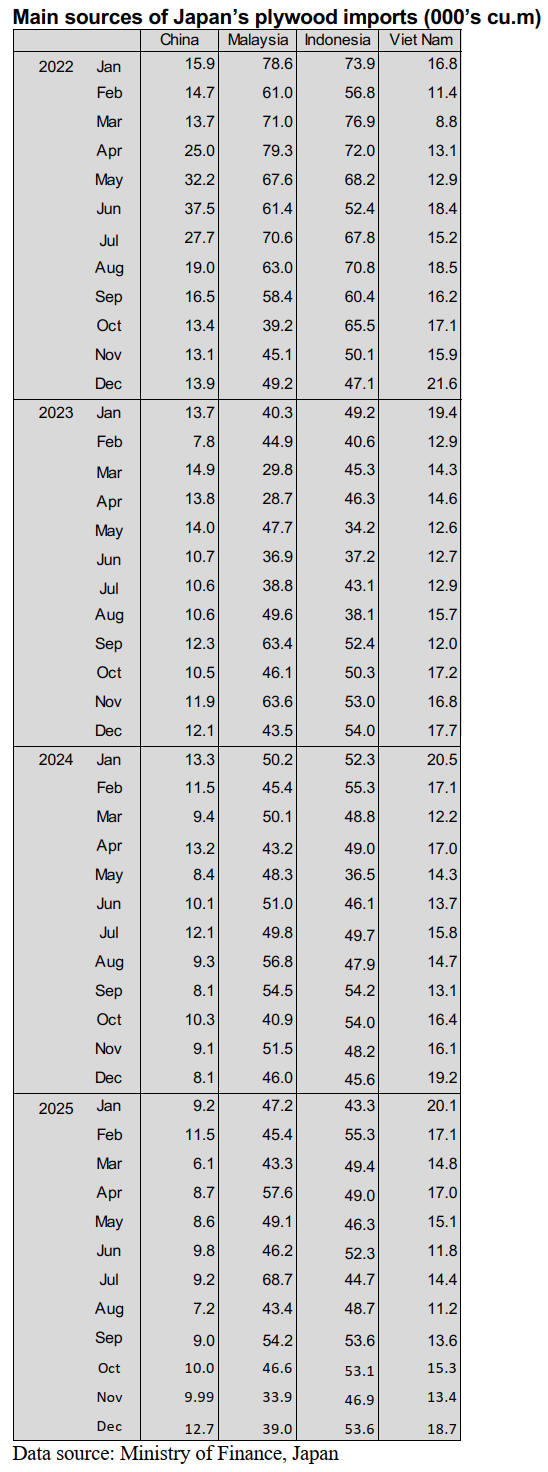
The volume of plywood imports in 2025 was just 6,000
cu.m more than in 2024. Indonesia and Malaysia continue
as the top suppliers of plywood to Japan but the volume of
imports from both countries has fallen significantly as
Japan’s overall imports of plywood have been scaled back.
In December, the combined volume of shipments from
Malaysia and Indonesia accounted for 74% of Japan’s
plywood imports (73% in November). The other top
shippers being Viet Nam and China. December arrivals
from Indonesia were up 14% month on month, up 15%
from Malaysia, up 27% from China and up 39% from Viet
Nam.
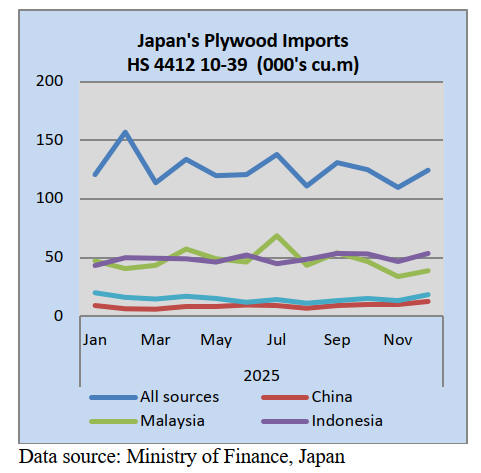
In December 2025 arrivals of HS441210-39 were
reported
at 124,460cu.m (109,850cu.m in November).
As in previous months, of the various categories of
plywood imported in December 2025, HS441231
accounted for most (85%) followed by HS441233 and
HS441234 at 6% each with the balance being HS441239
and HS441210.
Trade news from the Japan Lumber Reports (JLR)
The Japan Lumber Reports (JLR), a subscription trade
journal published every two weeks in English, is
generously allowing the ITTO Tropical Timber Market
Report to reproduce news on the Japanese market
precisely as it appears in the JLR. For the JLR report
please see: https://jfpj.jp/japan_lumber_reports/
Plywood
Domestic softwood structural plywood has been
experiencing sluggish movement. The distribution
channel, in particular, has seen sluggish movement at
dealers and local builders, partly due to delays in building-
permit reviews since last year.
For softwood structural plywood (12 mm, 3×6 panel), the
central market price in the Tokyo metropolitan area is
¥1,060–1,070 per sheet (delivered to wholesalers), with
even lower prices beginning to emerge.
The downward pressure on plywood prices appears to be
eroding profitability for plywood manufacturers. A major
plywood manufacturer in eastern Japan has announced that
it will raise prices starting with March shipments.
Imported tropical plywood has also been seeing weak
movement, including coated formwork panels. Importers
are facing negative margins on coated formwork plywood
due to the weak yen, and although they aim to raise
domestic prices, progress has been slow because the
market remains stagnant.
Domestic prices for imported tropical plywood are as
follows: coated formwork plywood (12 mm, 3×6) is
¥1,840–1,900 per sheet (delivered to wholesalers);
standard formwork plywood is around ¥1,600; and
structural plywood is likewise around ¥1,600.
Indonesian general-purpose plywood is trading at roughly
¥780 for 2.5 mm thickness, ¥930 for 4 mm, and ¥1,100 for
5.5 mm. Producer prices show the following trends. For
Malaysian plywood, coated formwork panels (12 mm,
3×6) are at US$600–610 per cubic meter (C&F), standard
formwork panels at US$ 500–510, and structural plywood
at US$510–520.
While unchanged from the previous month, the market
carries a slightly weaker undertone. Indonesian general-
purpose plywood is trading at around US$ 970 for 2.4 mm
(3×6), US$880 for 3.7 mm, and US$850 for 5.2 mm.
Domestic logs and lumber
Domestic wood products are moving mainly in direct-to-
site demand, with activity centered on small sized lumber
materials. As January progressed, overall market activity
began to calm, yet a number of sawmills remained busy as
buyers shifted away from imported lumber.
Cedar post and beam lumber has grown noticeably tight in
the spot market, with prices firming to ¥55,000–58,000 per
cbm (market delivery). Demand for cedar studs is strong,
but an increase in lower-grade material is holding A-grade
prices down, prompting mills to seek modest price hikes.
Cypress sill plates, meanwhile, continue to see weak
movement, with prices slightly softening around the
¥75,000 level. Domestic log prices have passed their peak,
and a softer tone has spread, but in regions where prices
fell early, signs of bottoming out and a modest rebound are
emerging.
Cedar log prices are flat compared with the previous
month: medium-diameter logs in Akita are at ¥16,500 per
cbm (log market delivery), while pillar-grade logs in
Kyushu are ¥16,000 and medium-diameter logs ¥14,500.
In Tochigi, pillar-grade logs, which fell last month, have
now stabilized at ¥15,500.
For cypress logs, pillar-grade logs in the Chugoku region,
which fell last month, have leveled off at ¥23,000 per cbm
(log market delivery), while sill-grade logs have
rebounded by ¥1,000 to ¥21,000.
In Kyushu, pillar-grade logs are down ¥500 to ¥20,000,
but sill-grade logs, which declined last month, are now
steady at ¥21,000. In Tochigi, sill-grade log
Plan for dedicated birch plywood plant revealed
Marutama Plywood Co., Ltd. plans to decide around
September this year whether to proceed with building a
dedicated birch plywood factory (its third plywood
factory). By using birch and other hardwood from
Hokkaido for the face and back veneers of flooring base
panels, the product can serve as an alternative material to
tropical hardwood plywood. The birch plywood
production line attached to the second plywood plant will
mark one year of operation in November 2025, and floor
manufacturing at the Maizuru plant in Kyoto has become
more stable.
The company will continue improving the precision of its
birch plywood and, after determining whether demand will
increase, make a final decision on whether to launch the
factory construction project.
Formulating wood procurement guidelines
Nomura Real Estate Holdings has formulated the “Nomura
Real Estate Wood Procurement Guidelines.” It applies to
timber and wood products procured within the group’s
supply chain.
It aims to achieve 100% use of sustainably sourced
timber
and 100% traceability to the place of origin by fiscal 2030.
It will also assess risks of deforestation, land-use
conversion, and human rights issues in the supply chain,
and work to reduce these risks in stages through measures
such as the use of certification schemes.
The guidelines were prepared under the supervision of
WWF Japan and set out goals based on environmental
conservation expertise and global sustainability trends
Tackling business barriers and global housing
shortages - supporting overseas expansion by
Japanese companies
Japan’s Ministry of Land, Infrastructure, Transport and
Tourism has launched the Council for International
Expansion of Housing and Building Industries (J-HAB) to
act as a central platform supporting the overseas expansion
of Japanese housing and construction companies.
The initiative aims to leverage Japan’s strengths—durable
wooden construction technologies, high seismic and
energy-efficiency performance, and highly productive
industrialized housing—to help address global housing
shortages while opening new business opportunities for
Japanese firms.
J-HAB will analyze the specific challenges and needs
companies face in each target region, develop action plans,
and coordinate strategies to support international business
development. Its membership includes the ministry (as
secretariat), the Japan Housing Finance Agency, the Urban
Renaissance Agency, and major industry associations.
The council also seeks to strengthen Japan’s housing
industry, contribute to economic growth, and enhance
Japan’s international presence through expanded overseas
engagement. Initial target markets are the United States,
Australia, Indonesia, and India, with the possibility of
adding more countries as the initiative evolves.
Activities will begin in fiscal 2025, focusing on
information sharing, networking, and identifying barriers
to overseas expansion. From fiscal 2026 onward, J-HAB
will implement action plans that link these identified
challenges with practical solutions.
Toward a new basic plan for forests and forestry
Japan will revise the Basic Plan for Forests and Forestry
for the first time in about five years. The plan, last
approved in 2021, guides national forest and forestry
policy.
The new version will emphasize mechanisms that promote
shared value and mutual prosperity across the wood
supply chain, aiming to strengthen the cyclical use of
forest resources.
While the current plan focuses on “Green Growth” and
achieving carbon neutrality by 2050 through sustainable
forest management and development of the forestry and
wood industries, the revised plan places greater weight on
transparency around sustainability and cost structures. It
seeks to build cooperative relationships among forest
owners, log producers, distributors, and processors by
sharing the value of wood as a renewable resource.
For the first time, the plan will also address the price
structure of wood, highlighting that current price levels do
not cover reforestation costs for forest owners - an issue
directly contributing to stalled reforestation efforts.
|


