|
1.
CENTRAL AND WEST AFRICA
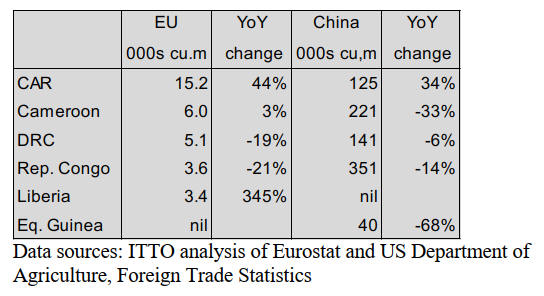
2025 African log import data
China and the EU are the main importers of tropical logs.
Shipments of logs from Afican countries to China
accounted for 17% the corresponding figue for the EU was
78%.
Overview
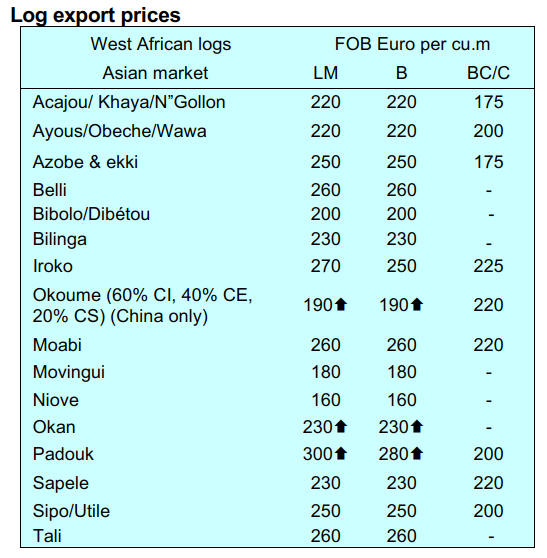
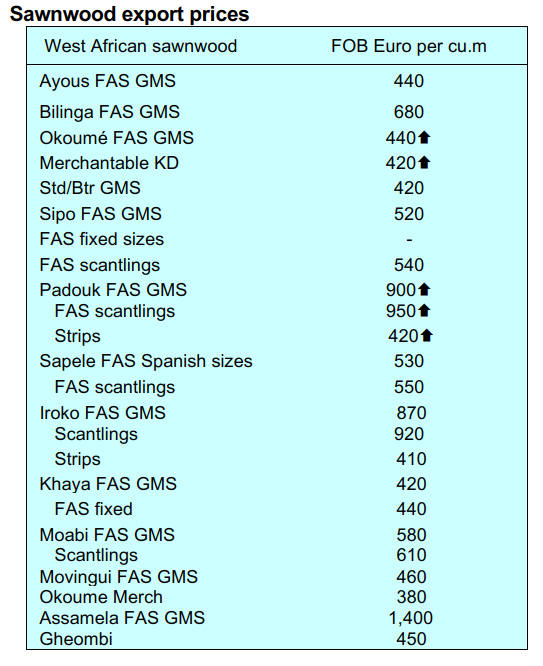
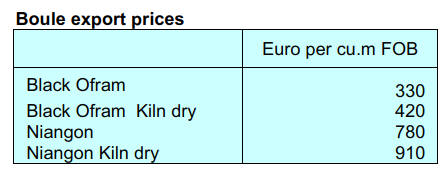
Producers report markets are beginning to accept moderate
price increases for both logs and sawnwood reflecting
tightening supply conditions and rising costs in producing
countries. The current pricing environment remains
difficult to assess precisely particularly because log
shortages in Gabon are constraining mill production and
limiting available volumes. Gabon continues to experience
heavy and persistent rainfall, significantly delaying the
movement of logs from forest concessions to mills. These
logistical disruptions are the main factor behind the
tightening supply situation currently influencing regional
prices.
Rainfall is also affecting operations in Congo, causing
some transport delays. However, the impact is less severe
than in Gabon due to comparatively better infrastructure
and operational capacity, particularly in remote forest
regions where experienced companies maintain more
reliable logistics.
Cameroon has entered its dry period which is supporting
harvesting and transport conditions. However, seasonal
Sahara winds are bringing sand, creating additional
operational challenges in some areas. Despite improved
weather conditions, the market remains cautious, with
operators monitoring demand trends closely while
awaiting clearer pricing signals.
Gabon
Heavy rainfall continues across upcountry regions, and
contrary to expectations, no real dry period materialised.
As a result, harvesting activity remains at a low level,
reflecting both difficult field conditions and subdued
market demand. Production continues to focus on the main
species, Okoume, Okan, Azobe and redwoods.
The Government announcements continue to highlight
large infrastructure ambitions, including a future transport
corridor linked to the Mayumba Port and mining projects
but progress remains limited due to funding constraints.
The electricity supply remains a critical constraint. Despite
repeated official assurances, the situation has worsened,
with two to three outages daily lasting three to four hours.
The power utility acknowledges that the infrastructure is
outdated.
Port operations at Owendo reported as functioning
normally and container availability is said to be adequate.
Transport to and from the port is generally stable despite
weather-related challenges inland.
Demand conditions are mixed. Sawmills report increased
interest in Okoume from the Middle East and renewed
enquiries from China following the removal of Chinese
import duties on African goods. However, overall
enquiries remain low in Europe due to high inventories
and a seasonal slowdown.
Azobe exports to the Netherlands continue but at reduced
monthly volumes of around 1,500 cu.m, mainly a flection
of availability. New demand streams are emerging,
including interest from China for Azobe reportedly for
table-top applications and imports by Bangladesh.
Export duties introduced on 1 January 2026 remain a
major factor shaping pricing. The immediate reaction has
been price increases of roughly €20 per cu.m for major
sawn species. Acceptance appears strongest in Azobe
where log shortages are supporting higher price levels.
The Gabonese timber sector enters the next quarter facing
persistent operational constraints, higher export costs and
fragile demand. Price support is likely to remain strongest
for species with tight log supply, particularly Azobe, while
broader market recovery will depend on improved
logistics, energy reliability and clearer demand signals
from Asia and the Middle East.
Cameroon
Harvesting activity is increasing as the dry season sets in,
with only light seasonal showers, locally described as
“mango rains” and occasional Saharan winds bringing
dust. Improved weather conditions are allowing operators
to repair forest roads and gradually raise production.
Transport and logistics are said to be functioning relatively
well. Container availability remains sufficient and both
Douala and Kribi Ports are operating normally, although
Douala continues to experience vessel delays of up to a
week. Kribi Port is increasingly handling containerised
exports, including timber from northern Congo.
Despite these improvements, electricity shortages persist
in major cities, mirroring challenges seen in neighbouring
countries and adding operational uncertainty for mills and
exporters. Demand conditions remain cautious, say
operators. Order levels are generally steady but
unspectacular with no major shifts reported across key
export destinations. Chinese demand continues to weigh
on market momentum, while other markets remain stable
without significant growth signals.
A widely circulating industry rumour suggests Azobe
could be proposed for CITES listing. While there is no
confirmation, such a development would have major
implications for mills and key European end-users,
particularly in the Netherlands. The situation is being
closely monitored.
Cameroon’s timber sector enters the next period with
improving operational conditions but limited demand
momentum. Production is likely to rise seasonally, yet
market growth will depend largely on a recovery in Asian
buying and clarity on regulatory developments,
particularly any movement on CITES.
Republic of the Congo
Road transport continues to function with repairs
progressing on laterite routes supporting timber movement
from production areas to export corridors. Export routing
remains centred on Pointe-Noire where container
availability is reported as normal and without shortages.
Sawmill operations are not reporting major disruption
linked to log availability or other production inputs.
No new government policy change have been announced
and operators continue to work under established
compliance requirements, including CITES obligations for
four listed species and continued EUTR-related due
diligence expectations for exports.
Demand sentiment remains cautious and unchanged with
no clear improvement signalled across the main import
regions. Enquiry levels and order activity are best
described as stable but subdued.
Congo’s production fundamentals remained steady at end
of February with logistics improving gradually through
road repairs and ports operating normally. The near-term
outlook remains driven more by external demand trends
and trade-policy positioning than by domestic operational
constraints.
Through the eyes of industry
The latest GTI report lists the challenges identified by the
private sector in the Republic of Congo and Gabon.
See: https://www.itto-ggsc.org/list_52/618.html
2.
GHANA
International Day of Forests – involving the youth
The Ministry of Lands and Natural Resources (MNLR) in
collaboration with the Forestry Commission (FC) has
arranged a debate competition between two of the
country’s universities as part of activities to mark the
International Day of Forests.
The University of Ghana and the University of
Professional Studies have been selected to debate on the
topic ‘The Economic Value of Forests should be measured
solely in terms of timber and non-timber products’.
The CEO of the FC, Dr. Hugh Brown, commended
representatives of the two institutions for agreeing to be
part of the debate and the celebration of Forests Day. He
underscored the importance of the debate, saying the
debate is targeted at the youth who will be the future front-
liners of the various institutions on forest protection.
This year Ghana will celebrate the Tree for Life
Reforestation Initiative (T4L) launched by President John
Dramani Maham, on 21st March 2025.
See: https://gna.org.gh/2026/02/forestry-commission-lands-
ministry-hold-debate-to-mark-international-day-of-forests/
Piloting treatment of contaminated water from illegal
mining operations
The Environmental Protection Agency (EPA) in
collaboration with officials from the Ghana Standards
Authourity (GSA) and Ghana Water Company Limited
(GWCL) has launched a pilot project using Ionic Nano
Copper technology to treat heavy metal water
contamination a result of illegal mining, popularly known
as ‘galamsey’.
The technology, which has been tested in the Birim River
in the Eastern Region, binds to toxins allowing them to
settle at the riverbed for cleaner surface water. This
initiative, estimated to cost US$200,000 for testing and
implementation, targets restoring major rivers like the
Ankobra, Pra and Offin to assist the Ghana Water
Company Limited (GWCL) in accessing safer water.
According to the Chief Executive Officer of the EPA,
Prof. Nana Ama Browne Klutse, the Birim River is
currently showing early signs of improvement following a
clean-up trial using the Ionic Nano Copper technology.
Prof. Klutse noted that Ionic Nano Copper is used to
chemically treat water contaminated with heavy metals
efficiently. The project is still ongoing, but early results
suggest the technology could play a major role in restoring
Ghana’s rivers. Dr. Awal Mohammed of the GSA on his
part has also confirmed that water samples from the pilot
exercise have been sent to various laboratories for detailed
analysis.
While some see this exercise as an innovative step toward
environmental restoration, environmentalists and experts
have raised concerns on the health implications of the
treated water.
Early this year’ Ghana’s Parliament revoked LI 2462
banning mining in the country’s forest reserves which
largely contributed to land degradation and the high
pollution of water bodies.
See: https://www.myjoyonline.com/birim-river-shows-
improvement-after-epas-nanocopper-technology-trial/
and
https://www.ghanaweb.com/GhanaHomePage/NewsArchive/EP
A-tryouts-ionic-nano-copper-technology-on-polluted-Birim-
River-2023079
New stakeholder platform to monitor forest legality
compliance
A new stakeholder platform has been launched in Ghana
to bolster tree tenure reforms with funding from the
European Union (EU) and is being implemented under a
European Forest Institute (EFI) programme.
The initiative, which is in partnership with several non-
state organisations, aims to strengthen multi-stakeholder
participation in the FLEGT Voluntary Partnership
Agreement (VPA) to enhance and empower
these actors in policy reforms in Ghana.
The platform will monitor legality compliance and
conduct independent timber validation audits, crucial for
transparency and accountability.
The Technical Director for Forestry at the Ministry of
Lands and Natural Resources, Mr. Joseph Osiakwan,
described the launch as a significant moment in Ghana’s
forest governance journey. He hailed Ghana becoming the
first African and second global nation to issue FLEGT
licenses for legal timber exports to the EU in August 2025.
Mr. Osiakwan stressed the importance of such reforms for
effective monitoring and problem-solving within the value
chain. He emphasised government is addressing insecure
tree tenure through transformative reforms, including
granting farmers benefit rights to naturally occurring trees.
See:https://www.businessghana.com/site/news/General/343477/S
takeholder-Platform-Launched-to-Support-Tree-Tenure-Reforms
Ghana enjoyed stable economy in 2025
The Ministry of Finance has outlined significant
improvements in Ghana’s macroeconomic indicators,
pointing to declining inflation, lower interest rates and a
stronger currency as evidence of a broad-based recovery in
2025.
According to figures detailed in the statement, the
country’s real Gross Domestic Product (GDP) growth
reached a provisional 6.1% year-on-year in the first three
quarters of 2025, largely driven by the services and
agriculture sectors.
The statement indicated that inflation, which had remained
elevated at the end of 2024, fell steadily for thirteen
consecutive months, dropping from 23.5% in January
2025 to 3.8% by January 2026. According to the Ministry,
the turnaround reflects coordinated fiscal and monetary
policies aimed at stabilising the economy and restoring
investor confidence.
Meanwhile, following the signing of the 24-Hour
Economy Authority Bill into law and recent legislative
reforms the government has reiterated its dedication to
expanding Ghana’s economy through the agricultural
sector.
See: https://www.myjoyonline.com/government-pledges-to-
boost-agribusiness-with-new-initiatives-eyes-economic-growth/
Through the eyes of industry
The latest GTI report lists the challenges identified by the
private sector in Ghana.
See: https://www.itto-ggsc.org/list_52/618.html
3. MALAYSIA
Strong GDP growth forecast for 2026
The Malaysian economy was one of Southeast Asia’s best
performers in 2025 driven especially by a surge in
investment in its data centre sector. Alongside Singapore
and Vietnam, it has also managed to cope with higher US
tariffs and global trade disruptions.
Maybank Investment Bank, MBSB Investment Bank and
RHB Bank expect Malaysia’s gross domestic product
growth to exceed the government’s 4% to 4.5% forecast
for 2026.
The abrupt change on reciprocal tariffs due to the US
Supreme Court ruling resulted in exporters to bracing for
potentially more volatility.
“Subject to clarity on the Trump administration’s new
15% global tariff, Malaysia’s exports will benefit from a
lower effective tariff compared to 19%,” noted Socio-
Economic Research Centre’s Executive Director, Lee
Heng Guie.
See:
https://ceomorningbrief.theedgemalaysia.com/article/2026/1106/
Home/6/793126
and
https://www.thestar.com.my/business/business-
news/2026/02/25/growth-momentum-intact
Proposals to list commercially important timber
species under the CITES of concern
The Sabah Timber Industries Association (STIA) has
called on industry players to remain resilient and adaptable
in the face mounting global and domestic challenges.
STIA president, Tan Peng Juan, said the sector had spent
the past year navigating global market volatility, rising
operational costs, tighter international regulations and
persistent logistical constraints adding the STIA also
reaffirms its commitment to strengthening Sabah’s
position as a global supplier of sustainably managed
tropical timber.
“A significant milestone this year was the successful
enhancement of the Sabah Timber Legality Assurance
System Plus (Sabah TLAS+), developed in collaboration
with the Sabah Forestry Department and industry
stakeholders. The upgraded TLAS framework strengthens
Sabah’s legality and sustainability, aligning with evolving
global market requirements, particularly the European
Union Deforestation Regulation and EU Corporate
Sustainability Due Diligence Directive (EU CS3D),” he
said.
According to Tan, the industry has also moved towards
digitalisation with the implementation of the e-Removal
Pass (e-RP) system, replacing manual processes with an
online system with digital approvals, QR code tracking
and improved reporting to strengthen monitoring and full
traceability of timber movement.
Among the priority concerns are developments under the
Convention on International Trade in Endangered Species
of Wild Fauna and Flora (CITES) and policies affecting
raw material supply, international trade and long-term
sustainability. Growing proposals to list commercially
important timber species under the CITES Appendices is
one of the primary areas where time and energy must be
focused.
In related news, Sabah State has expanded its Totally
Protected Areas (TPA) following the gazetting of about
216,000 hectares of new forest areas involving
commercial forest reserves and State land.
The move increases Sabah’s TPA coverage to 2.227
million hectares, equivalent to about 30% of the State’s
total land area.
See: https://www.dailyexpress.com.my/news/276152/sabah-
timber-industries-association-galloping-forward-amid-2026-
challenges/
Rising denand for carbon credits
Sarawak is well placed to become a key supplier of high-
integrity carbon credits in ASEAN as global demand rises,
said Malaysia Carbon Market Association president Dr.
Renard Siew. Siew added, the State’s vast forest resources
and renewable energy push give it a strategic edge
especially at a time when industries face mounting
pressure to secure high quality carbon credits to meet net-
zero commitments.
The aviation industry, he added, is already under pressure
to stock up on credible credits amid tightening climate
requirements. The maritime sector is expected to follow
suit after the International Maritime Organisation moved
to introduce a carbon levy on large oceangoing ships over
5,000 gross tonnage, which emit 85% of the total CO2
emissions from international shipping. These measures
are set to be enforced in 2027.
See:
http://theborneopost.pressreader.com/article/282230902142597
Upcoming furniture shows
Export Furniture Exhibition (EFE), 3-6 March 2026.
The 19th Edition will take place over 4 days at Kuala
Lumpur Convention Centre (KLCC). Around 400
exhibitors will be displaying their top quality ,modern and
contemporary furniture.
Malaysian International Furniture Fair (MIFF), 4-7 March
2026. World Trade Center Kuala Lumpur.
The event venue covers 100,000 sq m for an estimated 700
furniture manufacturers and exporters from Malaysia,
Vietnam, South Korea, UAE, Indonesia, Taiwan, India,
China, Thailand, Hong Kong and the United States.
See: https://www.tradeindia.com/tradeshows/132221/efe-export-
furniture-exhibition-malaysia-2026.html
and
https://miff.com.my/fact-sheet/
Through the eyes of industry
The latest GTI report lists the challenges identified by the
private sector in Malaysia.
See: https://www.itto-ggsc.org/list_52/618.html
4.
INDONESIA
US-Indonesia MoU signings
President Prabowo Subianto witnessed the signing of 11
agreements worth US$38.4 billion between Indonesian
and US companies during a business summit at the US
Chamber of Commerce in Washington on 19 February.
The deals, facilitated during a roundtable hosted by the
US-ASEAN Business Council, span key sectors including
mining and downstream processing, energy, agribusiness,
textiles and garments, furniture manufacturing and
advanced technology. Additional agreements cover corn
and cotton trade, textile sustainability initiatives and
multiple furniture and wood product partnerships between
Indonesian industry associations and US counterparts.
In related news, according to the Indonesian Chamber of
Commerce and Industry (Kadin), Indonesian enterprises
have welcomed the signing of the tariff agreement (ART)
between Indonesia and the United States viewing the 19%
tariff as competitive and potentially advantageous for
national exports.
The chairman of Kadin, Anindya Novyan Bakrie,
described the rate as attractive and noted that it could
allow for tariff reductions or exemptions on certain
products, particularly those incorporating US components.
The agreement has also motivated industry associations to
pursue concrete partnerships with American counterparts.
The Indonesian Furniture Industry and Craft Association
(HIMKI), for example, has expressed interest in importing
US raw materials for domestic processing and re-exporting
them as higher value-added products. This strategy
supports Indonesia’s down-streaming agenda.
See: https://en.antaranews.com/news/405074/prabowo-
witnesses-us384-bln-us-indonesia-mou-
signings
and
https://money.kompas.com/read/2026/02/20/133900726/kadin-
sebut-tarif-19-persen-ri-as-kompetitif-industri-bidik-peluang-
ekspor.
First, a framework for industrial cooperation
The Indonesian Furniture Industry and Craft Association
(HIMKI) views the recent investment and trade agreement
between Indonesia and the United States as a major step
toward easing export barriers. During the Indonesia–US
Business Summit at the U.S. Chamber of Commerce in
Washington, D.C., furniture and handicraft entrepreneurs
signed a memorandum of understanding (MoU) with the
American Hardwood Export Council signaling stronger
industrial collaboration.
The MoU outlines cooperation between Indonesian and
US businesses in areas such as sustainable raw material
supply chains, including the use of US hardwood, joint
trade promotion, technology exchange, standardisation and
expanded market access for Indonesian furniture.
Serving as a framework for industrial cooperation, it will
be followed by specific business-to-business contracts.
See: https://ekonomi.bisnis.com/read/20260219/257/1954059/ri-
as-sepakati-kerja-sama-dagang-pengusaha-mebel-berharap-tarif-
sektoral-turun
US tariffs impact furniture exports
Indonesia’s furniture industry has maintained relatively
stable performance despite global challenges with the
government continuing to support small and medium-sized
enterprises (SMEs) to ensure sustainable growth. The
Minister of Industry, Agus Gumiwang Kartasasmita,
pointed to ongoing guidance, assistance programmes and
collaboration with stakeholders to strengthen the
industry’s competitiveness in both domestic and
international markets.
However, Indonesia’s furniture export performance has
been affected by global market dynamics, particularly the
tariff policies of the United States. These policies have
created uncertainty and highlighted the need for adaptive
strategies and export market diversification.
Promising alternative destinations include Eastern Europe,
the Middle East, Latin America and Asian countries such
as India and Japan aiming to reduce dependence on the
U.S. market.
See: https://emitennews.com/news/tarif-resiprokal-as-
berdampak-kepada-kinerja-ekspor-furnitur-indonesia
and
https://id.investing.com/news/economy-news/kemenperin-kawal-
industri-furnitur-nasional-lewat-kolaborasi-berkelanjutan-
2928609
MFP Phase 5 launched, ‘Strengthening gobal trust in
Indonesian forest products’
The Indonesian and British governments launched Phase 5
of the Multi-stakeholder Forestry Programme (MFP) 9 in
February marking a continued commitment to sustainable
forest governance and stronger global trust in Indonesian
forest products.
Supported by the UK’s Foreign, Commonwealth and
Development Office (FCDO), the programme builds on a
strategic partnership that has existed since 2000. Forestry
Minister, Raja Juli Antoni, emphasised that MFP Phase 5
provides a collaborative platform for stakeholders to
promote transparent, inclusive and results-oriented forest
management balancing economic development with
environmental protection.
British Ambassador Dominic Jermey highlighted that the
initiative also advances climate and biodiversity goals
while creating sustainable economic opportunities,
including for MSMEs seeking to compete in international
markets.
See: https://forestinsights.id/mfp-fase-5-diluncurkan-
kepercayaan-global-pada-produk-hutan-indonesia-diperkuat/#
Accelerated roadmap for customary forest designation
The Ministry of Forestry in Indonesia is working to
finalise a roadmap aimed at accelerating the designation of
customary forests with completion expected by the end of
February. Julmansyah, Director of Tenurial Conflicts and
Customary Forests (PKTHA), stated that the plan is part of
efforts to meet the target set by the Minister of Forestry
Raja Juli Antoni to designate 1.4 million hectares of
customary forests under the Social Forestry Program.
As of December 2025, official data shows that 366,955
hectares of Customary Forests had been designated
throughout Indonesia. The roadmap and associated
initiatives are expected to streamline the designation
process, providing legal recognition and management
authority to Customary Communities while supporting the
government’s broader environmental and social forestry
goals.
See: https://www.antaranews.com/berita/5414878/kemenhut-
kejar-selesaikan-peta-jalan-percepatan-penetapan-hutan-adat
Go-ahead for recruitment of 70,000 forest rangers
President Prabowo Subianto has approved a major plan to
recruit up to 70,000 additional forest rangers to strengthen
the protection of Indonesia’s 125 million hectares of
national forest. The Minister of Forests, Raja Juli Antoni,
met the President twice to discuss improving the
personnel-to-area ratio. While the initial proposal aimed to
increase the number of rangers to 21,000, President
Prabowo pushed for a more ambitious target of one ranger
for every 2,000 hectares.
Currently, only about 4,800 rangers are deployed
nationwide with each officer responsible for an average of
25,000 hectares. The Minister acknowledged that
protecting such a vast forest area is extremely challenging
given limited manpower and budget constraints
compounded by the fact that many existing officers are
nearing retirement.
See: https://en.antaranews.com/news/405246/president-prabowo-
greenlights-addition-of-70000-forest-rangers
Strengthening mangrove data integration
The Ministry of Forestry is enhancing the integration of
national mangrove data through the Mangrove Data
Nusantara (Mandara) platform, aiming to support more
sustainable and measurable coastal rehabilitation planning
and execution.
Dyah Murtiningsih, Director General of Watershed
Management and Forest Rehabilitation, explained that
Mandara is designed to collect, verify and integrate
mangrove data from various sources into a unified,
accurate and up-to-date national reference. This initiative
marks the end of fragmented data systems, moving
towards an integrated approach to policymaking.
Dyah highlighted that data fragmentation has long
hindered optimal mangrove management, as
inconsistencies in sources and methods complicate
targeted rehabilitation efforts.
See: https://esgnow.republika.co.id/berita/tae4lh416/kemenhut-
luncurkan-platform-mandara-percepat-rehabilitasi-mangrove
Launch of Phase 4 of Community Fund for
Environment Services
Indonesia and Norway have launched the fourth phase of
the Community Fund for the Environment with an
allocation of Rp7 billion to support initiatives aimed at
achieving Indonesia’s 2030 Forestry and Other Land Use
(FOLU) Net Sink target.
The Community Fund for the Environment provides
financial support to local non-profits, indigenous groups,
universities and other community-based organisations.
Managed by Indonesia’s Environmental Fund
Management Agency (BPDLH), the programme has
already distributed Rp19.31 billion across three previous
phases benefiting 561 community groups and reaching
31,512 individuals in 36 provinces.
See: https://en.antaranews.com/news/404214/ri-norway-launch-
phase-4-of-community-fund-for-environment-service
Through the eyes of industry
The latest GTI report lists the challenges identified by the
private sector in Indonesia.
See: https://www.itto-ggsc.org/list_52/618.html
5.
MYANMAR
6.
INDIA
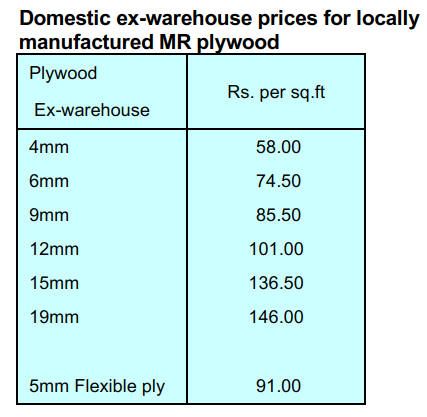
Good prospects for the panel sector
As timber raw material imports continue without
hindrance and with the potential for a revival in supply of
plantation logs prospects for 2026 are balanced and stable
for the panel sector, says Ply reporter in its early January
magazine.
The ready availabilty of raw materils for the panel sector
should help stabilise prices for all regions of the country.
Supplies are being delivered from the north and new raw
material sources are opening in areas such as Bihar,
Odisha and West Bengal which have species such as
Cashew, new species for wood panel makers.
See: https://www.plyreporter.com/magazine-January-2026
Real estate sector entering 2026 with confidence
In a press release the Confederation of Real Estate
Developers’ Associations of India (CREDAI), in
collaboration with real estate data intelligence firm CRE
Matrix reports on a CREDAI–CRE Matrix Developer
Sentiment Survey providing a comprehensive view of
developer expectations and strategies heading into 2026.
Based on responses to 18 focused questions the survey
captures sentiment on demand, pricing, launches,
inventory, emerging typologies, budget preferences,
technology adoption and policy priorities. The findings
point to a sector entering 2026 with confidence and
calibrated optimism.
In summary:
• Two-thirds of developers expect residential
demand to grow over 5% in 2026
• 42% plan to launch more than 1 million sq ft
production next year, signaling sustained supply
confidence
• 83% expect their own unsold inventory to sell out
within the next two years
• 76% of developers expecting prices to rise above
10% are concentrated in the National Capital
Region (NCR) and Mumbai Metropolitan Region
(MMR)
• 65% report construction cost increases capped
below 10% amid GST relief and tech adoption
Overall, the survey suggests that, as India heads into 2026,
the residential real estate sector is positioned for steady
growth, supported by end-user demand, disciplined
launches and improving cost efficiencies. The alignment
between developer strategy, buyer preferences and policy
expectations points to a market that is maturing while
remaining responsive to evolving economic and consumer
trends.
See: https://credai.org/media/view-details/?file_no=99
Sandalwood gene pool launched
India's first sandalwood gene pool and germplasm bank
has been established in Karnataka. This will ensure that
farmers get the best quality saplings for commercial
cultivation. While sample collection began three months
ago the recent Union Budget announcement promoting the
growth of sandalwood along the coast gave the project a
boost.
In 2025, Karnataka Forest Department planted partnered
with the private sector to plant 1 lakh (10 million)
sandalwood saplings annually across the state.
Mysuru, Chamarajanagar and Bandipur Tiger Reserve in
Karnataka State and Marayoor in Kerala state are known
for the best quality of sandalwood. In Karnataka 713
farmers are growing sandalwood on 4,000 acres. Apart
from this, it is naturally found in the State’s forests.
See:
https://www.newindianexpress.com/states/karnataka/2026/Feb/0
3/indias-first-sandalwood-gene-pool-launched-in-karnataka-to-
boost-quality-cultivation
7.
VIETNAM
Wood and Wood Product (W&WP) trade
highlights
According to Viet Nam Customs Office in 2025, Viet
Nam accounted for more than 45% of US imports of
wooden furniture, totaling around US$9,5 billion. This
made the US the largest export market for Viet Namese
woodwork, even as overall imports into the US declined.
Viet Nam’s forest product export value reached about
US$1.72 billion in January 2026, up roughly 13% year-on-
year. Forest products contributed significantly to the
overall 30% jump in agro-forestry exports.
Viet Nam’s Ministry of Agriculture and Environment
(MAE) announced a target of US$19 billion in forest and
wood product exports in 2026 as part of a broader goal of
US$73-74 billion for all agro-forestry/fishery exports.
High-end processing, market diversification and
sustainability are priorities.
Viet Nam’s State President has encouraged a more
impactful, sustainable tree-planting movement,
emphasising forest protection and ecological benefits. This
follows a successful multi-year planting campaign that
saw over 108 million trees planted, helping stabilise forest
cover and supporting forestry export growth.
To improve competitiveness and access high-end markets
Viet Nam is expanding systems for legal and sustainable
timber supply and supporting broader adoption of forest
management and chain-of-custody certification. These
efforts help mitigate trade barriers and align domestic
production with international market requirements.
Many Viet Namese exporters, including those in the wood
and forestry sectors, welcomed the US Supreme Court’s
decision to declare the previous retaliatory tariff regime
invalid seeing it as a short-term reduction in cost pressure
on shipments to the US. This decision removes some of
the most burdensome duties that had threatened export
volumes earlier.
Despite the initial relief on reciprocal tariffs, Viet Namese
wood businesses are cautiously watching the Trump
administration’s swift use of Section 122 first introducing
a 10 % tariff and then raising it to the maximum 15 %
permitted for 150 days because this still represents a new
cost increase on US imports.
Industry associations and experts note that a 10-15 % tariff
may be more manageable than earlier higher retaliatory
duties, especially if companies can adjust prices, optimise
supply chains and raise product value.
Wood product exports exceeded US$17 billion in 2025
W&WP exports earned nearly US$1.7 billion in December
2025 alone, bringing total export value for the year to
US$17 billion, an increase of nearly 6% compared with
2024.
In 2025, exports of timber and wood products to the US
totalled US$9.46 billion, up 4% year on year and
accounted for approximately 55% of the industry’s total
exports. Viet Nam continued to maintain its position as the
largest supplier of wooden furniture to the US market.
Viet Nam’s market share of wooden furniture in the US
increased significantly, rising from 41% in the first eight
months of 2024 to 45% in the same period of 2025. In
contrast, the share of China fell from 16% to 10%.
Meanwhile exports to Japan recorded robust growth of
over 23% in 2025 reaching more than US$2.1 billion. This
marked the first time exports to Japan exceeded US$2
billion. In 2025 Japan became the second-largest market
for Viet Nam’s wood industry.
Although exports to China slipped to third place, they still
grew modestly, reaching nearly US$2.1 billion. This was
the second consecutive year exports to China exceeded
US$2 billion.
Collectively, the three billion-dollar markets, the US,
Japan and China, accounted for nearly 80% of Viet Nam’s
total W&WP exports in 2025.
Other markets were considerably smaller in scale,
including the South Korea with US$709 million, Canada
with US$288 million and the UK with US$244 million.
In terms of products, wooden furniture remained the
backbone of the industry’s exports. According to the
Agency of Foreign Trade under the Ministry of Industry
and Trade, exports of wooden furniture reached US$9.4
billion in the first 11 months of 2025, accounting for
nearly 61% of total export value.
Several other product categories also recorded export
values of over US$1 billion, including wood chips at
US$2.2 billion; wood panels and floorings at US$2.1
billion; and wood pellets at US$1.25 billion.
According to the Ministry of Agriculture and
Environment, exports of W&WPs plus non-wood forest
products reached US$18.5 billion in 2025, up
approximately 7% from 2024.
Looking ahead to 2026, Deputy Minister of Agriculture
and Environment, Nguyen Quoc Tri, said that the forestry
sector aimed to maintain forest cover at around 42% and
achieve forest product exports of about US$ 18.5 billion.
Key priorities include expanding growth of large diameter
tree, promoting the application of science and technology,
advancing digital transformation and strengthening trade
promotion.
See: https://en.Viet Namplus.vn/Viet Nams-wood-exports-reach-
record-17-billion-usd-in-value-post336361.vnp
Viet Nam to complete forest database by 2026
Viet Nam aims to complete provincial forest boundary
databases and maps before the end of this year in a move
seen as critical to helping the timber industry adapt to the
European Union’s anti-deforestation rules and maintain
exports.
The goal is set out in an action plan issued by the Forestry
and Forest Protection Department under the Ministry of
Agriculture and Environment on adapting to the EU
Deforestation Regulation (EUDR), which bans products
linked to deforestation or forest degradation from entering
the bloc.
A forest database is considered a critical technical
foundation for meeting EUDR requirements on
traceability and spatial data transparency, while
accelerating the digital transformation of forest
management in line with international practices, with the
overall objective of fully complying with the EUDR,
sustaining exports and promoting sustainable forestry
development and biodiversity conservation.
Viet Nam will also engage with the EU and its member
states on risk assessment methods and monitoring
indicators, work with the EU’s Joint Research Centre to
align forest mapping databases and seek mutual
recognition mechanisms for legal timber certification.
In May 2025, the European Commission classified Viet
Nam as a low-risk country, meaning only about 1% cent of
shipments or exporters are subject to checks. However,
officials warned that this status depends on strict
compliance and reliable, transparent data systems.
The plan comes as Viet Nam’s wood exports show
positive signs. In January 2026, total agro-forestry-fishery
exports were estimated at US$6.51 billion, up 29.5 per
cent year on year, with wood and forestry products
reaching US$1.72 billion, up 13%, according to ministry
statistics.
See: https://en.Viet Namplus.vn/forest-databases-for-eudr-
implementation-to-be-completed-in-2026-post337668.vnp
Up-coming trade shows
Hawa Expo 2026: Gateway to Viet Nam’s Furniture
Prowess
The First and Central Destination of the March 2026 Fair
Chain. Theme 2026: Sourcing Smarter. Source Viet Nam.
Where trust, opportunity and smart value meet under one
roof. HawaExpo 2026 aims to bring together Viet Nam’s
top manufacturers known for design-led power, consistent
quality, and long-term partnership models.
VietWood/Viet NamWood
VietWood Exhibition, also known as Viet NamWood, is
an event that focuses on the wood processing and
machinery industry, including tools and essential wood
materials. Unlike HawaExpo which focuses on finished
furniture products for export, Viet NamWood is the
destination for technology and supply chain solutions.
Focus: Machinery, Woodworking Technology,
Accessories. Location: Ho Chi Minh City.
VIETBUILD International Exhibition
Vietbuild is a construction-focused exhibition organised
by the Vietbuild Construction International Exhibition
Organization Corp. While it includes interior and exterior
decoration, its primary focus is construction, real estate
and building materials.
The event is held frequently throughout the year in major
cities like Hanoi, Ho Chi Minh City, Da Nang, and Can
Tho. It serves as a platform for domestic and international
brands to introduce construction solutions.
See: https://www.hawaexpo.com/biggest-furniture-trade-shows-
in-Viet Nam/
8. BRAZIL
Forest Sector, a cornerstone of Brazilian
Agri-business
The Ministry of Agriculture and Livestock (MAPA) has
reported Brazilian agribusiness exports reached US$169
billion in 2025 maintaining a strong performance despite
an adverse macroeconomic environment marked by rising
protectionism in international trade, high interest rates and
logistical infrastructure constraints.
The forest sector accounted for US$15 billion in exports in
2025, ranking the fifth most significant segment within
agribusinesses. The sector encompasses 10.5 million
hectares of planted forests and conserves 7 million
hectares of native natural forests. Expansion has occurred
primarily on previously anthropised and in many cases,
degraded lands currently estimated at around 100 million
hectares nationwide.
Based on a forest mosaic model, which integrates planted
forests with native vegetation remnants, the sector
promotes ecological connectivity, ecosystem services
maintenance and biodiversity protection.
Approximately 1.8 million trees are planted daily and their
growth cycle enhances carbon capture and storage,
strengthening the sector’s contribution to the climate
agenda and the transition to a low-carbon economy.
The performance of the agribusiness sector reflects
sustained investments in research, innovation and human
capital, enabling a highly productive and globally
competitive tropical forestry model. The forest sector has
consolidated its role as a strategic component of Brazilian
agribusiness, combining value generation, export
diversification, degraded land restoration and
environmental conservation.
See: https://iba.org/comunicacao/o-agronegocio-e-um-horizonte-
de-brasil/
Expand planted forests and attract investment
The Government of the State of Goiás has structured a
Forest Sector Development Plan as a strategic instrument
of the State’s Forest Policy focusing on expanding planted
forests, strengthening wood-based value chains and
attracting industrial investments.
The initiative is led by the State Secretariat of Agriculture,
Livestock and Supply (Seapa), in partnership with the
Brazilian Micro and Small Business Support Service
(Sebrae), the Agriculture and Livestock Federation of
Goiás (Faeg), the Federation of Industries of the State of
Goiás (Fieg) and with support from the Brazilian Tree
Industry (Ibá).
The objective is to integrate public policies, technical
planning and institutional coordination, thereby enhancing
regulatory predictability and the competitiveness of the
forest-based sector.
In production terms, the State of Goiás has approximately
123,200 hectares of planted forests, which generated
R$782.6 million in 2024. Eucalyptus fuelwood production
reached 3.2 million cubic metres (R$389 million) in the
same year. The availability of logs destined for the pulp
and paper industry also expanded significantly, with
revenue reaching R$ 211.3 million in 2024.
Forestry activities in Goiás State also include the
production of natural rubber latex and charcoal,
consolidating a diversified production base. With the
implementation of the Plan the State aims to expand
supply capacity, add value to industrial value chains and
strengthen its competitive positioning considering growing
demand, the availability of suitable land and the region’s
favorable soil and climate conditions.
See: https://www.maisfloresta.com.br/plano-estadual-fortalece-
silvicultura-e-amplia-base-de-florestas-plantadas-em-goias/
Export update
In January 2026, Brazilian exports of wood-based
products (except pulp and paper) decreased 17% in value
compared to January 2025, from US$265.4 million to
US$220.5 million.
Pine sawnwood exports increased 20% in value between
January 2025 (US$49.6 million) and January 2026
(US$59.4 million). In volume, exports increased 29% over
the same period, from 210,700 cu.m to 271,100 cu.m.
Tropical sawnwood exports increased 2% in volume, from
27,700 cu.m in January 2025 to 28,200 cu.m in January
2026. In value, exports increased 15% from US$11.0
million to US$12.6 million over the same period.
Pine plywood exports decreased 34% in value in January
2026 compared to January 2025, from US$62.0 million to
US$40.8 million. In volume, exports decreased 29% over
the same period, from 195,600 cu.m to 138,800 cu.m.
Tropical plywood exports increased 22% in volume, from
1,800 cu.m in January 2025 to 2,200 cu.m in January
2026. In value, exports increased 40% from US$1.0
million to US$1.4 million over the same period.
As for wooden furniture, exports decreased 20% in value,
from US$34.8 million in January 2025 to US$27.7 million
in January 2026.
Brazil and India strengthen bilateral relations
The Brazilian Furniture Industry Association
(ABIMÓVEL) took part a mission to India from 18-21
February 2026, positioning the Brazilian furniture sector
within the strategy to strengthen bilateral relations and
reshape international trade under the BRICS framework.
As part of the delegation coordinated by the Brazilian
Trade and Investment Promotion Agency (ApexBrasil),
the Association highlighted the forest-based industry as a
driver of value addition, innovation and sustainability.
At the “Brazil/India Business Forum 2026,” organised in
partnership with the Ministry of Development, Industry,
Trade and Services (MDIC) and the Ministry of Foreign
Affairs (MRE), priority themes included energy transition,
critical minerals and industrial transformation.
From a forest sector perspective the mission underscored
opportunities to expand products derived from sustainably
managed planted forests, particularly furniture. Rapid
urbanisation and the expanding consumer market in India
are generating demand for products that combine design,
technical performance and regulatory compliance,
requirements in which Brazil’s forest-based industry has
established competitiveness. Although bilateral trade
reached US$15.2 billion in 2025 this figure remains below
its potential.
In this context, coordination between government and the
private sector is essential to translate institutional
alignment into contracts, investments and strategic
projects, positioning the forest–furniture value chain as a
platform for market diversification and integration into
global value chains.
See: https://abimovel.com/missao-presidencial-abimovel-integra-
agenda-brasil-india-e-reforca-papel-da-industria-moveleira-nas-
relacoes-bilaterais/
Mercosur/EU Agreement - opportunities for Brazil’s
timber sector
The Agreement between Mercosur and the European
Union is viewed by the forest sector as an opportunity to
strengthen control and traceability of the origin of
Brazilian timber. The Agreement includes environmental
targets, such as a 50% reduction in deforestation in the
short term and seeks to align productivity with traceability
to curb the commercialisation of wood associated with
illegal practices.
According to Minas Gerais Forest Industry Association
(AMIF) one of the main challenges lies in methodological
differences between Brazil and the European Union
regarding the definition of deforestation. Although Brazil
has a rigorous environmental legal framework, there are
cases of legally authorised forest and scrub clearing under
national legislation that may be interpreted by the EU as
deforestation.
Amid potential shifts in the international market the timber
sector is closely monitoring China, an important
destination for Brazilian exports. The industry is focusing
on market diversification and on the growing role of wood
as a strategic input for the bio-economy. According to the
Food and Agriculture Organization (FAO) global wood
consumption is expected to double by 2050, strengthening
the sector’s relevance over the medium and long term.
See: https://www.maisfloresta.com.br/acordo-mercosul-ue-pode-
aumentar-o-controle-da-origem-da-madeira-brasileira/
Through the eyes of industry
The latest GTI report lists the challenges identified by the
private sector in Brazil.
See: https://www.itto-ggsc.org/list_52/618.html
9. PERU
Co-financing to modernise small Peruvian mills
The National Forest and Wildlife Service (Serfor) has
launched a new call for proposals under the Forestry
Incentives Programme (PIF Plantations) which offers non-
reimbursable financial incentives to improve small
primary wood processing plants.
This is a co-financing scheme where beneficiaries
contribute between 10% and 20% of the total amount
while Serfor, through its Sustainable Productive Forests
Programme (BPS) will finance up to US$90,000.
The objective of the Programme is to bridge the gap
between the plantation and the market, strengthening the
sawing, grading and drying capacity for timber from
commercial forest plantations. This will generate greater
added value, local employment and competitiveness in the
forestry sector.
The grants may cover investments in infrastructure, as
well as specialised technical services, including
verification of the legal origin of raw materials, security,
maintenance and other services related to installation,
rental and business plan management.
See: https://www.gob.pe/institucion/serfor/noticias/1356300-
serfor-brinda-cofinanciamiento-de-hasta-s-300-mil-para-
modernizar-pequenas-plantas-de-transformacion-de-madera
Strengthened forest management for indigenous
communities
With the goal of empowering Indigenous communities as
key players in the sustainable management of their
communal forests the Supervisory Agency for Forest
Resources and Wildlife (OSINFOR) strengthened the
capacities of 343 Indigenous Communities during 2025.
Through workshops, technical assistance and training
events OSINFOR reached 332 native communities and 11
peasant communities that hold forestry permits, an
enabling title that supports the legal, responsible and
sustainable use of forest resources in their communal
forests.
Training sessions were held in Ucayali, San Martín, Pasco,
Madre de Dios, Loreto, Junín, Cajamarca, Amazonas and
Lima allowing for an intervention with a territorial and
intercultural approach adapted to the realities and needs of
each area.
See: https://www.gob.pe/institucion/osinfor/noticias/1334110-
mas-de-300-comunidades-indigenas-fortalecieron-la-gestion-
forestal-de-sus-bosques-en-el-2025
|