Japan
Wood Products Prices
Dollar Exchange Rates of 10th
February
2026
Japan Yen 153.27
Reports From Japan
Businesses prioritise stability
The business community in Japan has welcomed the ruling
Liberal Democratic Party's victory in the House of
Representatives election where it regained a majority.
Yoshinobu Tsutsui, chairman of the Japan Business
Federation (Keidanren) said, the organisation hopes that
the administration of Prime Minister Sanae Takaichi, also
LDP Leader, "will steadily implement important policies
under strong leadership backed by the huge public trust.
The Liberal Democratic Party secured a victory in the
recent Lower House election. This will essentially allow
the LDP-led coalition to override challenges that emerge
as a result of its lack of a majority in the Upper House. In
the event key bills and budgets are voted down in the
Upper House, they can be overridden in the Lower House
with a two-thirds majority.
Japanese businesses prioritise stability driven by concerns
over geopolitical tensions, fluctuating costs, a weakening
yen and the need for predictable interest rate policy from
the Bank of Japan (BoJ).
Firms seek to maintain a stable political environment,
specifically, financial market stability rather than drastic,
rapid changes in monetary policy.
In related news, the Japan Federation of Basic Industry
Workers’ Unions decided Wednesday to demand a
monthly pay scale increase of 15,000 yen in this year’s
spring wage negotiations. The unified demand is at the
same level as the previous year which was a record high.
See:
https://www.japantimes.co.jp/news/2026/02/09/japan/politics/jap
an-2026-lower-house-election/
See:
https://www.nippon.com/en/news/yjj2026020400879/?cx_recs_c
lick=true
Slow pace of household spending
A report from the Cabinet Office says Japanese household
spending increased at a slower pace than income over the
past five years indicating that people saved more amid
inflation.
According to the fiscal 2025 report on the country's
economic conditions, disposable income rose across all
age and income groups from 2019 to 2024 but
consumption growth was sluggish, with spending falling
in some groups. The savings rate increased for all groups
except those in their 20s.
Lower-income households were more affected by
inflation, as rising food costs accounted for a larger share
of their spending.
See: https://www.nippon.com/en/news/yjj2026021000904/
New norm of yen volatility
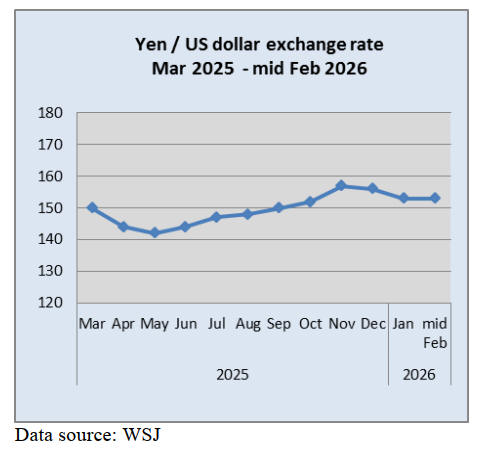
The volatility and depreciation of the Japanese yen, which
hit multi-decade lows in 2024/5 and remained unstable
into early 2026, has created a difficult environment for
Japanese importers.
The past two years have seen record-breaking swings, with
the yen occasionally falling to 160 per dollar prompting
massive intervention from the Ministry of Finance to
defend the currency. As of early 2026, the yen remained
highly volatile due to uncertainty surrounding Japan's
tentative exit from ultra-easy policy and inflationary
pressures.
Housing starts at 62-year low
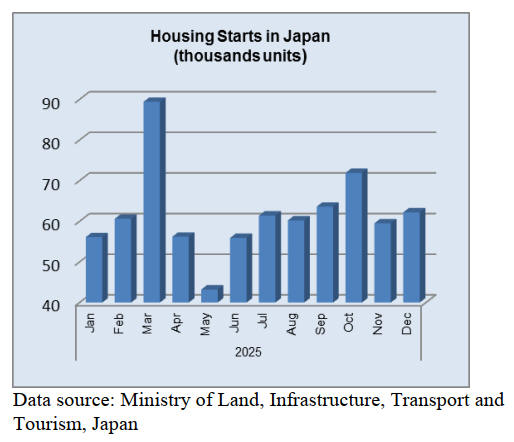
Housing starts in Japan fell 6.5% from the previous year to
740,667 units in 2025, down for the third straight year and
hitting a 62-year low. The drop reflected deterioration in
consumer sentiment amid rising prices as well as falling
demand due to the country's shrinking population.
Of the total, owner-occupied houses dropped 8% to
201,285 units, down for the fourth consecutive year.
Housing for rent fell 5% to 324,991 units, down for the
third year in a row. Condominiums and houses for sale
decreased 8% to 208,169 units, down for the third
consecutive year. Part of the slowdown could be because
of a revision to regulations on homes with energy-saving
features which has increased construction time and pushed
up prices.
See: https://www.nippon.com/en/news/yjj2026013001015/
Contrasting response of home buyers
Inflation is impacting the housing market in contrasting
ways. A Bloomberg Intelligence survey suggests potential
homebuyers are divided on their property purchasing plans
as surging living costs add to affordability concerns.
Some are delaying purchases while others are wary of
missing out on opportunities posed by rising home prices.
People who prefer to wait cited personal circumstances
and the rising cost of living as their main reasons while
those who were bringing forward plans to buy said they
were afraid of prices climbing even more.
See:
https://www.japantimes.co.jp/business/2025/10/17/economy/toky
o-homebuyers-purchase-plans/
Mortgage rates increased
Five major banks have increased base rate for a 10-year
fixed-rate mortgage. This decision is linked to the recent
increase in benchmark interest rates of long-term
government bonds. The rates of MUFG Bank, Sumitomo
Mitsui Banking Corp., Mizuho Bank and Sumitomo
Mitsui Trust Bank are set at the highest since their
establishment.
The new rates are subject to loans filed this month. Loans
that have already been taken out will not be affected. The
five banks did not change variable rate home loans, which
account for about 80% of housing loans that have been
taken out.
See:
https://japannews.yomiuri.co.jp/business/companies/20260201-
308306/
Import update
Wooden furniture imports
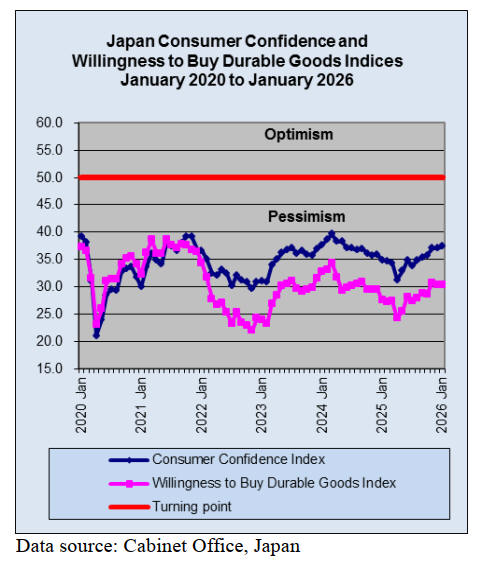
Consumer confidence is a primary driver of furniture
purchases as such items are considered discretionary.
When consumer confidence is high households are more
likely to invest in home improvements and durable goods.
The willingness of Japanese consumers to buy durable
goods has been steadily increasing since early 2025 but is
still below pre-pandemic levels.
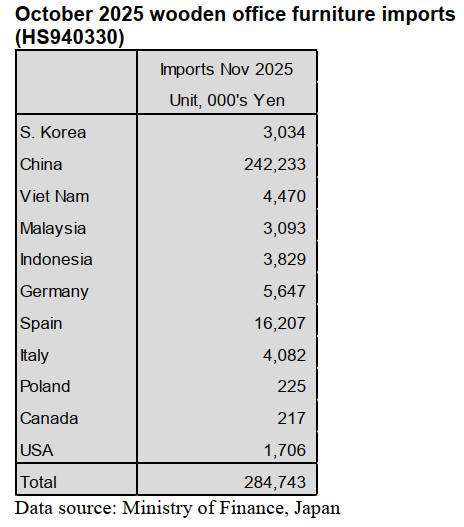
November 2025 wooden office furniture imports
(HS940330)
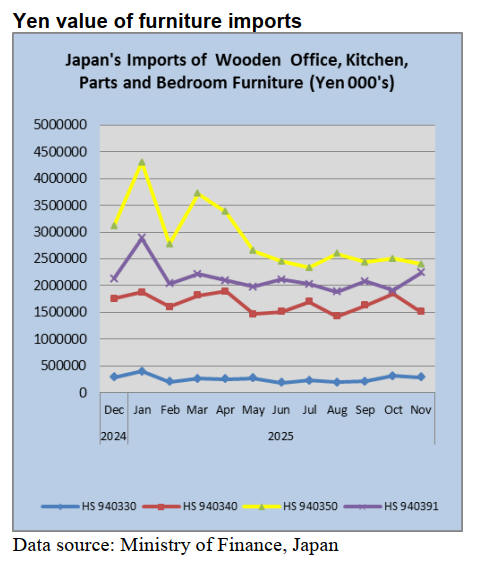
In November 2025 China accounted for 85% of the value
of wooden office furniture imports followed by Spain (6%
sharply up compared to previous months) and Viet Nam,
Malaysia and Indonesia at around 2.5% each. November
shipments from China were down10% compared to
October and also down by 3% year on year. The other
significant source of wooden office furniture in November
was Germany.
Year on year the value of Japan’s imports of wooden
office furniture (HS940330) in November fell 3%.
Compared to the value of October arrivals there was a
10% decline in the value of imports.
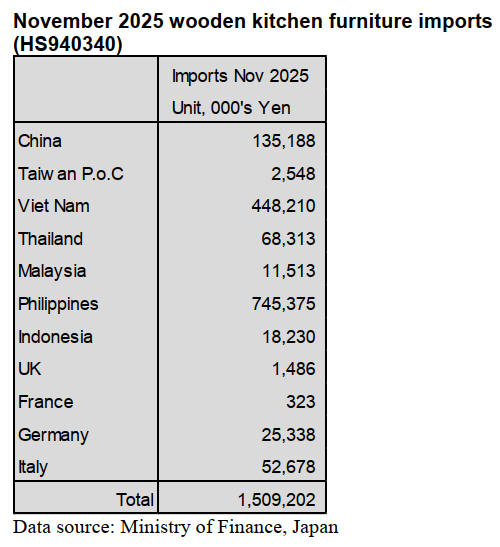
November 2025 wooden kitchen furniture imports
(HS940340)
November imports of wooden kitchen furniture
(HS940340) were dominated by shippers in the
Philippines (49% compared to 55% in October) and Viet
Nam (30% of imports). The value of November imports
from both the Philippines and Viet Nam declined month
on month with shipments from the Philippines dropping
27% and shipments from Viet Nam dropping 16%. The
third ranked shipper in terms of value in November was
China with the value of imports accounting for around 9%
of all HS940340 arrivals.
The top three shippers accounted for nealy 90% of
November arrivals with the other shippers being Thailand
and Italy, where there was a sharp rise in the value of
imports compared to a month earlier. Year on year the
value of November wooden kitchen furniture imports were
down 12%.
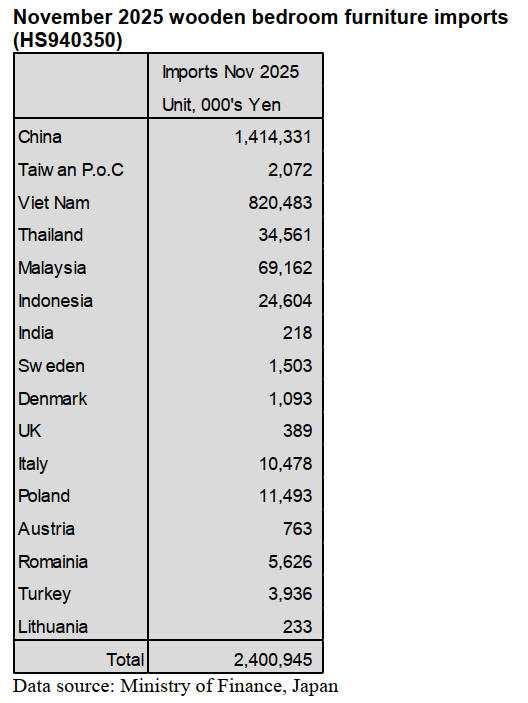
November 2025 wooden bedroom furniture imports
(HS940350)
Since mid-2025 the value of wooden bedroom furniture
imports has been remarkably steady compared to the
volatile trend in the early part of 2025. From June 2025
the value of arrivals has been in a narrow range.
In November over 90% of the value of shipments of
wooden bedroom furniture was shipped from China (59%
of the total) and Viet Nam (34%). Of the other shippers in
November Malaysia was at the top accounting for about
3% of the value of arrivals with November shipments
around three times more than in the previous month..
Year on year there was a 19% decline in the value of
November and a 4% decline in total imports of HS940350
imports.
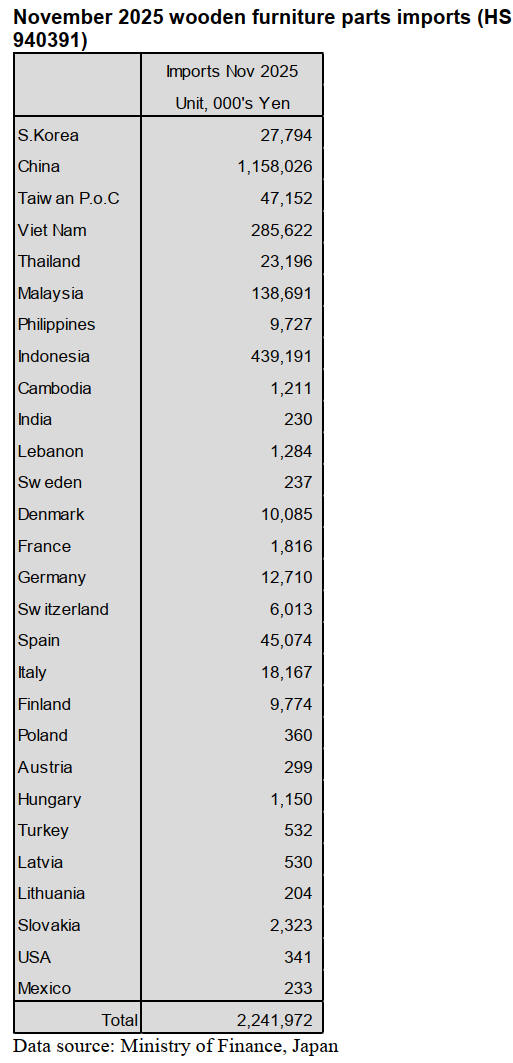
November 2025 wooden furniture parts imports
(HS940391)
Year on year, the value of November imports of
HS940391 was down around 10% but there was a 17%
increase in the value of imports compared to October.
The main shippers of wooden furniture parts to Japan in
November were China at 52% of the total (49% in
October) and Indonesia 20%, around the same level as in
October. November shipments from China were up 24%
month on month and there was a 21% increase in month
on month shipments from Indonesia.
In November the other main shippers of HS940391 were
Viet Nam (13% of imports) and Malaysia, 6% being some
20% higher than in the previous month.
Trade news from the Japan Lumber Reports (JLR)
The Japan Lumber Reports (JLR), a subscription trade
journal published every two weeks in English, is
generously allowing the ITTO Tropical Timber Market
Report to reproduce news on the Japanese market
precisely as it appears in the JLR. For the JLR report
please see: https://jfpj.jp/japan_lumber_reports/
Projection of import wood products
The Japan Lumber Importers Association disclosed
projection of imported wood products for 2025 and the
first half of 2026.
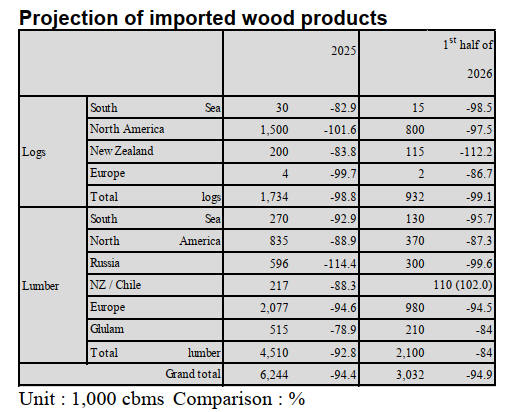
*European logs are softwood logs. South Sea logs
include
African logs. *Glulam is laminated structural softwood lumber
and does not include interior finish materials.
Both logs and lumber/products are expected to decrease
by around 5% compared to the same period last year. It is
considered to be the result of multiple factors, including a
decline in demand for housing-related materials, the
weaker yen and higher interest rates, as well as the
substitution of wood products made from domestic
timber.
In 2025, the supply–demand and price disruptions caused
by the third “wood shock,” which continued through
2024, began to settle down. As a result, issues related to
supply–demand adjustments for imports became less
prominent, while the stronger dollar and weaker yen in
the latter half of the year led to higher import costs.
The supply of U.S. log timber is influenced by the
operating conditions of Chugoku Lumber Co., Ltd., a
company based in Hiroshima. One factor behind this is
the start-up of the Kashima plant in 2025, which added an
additional 150,000 cubic meters of capacity. For New
Zealand timber, higher log prices have pushed up sawn
timber prices, leading to increased use of domestic cedar
for packaging materials. As a result, the decline in import
volumes has become more pronounced.
For South Sea logs, supply has been centered on deliveries
to Sattsuru Plywood Co., Ltd., which has limited demand
in areas such as Nagoya and Hiroshima. The roughly 5%
year-on-year decline in European timber is considered to
be almost within the normal range. If the yen continues to
weaken further, a decline in competitiveness will be
unavoidable going forward.
The decline in U.S. and Canadian timber is substantial,
and the fact that it is expected to fall by more than 10% in
the first half of 2026 is a cause for concern. Russian
timber was the only category to increase, rising by 14%.
The decline in New Zealand and Chilean timber is due to
shipping schedule arrangements.
The nearly 20% year-on-year decline in glulam
clearly
indicates a downturn in domestic demand for housing
construction materials.
North American logs
Harvesting of Douglas-fir logs in Washington and Oregon is
progressing smoothly, and stable output is expected through
February and March. Meanwhile, log inventories within the
United States are declining, keeping export prices on a firm
trend.
In contrast, Canadian supply has not increased due to
rising stumpage fees on public forests and U.S. import
tariffs. However, shipments to Japan remain stable
because they rely mainly on logs from private forests.
January shipments of Douglas-fir sawlogs were unchanged
from December: IS grade at $970 (FAS, 1,000 BM, Scribner
scale), SS grade at $1,000, and SLC grade at $890. Logs for
plywood were also flat at $220–221
Harvesting of Douglas-fir logs in Washington and Oregon is
progressing smoothly, and stable output is expected through
February and March. Meanwhile, log inventories within the
United States are declining, keeping export prices on a firm
trend. In contrast, Canadian supply has not increased due
to rising stumpage fees on public forests and U.S. import
tariffs. However, shipments to Japan remain stable
because they rely mainly on logs from private forests.
Plywood
Domestic softwood structural plywood saw improved
movement toward the end of last year due to pre-holiday
stocking, but activity has slowed somewhat in January.
Precut-plant demand remains relatively steady, while the
building-materials route continues to lack momentum.
Amid these conditions, domestic softwood structural plywood
(12 mm, 3×6) has been weakening, especially in the Tokyo
area since December. January prices in the region are
centered around ¥1,060–1,070 per sheet (wholesaler
delivery), about ¥20– 30 lower than the previous month.
Imported tropical plywood is seeing gradual price increases
for some Indonesian standard panels, while Malaysian 12-mm
products remain mostly flat. In Japan, demand— especially
for coated formwork panels—has been sluggish, domestic
prices have barely risen, and the weak yen has pushed up
forward costs. These factors have kept orders to producing
regions from gaining momentum.
Producing-region prices for Indonesian standard plywood
are around $970 per cbm (C&F) for 2.4-mm 3×6 panels,
$880 for 3.7-mm, and $850 for 5.2-mm. Malaysian
products remain flat from the previous month, with coated
formwork plywood (12 mm, 3×6) at $600–610, formwork
plywood at $500–510, and structural plywood at $510–
520 (all C&F, per cbm).
Coated formwork plywood (12 mm, 3×6) varies by
manufacturer, but prices are around ¥1,840–1,900 per
sheet (wholesaler delivery). Formwork plywood is priced
around ¥1,600 per sheet (wholesaler delivery), and structural
plywood is at a similar level. Indonesian standard plywood is
roughly ¥780 for 2.5-mm panels, ¥930 for 4-mm, and ¥1,100
for 5.5-mm (all per sheet, wholesaler delivery).
South Sea logs and products
Tropical and China-made wood products continue to face
weak sales, but producing regions remain firm due to rising
costs. In Indonesia, reduced log supply is pushing up prices
for keruing, selangan-batu, and Merkus pine products.
Tropical log arrivals from Malaysia and PNG have largely
completed for FY2025 H2, and despite some delays from
Thailand, overall supply–demand conditions are stable.
|


