|
1.
CENTRAL AND WEST AFRICA
Contrasting operating conditions
Weather conditions across the region are currently
contrasting. The Central African Republic and Cameroon
have now entered a dry season that is expected to last until
June supporting more stable harvesting and transport
conditions. In contrast, Gabon and the Republic of the
Congo are experiencing heavy and persistent rainfall,
significantly affecting logistics.
Cameroon
No major changes are reported in the timber sector.
Operations remain generally stable. The continuation of
the African Growth and Opportunity Act (AGOA) for
Cameroon by the United States administration is seen as a
positive development for the country.
Chinese operators, many of which pause activities during
the Chinese New Year period, are expected to resume
operations by the end of February. As is customary at the
beginning of the year concession contracts will be
renegotiated, a process that typically shapes operational
capacity for the months ahead.
Harvesting activity in Cameroon is gradually increasing as
the country has entered a dry period. The continued weak
demand from China is still disturbing operational flows,
however, production levels at sawmills are picking up,
although the recovery remains uneven.
Road transport conditions are reportedly improving as
rainfall has largely ceased allowing operators to move
timber more efficiently from forest to mill and onward to
ports. No major changes in rail or port access have been
reported during this period.
Gabon
Gabon continues to experience heavy rainfall which is
delaying the transport of both sawnwood and logs from
upcountry to the ports. At the same time, electricity supply
remains unreliable with power cuts occurring twice daily.
Despite repeated assurances and repair plans, the situation
has shown little improvement over the past year.
Despite these constraints, there has been a notable and
unexpected development on the demand side. The Chinese
government is actively attempting to stimulate
consumption and as a result buyers for the Chinese market
have returned. This comes as a surprise given the
previously weak outlook.
The recent increase in export duties is widely viewed as
potentially disastrous for the sector. Exporters are passing
on higher prices to the buyers. Producers in Gabon fear
this may lead to a shift in demand to Congo and Cameroon
where pricing is currently more competitive. Azobe may
be an exception as the market seems able absorb higher
prices due to extremely limited log supply. Heavy rains
and reduced availability within current AACs have
significantly constrained Azobe log deliveries to sawmills.
In northern Gabon, around Oyem, the Director of Forestry
has reportedly instructed operators to submit declarations
related to Kevazingo felling, despite harvesting of this
species being strictly prohibited.
The cancellation of the AGOA for Gabon by the United
State was a surprise coming only two weeks after a US
trade mission visit that did not signal such a decision.
While current exports from Gabon to the US are minimal,
future exports could have increased with the development
of special mineral production.
Road transport remains heavily impacted by rainfall.
Movements from the southern and eastern regions are
taking two to three days, with some extreme cases
reported. One truck equipped with a log loader required
four days to reach Okondja in the south.
The government continues to promote its long-term
infrastructure plan to rehabilitate 3,000 km of roads over a
four-year period, financed by the Islamic Bank and the
African Development Bank (BAD). However, this remains
largely at the project stage with no significant work
observed on the ground to date.
Electricity supply remains a critical issue. Currently,
operators are facing two to three power cuts per day, each
lasting three to four hours. These outages continue to
disrupt industrial operations and add further costs to
production.
Port operations are functioning normally and container
availability is not an issue. However, road transport costs
remain high and some transporters are being forced to
send trucks south despite lower earnings simply to
maintain activity.
The Middle East market has shown sign of improvement
with sawmills reporting increased orders especially for
Okoume. Brazilian softwood pine continues to arrive in
the Philippines and the Middle East at very competitive
prices.
Overall demand sentiment remains fragile and operators
are closely monitoring whether markets will absorb higher
prices under current conditions.
According to producers, the new duties will push
sawnwood prices up by around €20/cu.m. Operators are
increasingly nervous about whether international markets
will accept price increases.
Last year all operators holding forest rights were required
to submit aerial surveys of their concessions. These
surveys were carried out by the government agency
AGEOS using satellite imagery. Forestry authorities have
now expanded controls through the use of drones to
monitor forest operations directly on the ground.
Republic of the Congo
There is little trade news to report from Congo at this
stage. President Sassou Nguesso is widely expected to
secure another term in the upcoming March elections. The
AGOA agreement remains in force for Congo.
Rainfall has returned across the Republic of Congo which
is affecting harvesting conditions. Production remains at a
generally normal level but is reduced due to weak market
demand in Asia and Europe.
Transport logistics continue to favour the northern corridor
to Douala rather than Pointe-Noire as the distance to
Pointe-Noire from northern concessions is approximately
1,400 km. Congo’s main commercial species include
Sapelli, Ayous, Iroko, Padouk, Azobe and Okoume, with
Okoume concentrated mainly in the southern regions.
Harvesting activity remains slow, primarily due to the
continued absence of Chinese orders. As a result, sawmills
are increasingly targeting European-preferred species
which raises the risk of overproduction.
Demand from the Philippines for Okoume remains weak
while Vietnam continues to take Tali, Padouk and Niove.
The Middle East remains subdued on Okoume sawnwood
due to competition from Brazilian pine.
No major milling disruptions have been reported. Spare
parts for logging equipment remain available and are not
currently a limiting factor for production. Container
availability at Pointe-Noire remains adequate, with no
reported shortages. Port operations are steady and dispatch
activities continue without major disruption.
Carbon financing
A new note by Alain Karsenty analyses the structural
limitations of carbon financing mechanisms. This insight
is particularly relevant for stakeholders involved in
sustainable tropical forest management.
See: https://www.cst-foret.org/ressource/note-de-contribution-
les-marches-du-carbone-forestier-et-les-pays-en-developpement/
2.
GHANA
Forest Services Division revised vision statement
At a 2-day retreat the Forest Services Division of Ghana's
Forestry Commission reviewed its 2025 performance and
set new objectives and outlined its agenda for 2026
focusing on sustainable forest management and protection
of the country’s forest reserve.
In his opening remarks, the Forestry Commission Chief
Executive Officer FC, Dr. Hugh Brown, praised the team's
2025 achievements despite limited resources. He
highlighted successes like fighting illegal mining, the Tree
for Life Initiative, the division’s significant role in
contributing to securing the Forest Law Enforcement,
Governance and Trade (FLEGT) license.
He presented a revised Vision Statement of the
Commission to the management team emphasising five
key pillars which include enhancing forest protection and
law enforcement, scaling up reforestation and forest
restoration, promoting ecotourism and environmental
services, biodiversity conservation and supporting multi-
stakeholder collaboration and technological innovation.
Dr. Brown emphasised the need for legal backing to
protect Ghana's forest estate and called for the transition to
a whole military apparatus. Participants were optimistic
about the 2026 mandate and committed to excellence in
forest governance, with a renewed sense of purpose and
collaboration.
The Vice President, Prof. Jane Naana Opoku Agyeman
and Mr. Armah Kofi Buah from the Ministry of Lands and
Natural Resources also delivered a candid sector briefing
outlining the scale of environmental degradation facing the
country and the measures underway to reverse this.
See: https://www.graphic.com.gh/news/general-news/ghana-
news-forest-services-division-sets-sights-on-sustainable-
growth.html
and
https://www.ghanaenvironment.com/government-outlines-major-
push-to-protect-lands-forests-and-water-resources/
2025 wood product exports lowest in six years
Ghana recorded the lowest wood product exports in 2025
earning Eur98.38 million from the shipment of 217,000
cu.m. registering year on year decreases of 21% and 20%
in value and volume respectively according to data from
the Timber Industry Development Division (TIDD)
source.
The data showed that an estimated 1.66 million cu.m of
wood products were shipped during the period 2020 to
2025 valued at Eur763.07 million shown in figure 1
below.
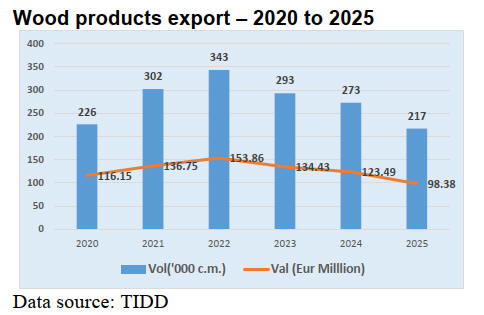
The country’s wood products export performance
gradually increased from 226,000 cu.m in 2020 to 343,000
cu.m in 2022. However, the export volume trend dipped
by close to 15% (50,000 cu.m) to 293,000 cu.m in 2023
and consistently slowed to the end of 2025.
The leading products exported were air-dried sawnwood
(55%), kiln-dried sawnwood (14%) and plywood (11%)
including trade with the ECOWAS region and billet
(10%). These altogether accounted for 89%% (1,472,837
cu.m) of the total export volume and 83% (Eur 629.59
million) of the total export value.
The top species in terms of volume were teak,
wawa/ayous, eucalyptus, cedrelaand gmelina. The export
destinations were Asia (63%), Europe (17%), Africa
(13%), America (4%) and Middle East (3%).
ECOWAS demand dominated by plywood
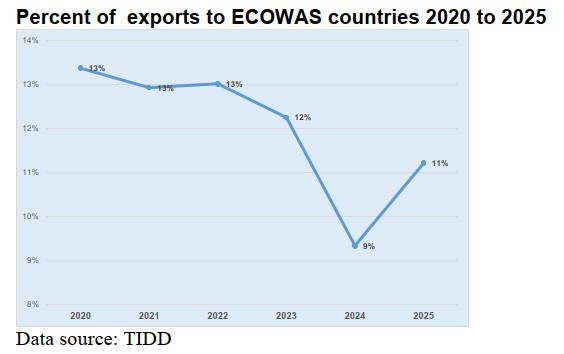
The volume of trade to African markets declined from
13% in 2020 to 9% in 2024 with signs of improvement in
2025 at 11%. For the period January to December 2025,
the ECOWAS sub-regional market recorded increases of
7% in volume and 1% in value when compared against the
same period in 2024.
In 2025 the regional market was dominated by plywood
which accounted for 17,791 cu.m (Eur6.79 million),
followed by sawnwood 1,668 cu.m (Eur618,147), sliced
veneer 170 cu.m (Eur146,758) and poles 142cu.m
(Eur12,232). Togo (5,817 cu.m), Burkina Faso (4,308
cu.m) and Gambia (3,036 cu.m) were the leading
importers of plywood.
In a related development, President John Dramani
Mahama has called on African nations to construct strong
regional production value chains across borders arguing
that fragmented national markets cannot support
competitive manufacturing or drive meaningful
industrialisation.
The President made the remark in a keynote address to
open the 2026 Africa Trade Summit in Accra. The Trade
Summit by the African Trade Chamber assembled key
African business leaders and policy makers to deliberate
on promoting trade integration and value addition on raw
materials from the continent.
See: https://www.newsghana.com.gh/mahama-urges-africa-to-
build-regional-production-chains/
AGI welcomes passage of 24 Hour Economy Authority
Bill
The Association of Ghana Industries (AGI) has praised the
government for passing the 24-Hour Economy Authority
Bill 2025, saying it's a bold step towards boosting Ghana's
economic growth. The Bill received over 100 million cedis
in the 2026 budget to finance the Authority’s activities and
operations.
In a statement signed by its president, Pharm Kofi Nsiah
Poku, AGI said the new law provides a strong legal and
institutional framework to stimulate investment,
strengthen supply chains and position Ghana as an export-
led economy.
The AGI president he believes this will create jobs,
increase productivity and reduce reliance on imports.
Meanwhile, the Association is calling for strong regulatory
oversight, investment in infrastructure and incentives like
tax rebates and subsidized electricity tariffs to support
manufacturing businesses. The AGI is also urging the
government to integrate existing industrial initiatives, like
the One District, One Factory programme, to maximise
impact.
These initiatives reflect AGI's commitment to promoting
industrial excellence and economic growth in Ghana.
See: https://www.newsghana.com.gh/agi-commends-passage-of-
24-hour-economy-authority-bill/
and
https://www.newsghana.com.gh/parliament-passes-24-hour-
economy-authority-bill/
Producer inflation ends 2025 at 1.9%
According to the latest update from the Ghana Statistical
Service (GSS), December 2025 recorded a year-on-year
producer inflation rate of 1.9% compared with 26.1% in
December 2024.
On a month-on-month basis, the producer inflation
declined by 0.8% between November and December 2025
reflecting a decrease in average producer prices over the
period. The overall Producer Price Index stood at 266.0 in
December 2025, compared with 268.1 in November 2025
and 261.1 in December 2024.
See: https://thebftonline.com/2026/01/22/producer-inflation-
ends-2025-at-1-9-down-from-26-1-in-2024/#google_vignette
Policy rate dropped by 250 basis points
The Bank of Ghana has further eased monetary policy,
cutting the Monetary Policy Rate (MPR) by 250 basis
points to 15.5% from 18%, citing improved
macroeconomic conditions and sustained growth
momentum. The move follows the Bank’s earlier
aggressive easing in late 2025, when the Monetary Policy
Committee (MPC) reduced the policy rate by 350 basis
points amid declining inflation and improving real sector
activity.
Announcing the decision after the MPC meeting, the Bank
of Ghana Governor, Dr. Johnson Asiama, said the
committee was encouraged by the continued moderation in
inflationary pressures and the resilience of economic
growth.
See: https://www.myjoyonline.com/mpc-slashes-policy-rate-to-
15-5-amid-stable-inflation-and-economic-growth/
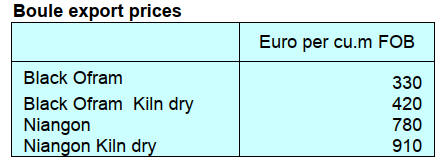 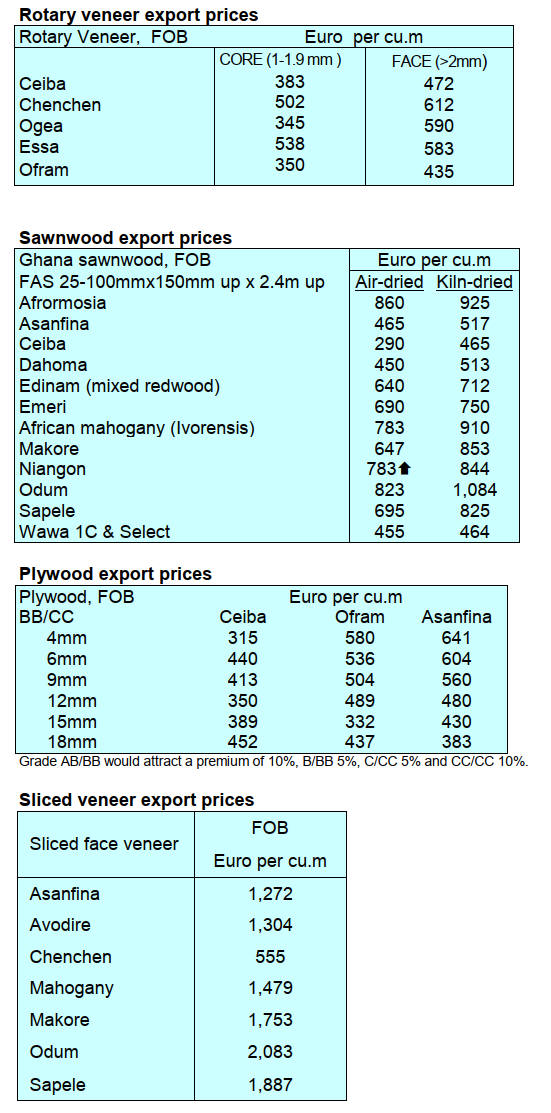
3. MALAYSIA
Furniture exporters face a strengthening ringgit
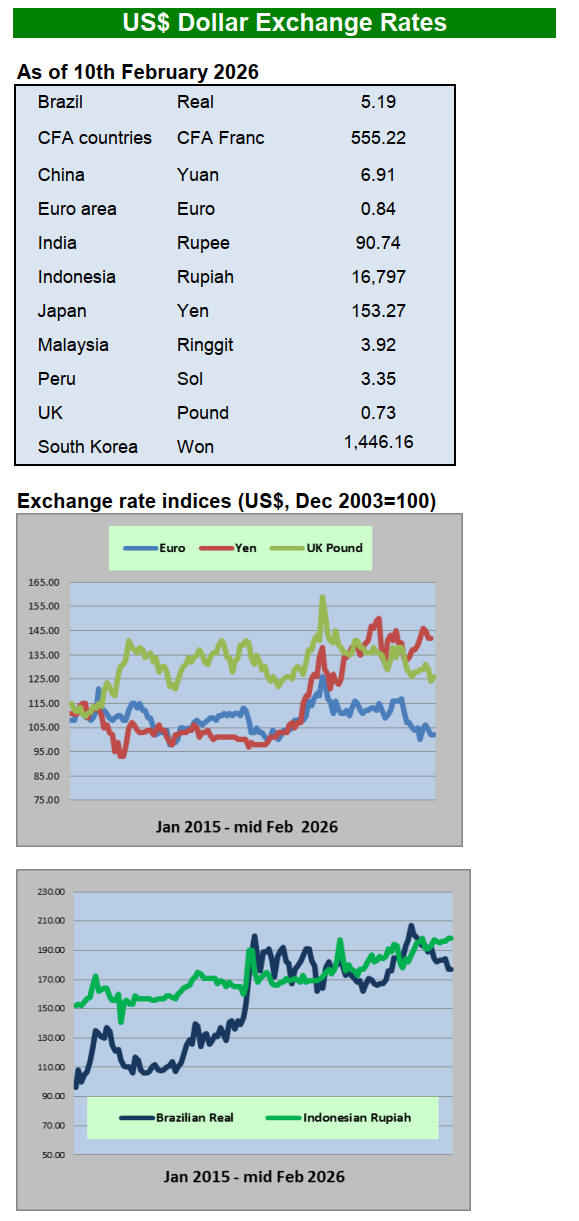
The Malaysian ringgit recently broke the threshold of
4.0 against the US dollar, marking its strongest level in
more than seven years as it continues a rally driven by
domestic fundamentals and global market shifts.
The appreciation reflects a strong performance for the
ringgit in 2025 and early 2026 making it one of the best-
performing currencies in Asia. But some Malaysian
furniture exporters said they remain largely unfazed by the
stronger currency, despite unilateral US tariffs sending
many export-driven industries into a tailspin last year.
American tariffs on Malaysian exports have given them a
competitive advantage over Chinese competitors, they
noted.
The US imposed a 19% tariff on Malaysia last year, one
of the lowest rates among members of the Association of
Southeast Asian Nations (ASEAN).
While Malaysia’s furniture industry has welcomed the
reciprocal tariff agreement for the business certainty it
brings the Malaysian government is facing strong
opposition over the trade deal signed with the US
administration.
It has been reported the Malaysian government will
reassess the deal to ensure Malaysia’s economic interests
are protected. Particular focus will be given to Malaysia’s
exports to the United States, worth RM233 billion (US$59
billion) as well as the estimated 648,000 jobs and
livelihoods tied to the trade.
See: https://www.channelnewsasia.com/asia/ringgit-strengthen-
us-dollar-malaysia-furniture-exporters-unfazed-tariffs-5893256
Partnership to market furniture
The Malaysian International Furniture Fair (MIFF) has
forged cooperation with the Malaysia External Trade
Development Corp (Matrade) to strengthen Malaysia’s
position as a global furniture export hub. Matrade will
work closely with MIFF as its International Trade Partner,
combining the trade agency’s international reach and
expertise with the Fair’s globally recognised platform to
further promote quality Malaysian furniture on the world
stage.
The strategic collaboration builds on MIFF’s proven 31-
year track record, which aligns closely with the
government’s mission to stimulate Malaysia’s trade and
export industries. CEO Matrade Abu Bakar Yusof said
MIFF’s global standing and commercial impact made it a
natural partner for Matrade. “MIFF is not merely a trade
exhibition. It is a global benchmark for the industry,” he
said, adding that the Fair was consistently ranked among
the world’s top 10 furniture trade shows and was the
largest in South-East Asia.
In 2025, MIFF attracted 54% first-time visitors from
around the world and generated a record US$1.31 bil in
on-site orders according to Matrade CEO, Abu Bakar
Yusof. He pointed out the booming development activity
in Saudi Arabia and the rising economy in Africa as
lucrative opportunities.
Based on Saudi Arabia’s trillion-dollar transformation via
the Saudi Vision 2030, he highlighted the Kingdom’s
economy as one of the most stable and high-growth trade
opportunities in the global market for Malaysian exporters.
See: https://www.thestar.com.my/news/nation/2026/01/30/miff-
matrade-forge-strategic-tie-up
Sabah TLAS+ booklet launched
EU Ambassador to Malaysia, Rafael Daerr, said Malaysia
is, in many respects, producing commodities more
efficiently and sustainably than many other parts of the
world.
He said Sabah’s long-standing partnership with the EU
dates back to 2006 through initiatives such as the
Voluntary Partnership Agreement process under the EU
Forest Law Enforcement, Governance and Trade
framework, leading to the development of the original
TLAS in 2009.
He also highlighted Sabah’s role as a like-minded partner
in climate and environmental protection through initiatives
such as the EU–Sabah REDD+ project, which saw Sabah
become the first state in Malaysia to implement a REDD+
strategy and establish an operational task force and
technical working groups.
He was speaking at the launch of the Sabah TLAS+
Booklet in Kota Kinabalu. Daerr said the launch of the
TLAS+ Booklet reflected the collaborative spirit between
Sabah and the EU and encouraged continued feedback to
ensure the system remained practical and effective.
See: https://www.dailyexpress.com.my/news/275381/sabah-first-
for-eu-timber-standards/
Malaysia Forestry Conference proceedings published
The Sabah Forestry Department has published the Pro-
ceedings of the 20th Malaysian Forestry Conference
(MFC), which was hosted by the Department in Kota Kin-
abalu in 2024 under the theme “Harmonising Forestry
towards Sustainability.”
The 566-page publication comprises three keynote
addresses, 24 working papers, 13 information papers and
30 poster presentations delivered during the conference.
The conference focused on five key sub-themes relevant to
current sustainable forest management challenges —
policy and governance framework; international coopera-
tion and partnerships; climate change mitigation and
adaptation; biodiversity conservation; forest plantations
and beyond; as well as community involvement and stake-
holder engagement. The Forest Department Sarawak
(FDS) will host the 21st Malaysian Forestry Conference
this year.
See: https://www.pressreader.com/malaysia/the-borneo-post-
sabah/20260126/281908779557972
Bamboo-based biomass development in Sabah
The Sabah Forestry Development Authority (Safoda) will
venture into renewable energy by conducting a pilot
bamboo planting project in Kota Belud to produce bio-
pellets, an environmentally friendly alternative fuel.
Safoda signed a Memorandum of Understanding (MOU)
with Nova Glove Consultancy Co Ltd and Greenova
Solutions Co Ltd. to explore potential opportunities related
to bamboo-based biomass development in Sabah through a
trial cultivation of a high density bamboo species from
India.
The MOU establishes a preliminary and non-binding
framework for the parties to jointly assess the commercial
viability and practical considerations of a potential large
scale bamboo plantation initiative using “Bambusa
Beecheyana” species, a type of high biomass yield
bamboo species, including its suitability for biomass pellet
production.
The bamboo bio-pellets are seen as a potential
replacement for coal in electricity generation, particularly
for export markets such as South Korea and Japan, which
are increasingly shifting towards greener energy sources.
It is said bamboo has a higher calorific and high carbon
value compared to wood making it highly suitable for
biomass energy production.
See: https://www.dailyexpress.com.my/news/275135/bamboo-
planting-project-for-bio-pellets-in-kota-belud/
4.
INDONESIA
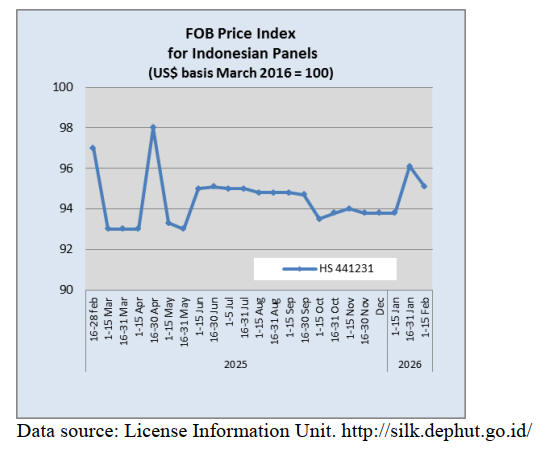
Export benchmark prices (HPE) for
wood products, 1-
28 February 2026
Please note the prices remain as in January.
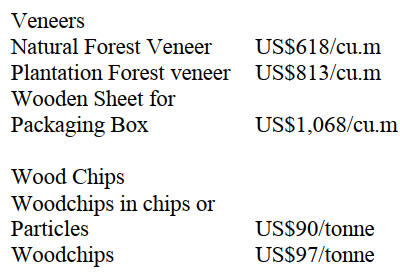
Processed Wood
Processed wood products which are leveled on all four
sides so that the surface becomes even and smooth with
the provisions of a cross-sectional area of 1000 sq.mm to
4000 sq.mm (ex 4407.11.00 to ex 4407.99.90)
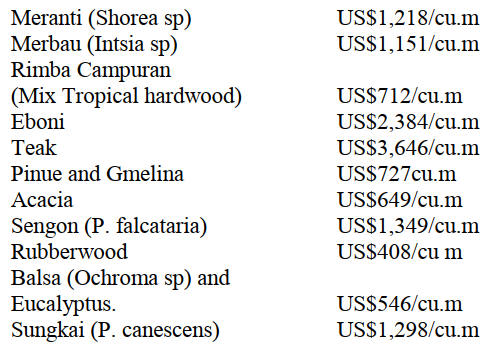
Processed wood products which are leveled on all four
sides so that the surface becomes even and smooth of
Merbau wood with the provisions of a cross-sectional area
of 4000 sq.mm to 10000 sq.mm (ex 4407.11.00 to ex
407.99.90) US$1,500/cu.m
See: https://jdih.kemendag.go.id/peraturan/keputusan-menteri-
perdagangan-republik-indonesia-nomor-2139-tahun-2025-
tentang-harga-patokan-ekspor-dan-harga-referensi-atas-produk-
pertanian-dan-kehutanan-yang-dikenakan-bea-keluar-dan-tarif-
layanan-badan-layanan-umum
Revocation of permits will impact exports
The Association of Indonesia Forest Concessionaires
Holders (APHI) stated that the government’s decision to
revoke Forest Utilisation Business Permits (PBPH) for 22
companies across Aceh, North Sumatra and West Sumatra
will significantly impact national forest product exports.
According to APHI Secretary General, Purwadi
Soeprihanto, the revocations covering more than one
million hectares and reportedly linked to responses to
hydrometeorological disasters will disrupt the forestry
supply chain which depends on domestic timber. Reduced
upstream raw material supply is expected to affect
downstream industries lowering production output and
export performance.
Beyond the impact on industries APHI highlighted the
serious socio-economic consequences including an
estimated loss of around 19,000 jobs in both upstream and
downstream sectors.
The policy is also projected to reduce domestic trade
value, non-tax state revenue, export taxes and foreign
exchange earnings by about US$125.29 million annually
excluding broader multiplier effects on regional
economies.
While APHI supports the government’s efforts to improve
forestry governance it suggested that permit evaluations be
conducted objectively and gradually with opportunities for
guidance and improvement to minimise the negative social
and economic impacts while still achieving reform goals.
See: https://www.antaranews.com/berita/5371770/aphi-
pencabutan-izin-pbph-berdampak-pada-ekspor-hasil-hutan
and
https://www.agrofarm.co.id/2026/01/aphi-dorong-perbaikan-tata-
kelola-hutan-minimalkan-dampak-sosial-ekonomi/
IEU-CEPA Business Council planned
Indonesia’s Ministry of Trade, together with national
business stakeholders, will establish the Indonesia–
European Union Comprehensive Economic Partnership
Agreement (IEU-CEPA) Business Council as part of
preparations for implementing the trade agreement.
Trade Minister Budi Santoso said the agreement has
entered the legal drafting stage on the European Union
side, a process involving all 27 EU member states and
expected to be completed by May. While implementation
is targeted to begin in January 2027 the ministry, in
collaboration with the Indonesian Chamber of Commerce
and Industry (Kadin) and the Indonesian Employers
Association (Apindo), will form the Business Council as
an early preparatory platform.
The IEU-CEPA Business Council will function as a
business-to-business forum to facilitate communication
between Indonesian and European companies and help
them identify potential trading partners ahead of the
agreement’s entry into force.
See: https://www.tempo.co/ekonomi/kemendag-dan-pengusaha-
akan-bentuk-dewan-bisnis-ieu-cepa-2113140
Showcasing Indonesia’s furniture innovation
IFEX 2026 is being prepared by the Indonesian Furniture
and Craft Industry Association (HIMKI) as a strategic
platform to strengthen the global promotion and
competitiveness of Indonesia’s furniture and handicraft
industry. Scheduled for March 5–8, 2026, at the Indonesia
Convention Exhibition (ICE) BSD in Tangerang, the expo
will showcase more than 5,000 premium products from
over 500 exhibitors.
The organisers say the exhibition aims to generate
substantial cross-border business opportunities while
reflecting the industry’s transformation toward higher
value-added products.
Beyond facilitating transactions, IFEX 2026 is expected to
offer insights into future design directions, market trends,
and evolving quality benchmarks, reinforcing the
integration of aesthetics and economic value in
Indonesia’s furniture industry.
See: https://rri.co.id/en/business/2161577/ifex-2026-showcases-
indonesia-s-global-furniture-innovation
and
https://money.kompas.com/read/2026/02/05/190510026/ifex-
2026-jadi-strategi-pelaku-usaha-bidik-pasar-global
In related news, during Expo Indonesia (TEI) 2026 the
HIMKI is advocating stronger integration of the domestic
market alongside export expansion. Beyond export
promotion, HIMKI is urging the government to expand the
use of locally made furniture and craft products through
public procurement mechanisms.
The Association encourages the involvement of state-
owned enterprises, central government agencies and
regional administrations under the Domestic Component
Level (TKDN), increased use of domestic products
(P3DN) and business-to-government procurement
schemes. This approach is expected to enable export-
oriented products to be absorbed by government offices
and public infrastructure projects, strengthening domestic
demand and building a more resilient national market.
See: https://rri.co.id/en/business/2132546/himki-pushes-
export-and-domestic-integration-at-tei-2026
Commitment on legal certainty
The Minister of Forestry, Raja Juli Antoni, reaffirmed the
government’s commitment to strengthening legal certainty
in forest control and management by aligning forestry
policies with the national spatial planning system.
He emphasised that forest areas are a strategic component
of national spatial planning, making the integration of
updated forest area maps into provincial and district/city
Spatial Planning Plans (RTRW), a top priority to prevent
overlapping land use and ensure clearer legal frameworks.
The Minister also outlined measures to resolve land tenure
disputes within forest areas through schemes such as Land
Tenure Settlement within the Framework of Forest Area
Arrangement (PPTPKH/TORA) and regulate forest
utilisation and social forestry as a legal access pathway for
forest communities.
This approach aims to settle tenure conflicts fairly while
prioritising administrative solutions and reinforcing
equitable, sustainable and people-oriented forest
governance under the One Map Policy.
See: https://inp.polri.go.id/artikel/forestry-ministry-emphasized-
commitment-on-legal-certainty-for-forest-management
Social forestry plays a strategic role
The Ministry of Forestry is strengthening its collaboration
with the Indonesian Farmers' Harmony Association
(HKTI) to advance Social Forestry as a strategic tool for
supporting national food self-sufficiency and improving
the welfare of forest farmers.
This initiative was discussed during the HKTI Forestry
Working Program Detailed Meeting for 2025–2030 on 5
February2026 which emphasised community-based forest
management, downstream development of Social Forestry
products, institutional strengthening of forest farmer
groups, and the development of regional flagship
commodities.
Vice Minister of Forestry, Rohmat Marzuki, highlighted
that Social Forestry plays a key role in the national
development agenda, including Asta Cita and the 2025–
2029 National Medium-Term Development Plan.
See: https://rri.co.id/en/national/2165096/the-government-social-
forestry-plays-a-strategic-role
Early mitigation to address forest fire risks
Indonesia’s Ministry of Forestry is strengthening early
mitigation measures to address the heightened risk of
forest and land fires in 2026 as hotter climate conditions
are projected. The ministry is preparing an integrated,
data-driven strategy that emphasises early warning
systems, field readiness and firm law enforcement.
Key prevention efforts include detailed mapping of fire-
prone areas by integrating fire risk data with land-use
permits, conservation zones, and records of burned areas,
as well as expanding Community Fire Care Groups in
vulnerable provinces.
The strategy also combines prevention, rapid response and
post-fire recovery, supported by joint patrols in fire-prone
villages, enhanced use of the Sipongi Plus early detection
system and preparedness for weather modification
operations before the peak dry season.
The Ministry has reaffirmed zero tolerance for land and
forest burning, requiring concession holders to control
fires within their areas.
See: https://www.metrotvnews.com/read/N0BC1jow-kemenhut-
perkuat-mitigasi-dini-hadapi-ancaman-karhutla-2026
and
https://jogja.antaranews.com/berita/800542/kemenhut-siapkan-
strategi-terpadu-hadapi-potensi-karhutla?
Indonesia targets carbon market launch by mid-2026
Indonesia is targeting the full-scale operation of its
national carbon market by late June 2026 with large-
volume transactions expected to commence in July. The
timeline aligns with Presidential Regulation No. 110 of
2025 on Carbon Economic Value Instruments and
National Greenhouse Gas Emission Control, according to
Hashim Djojohadikusumo, President Prabowo Subianto’s
special envoy for climate and energy.
Hashim noted that the government is currently integrating
multiple carbon registration systems into a single national
framework to enhance efficiency, transparency and
accountability. He also highlighted Indonesia’s strong
potential to generate economic benefits from carbon
trading, driven by increasing global demand for carbon
credits, particularly those derived from natural resources.
See: https://en.antaranews.com/news/402758/indonesia-targets-
full-scale-carbon-market-launch-by-mid-2026
5.
MYANMAR
6.
INDIA
Inflation tamed
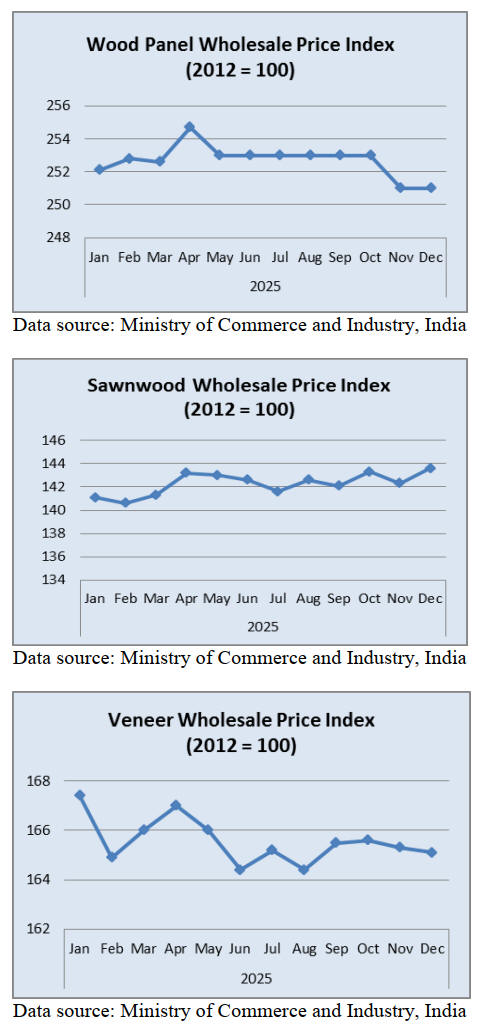
The annual rate of inflation based on the all India
Wholesale Price Index (WPI) was 0.83% for December
2025 ( -0.32% for November 2025). The positive rate of
inflation in December 2025 was primarily due to
increased prices of other manufacturing, minerals,
manufacture of machinery and equipment, manufacture of
food products and textiles. The index for manufacturing
increased by 0.41% from 145.0 in November 2025 to
145.6 in December 2025.
Out of the 22 NIC two-digit groups for manufactured
products, 13 groups saw an increase in prices, 8 groups a
decrease in prices and 1 group no change in prices. Some
of the important groups that showed month on month
price increases were other manufacturing; basic metals;
chemicals and chemical products; textiles and other non-
metallic mineral products.
Some of the groups that witnessed a decrease in prices
were manufacture of rubber and plastics products; food
products; computer, electronic and optical products; paper
and paper products and beverages.
See: https://eaindustry.nic.in/
and
chrome-
extension://efaidnbmnnnibpcajpcglclefindmkaj/https://eaindustry
.nic.in/pdf_files/cmonthly.pdf
Furniture sector braces for BIS QCO
Implementation of the Bureau of Indian Standards (BIS)
Quality Control Order (QCO) on the furniture sector will
begin this month. Last year on 30 October 2025 the
Department for Promotion of Industry and Internal Trade
of India (DPIIT) held a meeting under the chairmanship of
the Joint Secretary, Shri Sanjiv, where discussions were
held on effective implementation of the Furniture Quality
Control Order (QCO), 2025.
Earlier this year DPIIT, in exercise of powers conferred by
section 16 of the Bureau of Indian Standards Act, 2016 (11
of 2016), after consulting Bureau of Indian Standards, had
made a dispensation of statutory order notifying the
enforcement of the Furniture Quality Control will come in
effect after on 13 February 2026 for large scale
manufacturers and all importers. For micro and small
manufacturers the implementation date is 12 August 2026.
The BIS QCO on furniture will be applied to furniture
consisting of a set of chairs, tables and desks, beds and
storage units and all will require compulsory BIS
certification. The notification order applies on both
imports and domestic industry while exports are
exempted.
IMF raises FY 26 growth forecast to 7.3% from 6.6%
The IMF raised India’s GDP growth estimates for 2025-26
to 7.3% from the earlier projection of 6.6% due to strong
third and fourth quarter expansion. The latest estimate is
slightly below the 7.4% growth projected by the country’s
statistics office for the current fiscal year that ends in
March and matches the 7.3% estimated by RBI.
The World Bank has also recently revised upwards its
growth estimates for India from 6.3% to 7.2% citing
robust demand due to strong consumption on the back of
tax cuts and higher rural income.
Growth is projected to moderate to 6.4% in 2026 and 2027
as cyclical and temporary factors wane, the multilateral
agency said in its latest report. India retains the fastest
growing major economy tag as China’s growth has been
projected at 5% in 2026 and 4% in 2027. Several agencies,
economists and brokerages have raised India’s GDP
growth forecast for FY26.
https://timesofindia.indiatimes.com/business/india-
business/imf-raises-fy26-growth-forecast-to-7-3-from-6-
6/articleshow/126718682.cms
Take-aways from the Union budget 2026-27
The Union Budget 2026–27 was recently presented and
comes after twelve years of policy continuity marked by
macroeconomic stability, fiscal discipline and sustained
economic growth driven by structural reforms and public
investment.
Guided by ‘Atmanirbhar Bharat’ (Self-reliant India) the
Budget emphasises strengthening domestic manufacturing,
energy security and reducing import dependence.
It highlights inclusive measures supporting employment,
agriculture, household purchasing power and universal
services contributing to growth of around 7%. The Budget
also recognises global trade disruptions, supply chain risks
and rapid technological change shaping the external
environment.
Highlights with respect to the forestry and wood procesing
sectors
Through the Union Budget 2026-27 and recent
policy trends the Indian government is focusing
on strengthening the timber and wood-based
industry through modernisation, sustainable
agroforestry and infrastructure development.
The 2026-27 Budget proposed establishing Hi-
Tech Tool Rooms by Central Public Sector
Enterprises (CPSEs) to design, test and
manufacture high-precision components which
can support the machinery needs of the wood-
processing industry.
Increased capital expenditure on infrastructure
and urban development is expected to drive up
demand for construction-grade timber, plywood
and furniture.
As natural forest logging is restricted, the
government is focusing on promoting
agroforestry and Trees Outside Forests (TOF) to
meet the raw material demand of the wood-based
industry.
The Budget reveals a continued reliance on
importing logs, lumber and wood products with
imports rising toUS$2.3 billion.
Government policies aim to encourage the
cultivation of local species to reduce reliance on
imported teak and other hardwoods.
The Budget and associated policies are pushing the Indian
timber sector to modernise, move towards higher value-
added products and secure raw materials through farm-
industry partnerships.
7.
VIETNAM
Wood and Wood Product (W&WP) trade
highlights
According to data provided by the Viet Nam Customs
Office W&WP exports in January 2026 reached US$1.6
billion, down 3.4% compared to December 2025 and up
12% compared to January 2025.
WP exports contributed US$1.08 billion, up 0.9%
compared to December 2025 and up 9% compared to
January 2025.
In January 2026 wooden furniture exports earned
US$922
million, up 4.4% compared to January 2025. The export
value of wooden furniture, at over of over US$900 mil. in
the first month of the year, signals that businesses have
taken the initiative to source raw materials and sign long-
term orders until the end of the second quarter of 2026.
W&WP exports to the EU market in January 2026
amounted to US$84.1 million, down 3.4% compared to
December 2025 but up 38% compared to January 2025.
Although there is a slight decline compared to December
2025 reflecting the cyclical nature of the market after the
peak shopping period at the end of the year, compared to
the same period in 2025 exports recorded a breakthrough
growth of up to 38%.
W&WP exports to the US in January 2026 were valued at
US$805 million, down 3.4% compared to December 2025,
but up 3.2% compared to January 2025.
At the beginning of 2026, Viet Nam's W&WP exports to
the US continue to record positive signals, despite the
pressures from tariffs.
Viet Nam's W&WP imports in January 2026 amounted to
US$300.0 million, down 6% compared to December 2025,
however, compared to January 2025, the value increased
by 52%.
Viet Nam's pine imports in December 2025 were recorded
at 108,700 cu.m, worth US$20.9 million, up 7% in volume
and 0.4% in value compared to November 2025.
Compared to December 2024 imports increased 55% in
volume and 40% in value.
In 2025, pine imports reached 1.11 million cu.m, worth
US$220.9 million, up 14% in volume and 1% in value
compared to 2024.
Viet Nam's tali wood imports in December 2025 were
38,200 cu.m, worth US$13.5 million, down 30% in
volume and 35% in value compared to November 2025.
Compared to December 2024 imports were down 26% in
volume and 26% in value. In 2025, tali wood imports
amounted to 376,700 cu.m, worth US$140.2 million, up
19% in volume and 17% in value compared to 2024.
Imports of raw wood (logs and lumbers) from the US in
December 2025 were recorded at 160,240 cu.m, with a
value of US$64.79 million, an increase of 34% in volume
and 37% in value compared to November 2025
In 2025, raw wood imports from the US were 1,395
million cu.m with a value of US$577.69 million, an
increase of 102% in volume and 93% in value compared
to 2024.
Imports of raw wood from Africa in December 2025 were
reported at 63,330 cu.m, at a value of US$22.44 million,
down 25% in volume and 28% in value compared to
November 2025 and down 25% in volume and 22% in
value over the same period in 2024.
In 2025, imports of raw wood from Africa totalled
813,610 cu.m, with a value of US$290.88 million, up 11%
in volume and 8% in value compared to 2024.
Viet Nam's wood producers boost shipments to
Europe
The Viet Nam Timber and Forest Products Association
said that enterprises are accelerating exports to the
European Union as import demand recovers and EU
partners increased orders in early 2026.
According to Viet Nam Customs, exports of wood and
wood products reached about US$17.2 billion in 2025, up
nearly 6% from the previous year, the highest level on
record.
In addition to traditional markets such as the United
States, Japan and China exports to the EU have shown
positive signs driven by rising demand for added value
wood products and high-end furniture.
As EU demand rebounds, Viet Namese wood enterprises
are boosting exports and front-loading shipments ahead of
traceability requirements while investing in supply chain
digitalisation and raw material sourcing transparency.
See: https://en.sggp.org.vn/vietnams-wood-producers-boost-
shipments-to-european-market-post123776.html
Viet Nam’s wood and furniture export outlook
Viet Nam’s wood industry enters 2026 with a positive
growth outlook as furniture demand in major markets
shows signs of gradual recovery. After a period of global
economic volatility improving conditions in housing and
retail markets are supporting renewed demand for wood
products and furniture.
Within this context, the United States continues to play a
pivotal role, while also imposing increasingly stringent
requirements on product quality and supply chain
reliability.
In 2025, Viet Nam’s wood and wood product exports
recorded solid growth across most major markets. The
United States remained the largest destination, with
exports reaching US$9.4 billion, up 4% compared with the
previous year, reaffirming its position as Viet Nam’s
primary export market.
Japan stood out with an impressive growth rate of 23%,
reaching US$2.15 billion, signaling rapidly expanding
demand for Viet Namese wood products. Among other
major markets, exports to China increased by 3.5% to
US$2.08 billion, while exports to Canada and the United
Kingdom grew by 14% and 9% respectively, reflecting
successful market diversification.
Regional markets such as Malaysia and Australia also
maintained growth momentum, with export values of
US$167 million and US$163 million respectively.
Overall, the data show that Viet Nam’s wood industry
continues to expand strongly in the US market. Beyond
price competitiveness, the US increasingly prioritises
sustainability certifications, transparent origin and
traceability, while also requiring stable delivery times and
flexible order fulfilment capabilities.
Over the past year, Viet Nam’s wood industry has faced
multiple simultaneous pressures, including weakening
demand in certain major markets, volatile logistics costs
and increasingly stringent requirements related to legal
sourcing and environmental standards. In addition, risks
arising from trade defense measures and intensified
regional competition have required exporters to adjust
their production and export strategies.
Nevertheless, despite these challenges, Viet Nam’s wood
export value surpassed US$17 billion for the first time.
This achievement highlights the sector’s resilience,
adaptability and the relatively solid production and supply
chain foundations that have been built in recent years.
E-commerce places high demands on supply chain
operations
Alongside traditional export channels, e-commerce is
emerging as a promising avenue for Viet Namese wood
exporters, particularly in the US market. However,
participation in e-commerce channels also places higher
demands on supply chain operations, including on-time
delivery performance, inventory management at
destination markets and flexible order processing. As a
result, exporters must not only invest in product
development but also build logistics capabilities that are
aligned with cross-border e-commerce models.
In this context, integrated logistics solutions covering
international transportation, warehousing and domestic
distribution in import markets are becoming increasingly
important in supporting Viet Namese wood enterprises as
they expand their global sales channels.
Looking ahead to 2026, Viet Nam’s wood industry faces
significant growth opportunities, with the US continuing
to serve as the primary growth driver and e-commerce
offering additional development potential. In an
environment of increasingly demanding market
requirements, effective supply chain management will be a
key factor in sustaining competitiveness.
Closer collaboration between Viet Namese wood
manufacturers and experienced logistics service providers
can help strengthen export supply chains, creating a solid
foundation for Viet Namese wood products to access the
US market in a sustainable and long-term manner.
See: https://vantage-logistics.com.vn/vietnams-wood-and-
furniture-exports-outlook-2026-bv512.htm
A new benchmark for Viet Nam's timber exports
In terms of direct share, W&WP exports to the European
Union (EU) currently account just for about 5% of the
total export value of the entire industry.
However, reality shows that this is a 'new benchmark'
market, with a significant influence on standards and
shaping the sustainable development trend of Viet Nam's
forestry industry in the new period.
According to the Viet Nam Wood and Forest Products
Association, since the beginning of 2026, orders from
Europe have been recovering positively, especially in the
processed wood products, high-end furniture, and
environmentally friendly products sectors.
Notably, along with the EVFTA, tariffs on many wood
and wood products have been significantly reduced,
creating a competitive advantage for Viet Namese
businesses.
However, tariff advantages are only a necessary condition;
the sufficient condition to maintain and expand market
share in the EU is meeting sustainable development
standards and ensuring transparency in the supply chain.
Dr. Truong Tat Do, from the Department of Forestry and
Forest Protection (Ministry of Agriculture and
Environment), emphasised: "We shouldn't view the EU
solely from the perspective of market share. This is a
standard setting market. By meeting EU requirements,
businesses will have an easier time accessing other high-
end markets."
According to him, the EU is not only a place for
consuming products but also a "benchmark" for
sustainable development, transparency and social
responsibility. EU regulations often have a ripple effect,
forcing global supply chains to adapt.
Currently, a new and pivotal challenge in the export of
certain products, including wood and forestry products, is
the EU's Regulation on Deforestation Prevention and
Control (EUDR) – a set of standards that are much stricter
than before.
According to Dr. Truong Tat Do, the fundamental new
feature of EUDR is the shift from controlling paper
documents to controlling using spatial data and remote
sensing technology. Businesses must provide the precise
geographical coordinates of the land plot used for raw
material production. For areas of 4 hectares or more, it is
mandatory to define the boundaries of a closed polygon.
This data will be compared by the EU with satellite
mapping systems as of December 31, 2020, to assess the
risk of deforestation. Inaccurate or dishonest declarations
will be easily detected when compared against an
independent system.
The Viet Namese timber industry is characterised by a
multi-tiered supply chain involving numerous
intermediaries, from small-scale forest farmers and traders
to primary processing enterprises and export factories.
This fragmentation increases the risk of material
adulteration, coordinate data discrepancies, or map
overlaps if a unified management system is lacking.
According to experts, the fundamental solution is to build
an integrated spatial data platform, overlaying forest
boundary maps at the December 31, 2020 mark with
current raw material area maps, thereby classifying risk
areas and controlling input from the outset.
The government issued Resolution 88/ND-CP dated June
8, 2023 and related directives assigning the Ministry of
Agriculture and Environment to lead the development of
an action plan to adapt to the EUDR. The framework of
solutions includes improving mechanisms, providing
technical guidance, digitising data, strengthening
communication, and mobilising resources to support
businesses.
In the context of increasingly public and accurate satellite
data, "avoiding" or merely providing false information is
no longer feasible. The only way forward is honest
declaration, data standardisation, and supply chain
management according to international standards.
In the overall picture of timber exports, the EU may only
account for about 5% of the direct share, but it carries
significant influence in terms of direction. This is a
comprehensive "test" of the transparency, legality and
environmental responsibility of businesses.
The EU's Forest Protection Regulation (EUDR), with its
requirement for traceability down to geographical
coordinates, is setting a new standard, forcing businesses
to restructure their supply chains towards transparency and
sustainability. If Viet Nam's timber industry can overcome
this standard hurdle, it will not only meet the demands of a
discerning market but also gradually assert its position in
the global timber value chain where green development is
no longer an option but a mandatory requirement.
See: https://www.vietnam.vn/en/thuoc-do-moi-cho-xuat-khau-
lam-san-viet-nam
Localities nationwide are required to complete the
development and publication of provincial-level forest
boundary databases and maps as of December 31, 2020,
by the end of this year, as part of Viet Nam’s efforts to
adapt to the EU Deforestation Regulation (EUDR).
The task is among key targets set out in an action plan on
EUDR implementation in the forestry sector, recently
issued by the Forestry and Forest Protection Department
under the Ministry of Agriculture and Environment. Under
the plan, provinces and cities must also identify and
announce coffee, rubber and timber raw material
production areas at risk of deforestation and forest
degradation.
The action plan aims to assess impacts and risk levels and
propose solutions for the timber and wood products sector
to adapt to the EUDR. Another goal is to update and issue
official EUDR compliance guidelines for the timber and
wood products industry.
At the same time, the plan focuses on developing and
improving institutions and policies to promote sustainable
production and trade of agricultural and forestry products
that do not cause deforestation or forest degradation. It
seeks to strengthen traceability of agro-forestry products,
support low-emission, circular and green economic
development, and enhance adaptation to climate change.
Along with communication and awareness-raising
activities, the Forestry and Forest Protection Department
will continue to improve the legal framework related to
EUDR implementation. A set of indicators and forest
monitoring guidelines meeting EUDR requirements will
be developed, enabling sectors to compare, verify and
demonstrate that agricultural and forestry production and
trade activities in Viet Nam are deforestation-free.
The department will also build and operate an integrated
technology platform linking EUDR traceability
requirements with data on planting area codes and
sustainable forest management certification. Information
technology will be applied to strengthen traceability
control and geographical indication of agro-forestry
products.
In addition, technical handbooks will be developed to
support information lookup, traceability and geographical
indication of forest products, serving as a basis for
controlling the production and processing of timber and
wood products that do not cause deforestation or forest
degradation. Annual forest status databases and maps will
be compiled to provide evidence for verifying EUDR
compliance.
Management agencies will focus on issuing official
guidance on EUDR compliance for the timber and wood
products sector and supporting forest owners, enterprises
and supply chain actors in collecting information and
fulfilling accountability requirements. EUDR
implementation capacity will be assessed in association
with improving the effectiveness of the Voluntary
Partnership Agreement on Forest Law Enforcement,
Governance and Trade (VPA/FLEGT), the Viet Nam
Timber Legality Assurance System, and timber import-
export management.
Training courses will be organised, along with guidance
documents, for central and local agencies, associations,
enterprises, forest owners, farmers and assessment and
certification organisations. Viet Nam will also step up
cooperation with the EU and its member states, the EU’s
Joint Research Centre, and regional partners to harmonise
data, exchange experience and mobilise technical
assistance during the EUDR implementation process./.
See: https://en.vietnamplus.vn/forest-databases-for-eudr-
implementation-to-be-completed-in-2026-post337668.vnp
8. BRAZIL
Rain season harvesting ban in Mato Grosso
The period for restricted timber harvesting in managed
forests in the State of Mato Grosso in the Amazon Region
is in effect from 1 February to 1 April and is a key
regulatory instrument to reduce environmental impacts
during the rainy season. Established under Federal and
State regulations, this measure aims to protect soil, prevent
erosion and ensure the sustainability of forest management
in the Amazon Region.
According to the Mato Grosso State Secretariat for the
Environment (Sema) and Sindusmad, the temporary
suspension of activities is essential to balance
environmental, economic and social objectives. In wet soil
conditions, operations such as cutting, felling, skidding
and log transportation tend to intensify erosion and land
degradation which justifies the temporary interruption of
activities.
During the restriction period, Sema’s systems fully block
operations and rely on satellite-based monitoring while the
forest sector organises its operations through advance
planning, stockpiling and technical guidance to
companies. Compliance during the harvesting ban,
combined with companies’ annual planning and
strengthening enforcement and productive reforestation, is
considered indispensable to ensuring the continuity and
long-term sustainability of forest-based activities.
See: https://www.sindusmad.com.br/Noticias/Periodo-proibitivo-
de-extracao-da-madeira-reforca-compromisso-ambiental-e-exige-
planejamento-do-setor-florestal/
Investment in a forest conservation in the Amazon
The Mejuruá Project, developed by the BR Arbo Gestão
Florestal in the municipality of Carauari, Amazonas,
foresees an investment of approximately US$50 million in
an integrated model combining forest conservation,
certified timber management and the generation of carbon
credits.
Covering an area of approximately 900,000 hectares and
with a 30-year horizon, the initiative aims to keep the
forest standing, including a voluntary decision to forego
the legally permitted clearing of up to 20% of the area.
The project seeks to reconcile economic viability,
environmental conservation and job creation. The project
is expected to generate approximately 400 direct jobs and
up to 2,000 indirect jobs.
The project combines reduced-impact forest management
with 30-year cutting cycles scheduled to begin in 2027 and
the commercialisation of carbon credits certified under
internationally recognised standards. Estimated revenue
from carbon credits, in the order of US$40 million over a
40-year period, are presented as a mechanism to mitigate
economic risks, strengthen conservation outcomes and
enable social investments in infrastructure, renewable
energy, potable water, internet connectivity and non-
timber forest product value chains, with the participation
of local communities.
Despite its sustainability focus, the Mejuruá Project has
faced controversy related to free, prior and informed
consultation with traditional communities and to land
tenure issues. Investigations by the Federal Public
Prosecutor’s Office (MPF) in Amazonas State identified
overlaps between community territories and the project
area, leading to recommendations and subsequent
institutional revisions that allowed activities to resume.
The debate remains ongoing, reflecting both the project’s
potential to promote conservation, social inclusion and
regional development and the governance challenges,
community participation and equitable benefit-sharing
challenges associated with carbon initiatives in the
Amazon.
See: https://sustentavel.istoe.com.br/grupo-investe-us-50-
milhoes-em-projeto-de-conservacao-na-amazonia
Structuring forest restoration and silviculture with
native species
According to Indústria Brasileira de Árvores (IBÁ), Brazil
has strategic conditions to achieve a global green economy
by structuring forest restoration and silviculture of native
species as a new long-term investment frontier. Productive
models already demonstrate the technical feasibility,
operational scalability and the potential to generate
significant social and environmental impacts, particularly
in rural and forested lands.
Studies highlight the scale of this opportunity: ecological
restoration in Brazil could mobilise up to US$26 billion
per year and generate approximately 880,000 jobs while
the global tropical timber market reached US$992 billion
in 2024 and around US$1 trillion in 2025.
Brazil’s estimated potential of 1.5 million hectares of
native timber species silviculture positions the country
competitively to meet the growing demand for forest
products associated with the transition to a low-carbon
economy although access to appropriate financial
instruments remains the main challenge.
Unlocking this potential will require tailored financial
solutions, including guarantee funds, long-term credit
lines, blended finance mechanisms as well as legal
certainty, regulatory predictability and integration with
international carbon markets.
In the post-COP30 context, forest restoration and native
timber species silviculture are key pillars for translating
climate commitments into tangible outcomes,
strengthening local economies and positioning Brazil as a
global reference in nature-based forest solutions.
See: https://iba.org/comunicacao/a-nova-fronteira-estrategica-da-
economia-verde/
Mato Grosso timber sector in 2025
The timber sector in the State of Mato Grosso generated
BRL3.17 billion in 2025, representing a 2.8% increase
compared to 2024 (BRL3.09 billion), with total production
reaching 16.4 million cu.m. The interstate market was
again the largest destination accounting for 46 of the total
value traded (BRL1.46 billion) and recording 19 % growth
year on year offsetting declines in intrastate markets (-8%)
and exports (-11%).
Exports totalled BRL596.9 million (US$113.01 million)
with India (US$51.2 million and 156,800 tonnes), the
United States (US$15 million and 8,500 tonness), China
(US$11.1 million and 18,200 tonnes), France (US$7.1
million and 4,100 tonnes) and Vietnam (US$5.9 million
and 9,500 tonnes) as the main destinations.
According to the Center of Timber-Producing and
Exporting Industries of the State of Mato Grosso
(CIPEM), the overall decline in exports was mainly
attributed to increased regulatory bureaucracy, intensified
by the inclusion of Ipê and Cumaru species under CITES
appendix II, which raised compliance costs and reduced
international competitiveness despite advances in
sustainable forest management, traceability systems and
the international promotion of timber from Mato Grosso.
In the domestic market the forest-based value chain
continued to play relevant economic and social roles as
well as playing a strategic role in regional development,
with 1,339 establishments, more than 10,300 direct jobs
and approximately 30,000 indirect jobs across 89
municipalities in addition to BRL28.5 million in tax
revenues collected in 2025 through FETHAB fund.
For the coming years CIPEM identifies regulatory
modernisation and reduction of bureaucratic barriers as
key priorities including greater integration between State
and Federal systems such as the Timber Identification
Certificate (CIM) and the need to migrate from Sisflora
2.0 to DOF+ timber control system.
See: https://cipem.org.br/mercado-da-madeira-movimenta-r-317-
bilhoes-em-mato-grosso/
9. PERU
Serfor initiative positions Peru among leaders in
sustainable forest production
The Forest Incentive Programme (PIF Plantations) of the
National Forest and Wildlife Service (Serfor) has been
selected as the Official Case Study for the Dialogue on
Forests, Agriculture and Commodity Trade (FACT
Dialogue), one of the most important international
platforms focused on transforming production systems
toward sustainable and deforestation-free supply chains.
The FACT Dialogue comprises 28 countries that produce
and consume agricultural and forest products. As part of
its new focus, based on an evaluation of its first five years
of work, this platform promotes sustainable production
models that contribute to food security and to the
protection of forest ecosystems.
This initiative, presented at a COP30 event in November
2015, has become a successful pilot programme for large-
scale investments in forest plantations, demonstrating a
high demand for incentives and a strong capacity among
local communities to actively participate in sustainable
development models.
See: https://www.gob.pe/institucion/serfor/noticias/1352261-
iniciativa-del-serfor-posiciona-al-peru-entre-los-referentes-
globales-de-produccion-forestal-sostenible
Madre de Dios, Ucayali and Loreto lead in FSC
certification
The Forest Stewardship Council (FSC) is increasingly
expanding its presence in the country approaching one
million hectares of certified forests. Currently, it has 93
private initiatives certified by FSC in the timber and paper
sectors.
According to information provided by FSC Peru as of 31
December 2025 the country had 970,055 hectares
certified. Of the 93 initiatives all are in the private sector
and of these, eleven are related to forest management and
82 to chain of custody (CoC).
The regions of the country with the largest certified areas
are: Madre de Dios with 539,599 hectares followed by
Ucayali with 327,912 hectares, and finally Loreto with
102,543 hectares.
Agreement to reduce forest fires
The National Forest and Wildlife Service (Serfor) and the
Cement Producers Association (ASOCEM) signed an
Inter-institutional Cooperation Agreement establishing a
framework for joint work aimed at preventing forest fires
and reducing carbon dioxide emissions in cement
production.
The Agreement seeks to coordinate efforts between the
public and private sectors to implement strategic actions
that will allow for the management of vegetative residues
to combat forest fires.
Plant waste left by forestry or agricultural activities, if not
managed, becomes combustible material that increases the
risk of fires. Cement production uses kilns that can utilise
certain highly combustible plant residues. This action
contributes to reducing CO2 emissions from traditional
cement production,” stated the CEO of ASOCEM.
See: https://www.gob.pe/institucion/serfor/noticias/1342544-
serfor-y-asocem-suscriben-convenio-para-prevenir-incendios-
forestales-y-reducir-emisiones-de-co
|