|
Report from
Europe
Recovery in European furniture production stalls in
2025
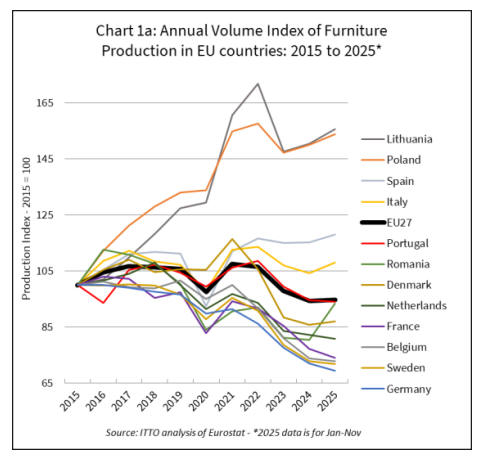
Signs of recovery in EU27 furniture production during the
opening months of 2025, petered out in the second half of
the year. Eurostat data indicates that seasonally adjusted
furniture production in the EU27 during the January to
November period of 2025 was up by only around 0.5%
compared to the previous year.
Production in 2025 remained stubbornly below that
recorded during the previous record downturn in 2020 at
the height of the COVID-pandemic.
Overall production in the EU27 was dragged down during
2025 by particularly sluggish performance in several large
producing countries in Western Europe including
Germany, Sweden, Belgium, France and the Netherlands.
But the downturn in these countries was offset by strongly
rebounding production in Lithuania, Poland, Spain, Italy,
and Romania. Production in Portugal and Denmark
remained at the same level as the previous year. (Chart
1a).
Drawing on Eurostat data and commentary in World
Furniture Online (www.worldfurnitureonline.com) by the
Italy-based market research organisation CSIL, it is
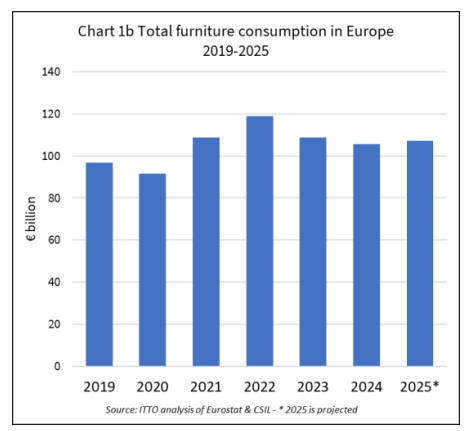
estimated that total furniture consumption in Europe
increased by around 1.5% to €107 billion in 2025. This
follows on from a 3% fall in 2024 and even sharper 8%
decline in 2023 (Chart 1b).
The marginal rise in European furniture consumption last
year was due in part to an 0.5% increase in domestic
production and in part to an increase in Europe’s furniture
trade deficit. While exports of furniture products to
countries outside the region were static last year, there was
a rise in imports, particularly from China.
The volatile global market situation created by rapid and
unpredictable changes to U.S. tariffs has been generally
detrimental to the European furniture industry. In addition
to the direct impact on EU furniture exports to the U.S., it
has led to an increased proportion of furniture produced in
other parts of the world previously destined for that market
to be shifted elsewhere. This effect has been compounded
by the recent downturn in the Chinese real estate market.
Overall, CSIL’s forecast of June 2025, that furniture
demand in Europe would “remain almost stagnant in
2025” has been borne out by events. More positively, the
upside factors mentioned by CSIL in mid-2025 that could
support a stronger recovery remain valid. These include a
slow improvement in macroeconomic indicators, an
expected easing of inflation and interest rates, and
potential wage growth. These factors could boost
consumer confidence and encourage greater spending on
furniture during 2026.
In a volatile global trading environment, the European
furniture industry also benefits from its huge captive
internal market and essentially insular nature. The industry
is characterised by an exceptionally high level of business-
to-business trade concentration and integration within the
region. Unlike in the U.S. where a large share of furniture
production has been relocated to China, Southeast Asia
and Mexico, 80% of current demand in Europe continues
to be met by manufacturers located in the region.
Even a large proportionate increase in imports from China
and other parts of the world barely impacts on overall
consumption, such is the market domination of Europe’s
domestic producers.
The direct business benefits of proximity to the market,
particularly to facilitate rapid adjustment to changing
fashions and other market trends, and for quick returns and
turnaround times, tend to reinforce the market dominance
of domestic manufacturers. So too does Europe’s strong
focus on environmental issues in the furniture sector,
particularly around circularity and deforestation-free
material origin.
Europe’s furniture imports likely to feel effects of
EUDR
When EUDR finally enters into force, expected now from
the beginning of 2027, the EUDR obligations will be
particularly challenging to meet for EU imports of
composite products manufactured primarily by SMEs and
which derive a high proportion of material from
smallholders or material waste streams. These are all
defining features of the international furniture
manufacturing sector.
The European Commission (EC) is currently in the
process of reviewing EUDR with a view to proposing
additional simplifications and is due to report before the
end of April 2026. In practice that means the EC will need
to receive input before the end of February.
European furniture exports remain flat while imports
rose rapidly
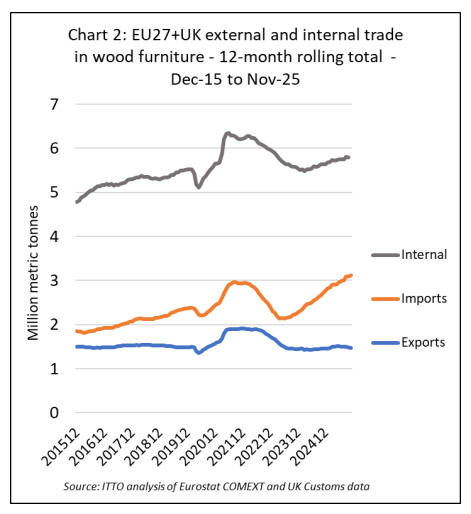
The latest Eurostat and UK trade data (Chart 2) shows that
European exports of wooden furniture to countries outside
the region, after rising and then falling rapidly between
2021 and 2022, remained stable between 2023 and 2025 at
an annualised level of just below 1.5 million tonnes.
In contrast, European imports of wooden furniture from
other parts of the world began to increase in the second
half of 2023, a trend maintained throughout 2024 and
2025.
Imports from outside the region in the 12 months ending
November 2025, at 3.1 million tonnes, exceeded those at
the height of the boom in European spending on furniture
in 2021 and early 2022 which occurred during and
immediately after the COVID pandemic.
Internal European trade in wooden furniture, which was
slowing in 2023 and the opening months of 2024, began to
rise in May 2024 and the gradual upward trend was
maintained throughout 2025.
This may reflect both the slow recovery in underlying
consumption in Europe and a continuing shift in
manufacturing locations within the region, particularly
into Poland and Lithuania and away from some traditional
manufacturing centres, such as in Germany, France and
the UK.
China drives rise in European furniture imports
Closer analysis of the data reveals that the recent growth
in wooden furniture imports into the EU27+UK has been
driven almost entirely by China. Imports into Europe from
China, after rising 5% in 2023, increased by more 35% to
1.68 million tonnes in 2024 and were up 19% to 1.81
million tonnes in the first eleven months of 2025 (Chart 3).
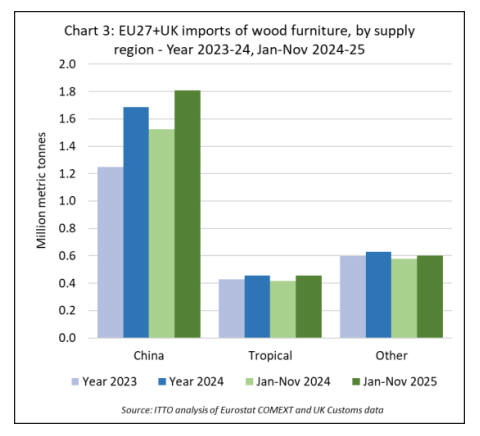
EU27+UK wooden furniture imports from tropical
countries, after falling by 23% in 2023, were up 6% to
454,000 tonnes in 2024. The pace of tropical wooden
furniture imports picked up in 2025, rising 9% to 456,000
tonnes in the January to November period last year.
Imports from all other countries (mainly non-EU European
countries and Turkey), after decreasing 8% to 600,000
tonnes in 2023, rebounded by 5% to 630,000 tonnes in
2024 and had already reached 600,000 tonnes by the end
of November in 2025, 4% more than the same period in
2024.
Wooden furniture imports from China have increased both
into the UK, the largest single wooden furniture importing
country in Europe, and into most EU countries (Chart 4).
UK imports from China increased 17% to 488,200 tonnes
in 2024 and were up another 24% to 542,600 tonnes in the
first eleven months of 2025.
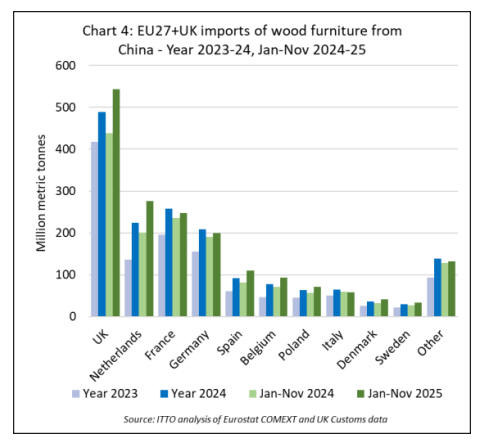
EU imports of wooden furniture from China increased
44% to 1,196,400 tonnes in 2024 and increased another
17% to 1,264,300 tonnes during the January to November
period last year.
Imports of wooden furniture from China have risen into
nearly all EU countries, but the gains have been
particularly dramatic in the Netherlands, Spain and
Belgium where they increased by more than 50% in 2024
and gained more than 30% in the first eleven months of
2025.
Vietnam more prominent in European furniture imports
Following a steep decline in 2023, European imports of
wooden furniture from the three largest tropical supplying
countries, Vietnam, Malaysia and India recovered some
lost ground in 2024. In 2025, European imports from
Vietnam accelerated,but slowed from India and declined
slightly from Malaysia (Chart 5).
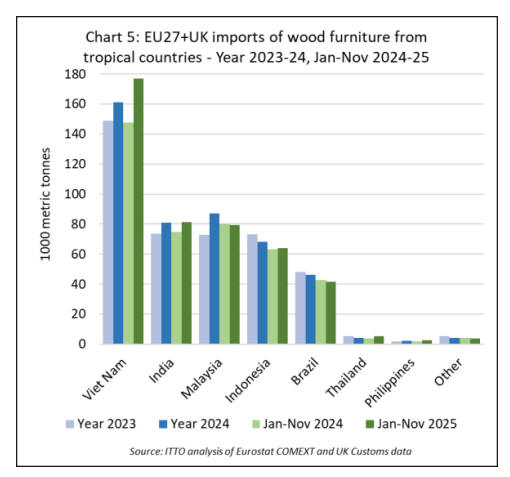
After 11 months in 2025, EU27+UK imports were up 20%
to 177,000 tonnes from Vietnam, up 9% from India to
81,000 tonnes, but down 1% from Malaysia to 79,000
tonnes.
European imports of wooden furniture from Indonesia,
after declining 7% in 2024, made some slight gains in the
first eleven months of 2025, up 2% to 64,000 tonnes.
However, imports from Brazil fell 3% to 42,000 tonnes
during the January to November period last year following
a 5% fall in 2024.
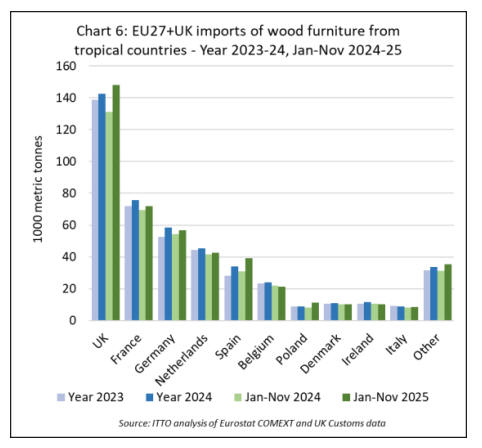
After most European destinations for tropical wooden
furniture recorded a large downturn in 2023, there was a
recovery in all the main markets in 2024 and 2025 (Chart
5 above).
During the first eleven months of 2025, imports of tropical
wooden furniture increased in the UK (+13% to 147,900
tonnes), France (+3% to 71,800 tonnes), Germany (+4% to
56,700 tonnes), Netherlands (+2% to 42,500 tonnes), and
Spain (+27% to 39,300 tonnes).
Imports into smaller European import markets were more
variable, declining to Belgium (-3% to 21,400 tonnes) and
Ireland (-1% to 10,400 tonnes), but rising to Poland (+36%
to 11,200 tonnes), Denmark (+2% to 10,400 tonnes), and
Italy (+5% to 8,700 tonnes).
Projected 3% decline in global wooden furniture trade
in 2025
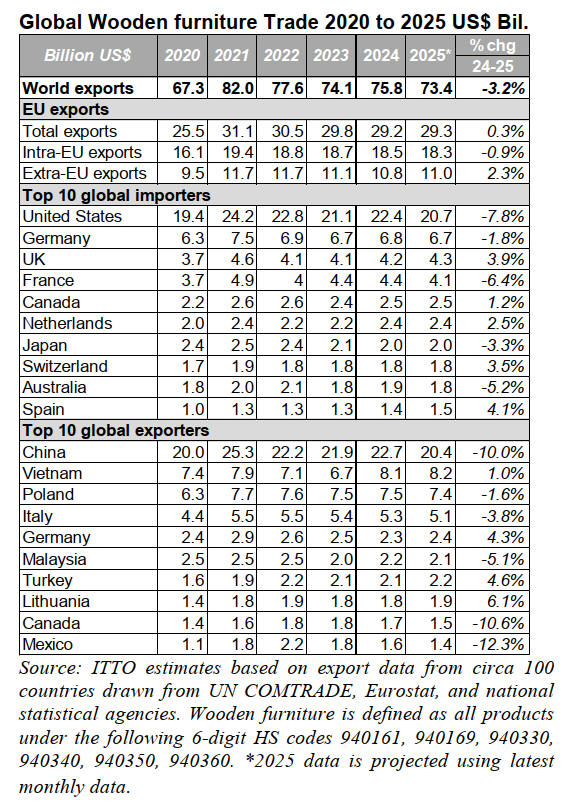
Preliminary assessment of trade data suggests that the total
value of global trade in wooden furniture declined by
around 3% last year to US$73.4 billion. This followed a
2% rise the previous year. 2025 represented a reversal
compared to the previous year in more ways than one.
In 2024, while there was robust growth in the global
wooden furniture trade, the overall level of trade was
dragged down by a downturn in the EU. In 2025, EU trade
held up reasonably well, but there was a dramatic
downturn in trade flows elsewhere in the world driven
mainly by political events in the United States.
In 2025, it is projected that US imports of wooden
furniture fell by nearly 8% to US$20.7 billion. China,
Canada and Mexico were hit particularly hard on the
export side, all key targets of the Trump Administration’s
tariff policy during the year. Projected wooden furniture
exports from China declined 10% to US$20.4 billion last
year, exports from Canada were down 11% to U$1.5
billion and exports from Mexico were down 12% to
US$1.4 billion.
There were mixed fortunes for the leading tropical
exporters of wooden furniture last year. Vietnam’s
wooden furniture exports rode the tariff storm reasonably
well last year, projected to have increased by 1% to
US$8.2 billion.
However, projected exports from Malaysia were down
5% to US$2.1 billion, while exports from Indonesia were
down 6% to US$1.4 billion, exports from India were down
8% to US$810 million, and exports from Brazil were
down 0.5% to US$650 million.
Global furniture trade trends identified in CSIL
association survey
While a 3% downturn in global wooden furniture trade last
year is a setback for a sector that had just begun to recover
from the volatility of the pandemic years, there is some
consolation in the fact that trade did not decline further. As
noted by CSIL in World Furniture Online
(www.worldfurnitureonline.com), the tariff shock turned
out to be smaller than initially expected during 2025.
Households and businesses front-loaded consumption and
investment in anticipation of higher tariffs, giving a
temporary boost to global activity early in the year. Trade
flows began to reroute toward third countries during 2025.
Nevertheless, CSIL note that prospects for 2026 remain
uncertain in the absence of clear and durable agreements
among trading partners. To gain additional insights into
emerging industry dynamics at a global level, CSIL
undertook a survey of furniture sector associations in 2025
with the following conclusions:
A large majority (73%) of surveyed associations
agreed that “leveraging digital tools for
marketing, sales and trade facilitation” is a key
opportunity.
63% identified “developing niche or high-value
products to meet international demand” as
another key opportunity.
Associations identified lower export volumes and
declining price competitiveness as the key
challenges in 2025.
South America and Africa, as export destinations,
were identified as exceptions. Reduced exports to
these regions were less of a concern, although
rising export costs were noted.
Tariffs introduced in 2025 primarily affected
trade with the US, although broader uncertainty
impacted nearly all regions.
To cope with this uncertainty, 65% of
respondents reported that member companies are
exploring new or emerging markets, particularly
in the Middle East, Africa, South America, and
India.
Looking ahead to 2026, respondents expect tariffs
to continue to rise in the United States, and more
non-tariff barriers to be introduced in both North
America and Europe.
Non-tariff barriers are seen by respondents as a
particularly pressing concern by respondents.
Reflecting this, 57% of respondents flagged
“higher compliance costs” as an extremely
relevant challenge.
Despite these hurdles, several positive factors
were identified as potentially supporting export
performance in 2026. New and ongoing trade
agreements, such as the EU-Mercosur deal,
Vietnam’s FTAs and others, could open new
markets and improve conditions.
Finally, growing global demand for sustainable
and certified products is seen as a positive trend,
encouraging eco-friendly and innovative
furniture.
|


