US Dollar Exchange Rates of
25th
January
2026
China Yuan 6.95
Report from China
Decline in both volume and value of imported logs in
2025
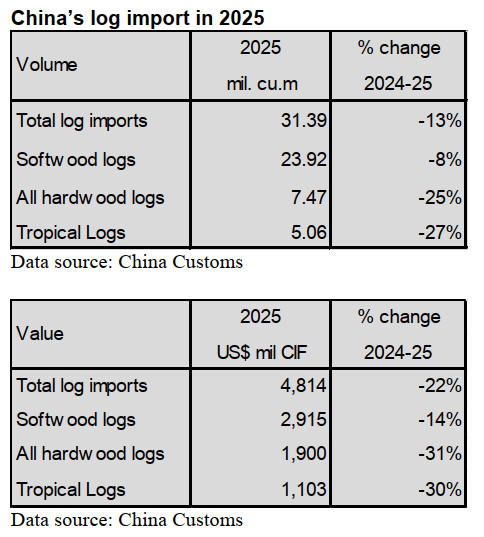
According to China Customs, log imports in 2025 totalled
31.39 million cubic metres valued at US$4.814 billion, a
large decline of 13% in volume and 22% in value year on
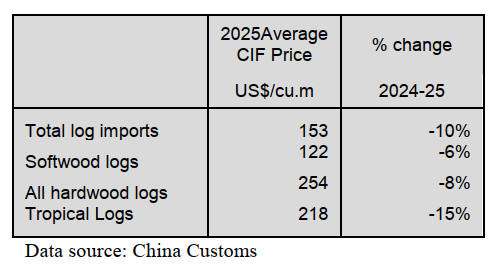
year. The average price for imported logs was US$153
(CIF) per cubic metre, down 10% on 2024 levels.
Of total log imports in 2025 softwood log imports fell 8%
to 23.92 million cubic metres, accounting for 76% of the
national total, up 4 percentage points from 2024 level. The
average price for imported softwood logs was US$122
(CIF) per cubic metre, down 6% on 2024 level.
Hardwood log imports in 2025 fell 25% to 7.47 million
cubic metres (24% of the national total log imports).
The average price for imported hardwood logs in 2025
was US$254 (CIF) per cubic metre, down 8% on 2024.
Of total hardwood log imports, tropical log imports were
5.06 million cubic metres valued at US$1.103 billion,
down 27% in volume and down 30% in value from 2024
and accounted for 16% of the national total import volume
in 2025. The average price for tropical log imports in 2025
was US$218 (CIF) per cubic metre, down 15% on the
2024 level.
Radiata pine was the largest imported log species in terms
of volume in 2025. China’s radiata pine log imports rose
2% to 17.45 million cubic metre, accounting for 56% of
the national total log imports in 2025.
Over 90% of species in China’s imported logs are Radiata
pine, Spruce and fir, Douglas fir, Oak, Birch, Mongolia
Scots pine and Korean pine in 2025.
The volume of Spruce and fir, Douglas fir, Oak, Birch,
Mongolia Scots and Korean pine decreased 44%, 16%,
37%, 17%, 16%, 4%, 16% and 50% respectively year on
year in 2025.
The large decrease in China’s log imports was affected
that the global log supply chain experienced a severe
shock.
The uncertainty of international trade soared, with
geopolitical conflicts, repeated adjustments of tariffs and
weak demand in China combined with policy adjustments
and supply chain restructurings in some log-exporting
countries in 2025.
Domestic demand for logs continued to shrink. The real
estate industry is still in a deep downward trend resulting
in a sharp decline in wood product consumption, long-
term low prices of log spot markets, compressed profit
margins in the timber industry and low willingness of
timber traders to replenish inventories.
Rise in log imports from New Zealand
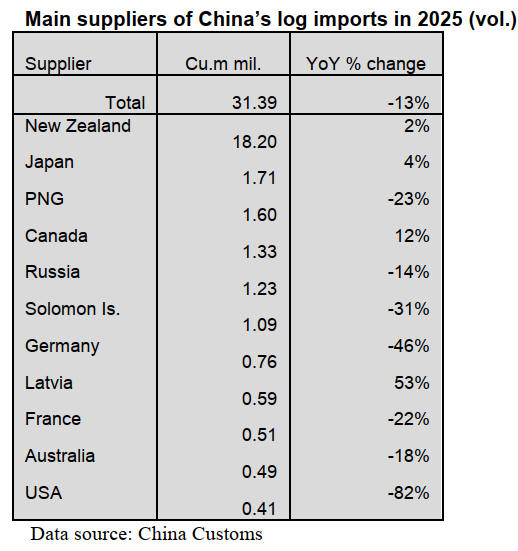
Despite a significant decrease in the total volume of
imported logs the volume of logs imported from New
Zealand increased by 2% year-on-year and the proportion
rose from 50% to 58% of the national total log imports in
2025.
China’s log imports from New Zealand totalled 18.20
million cubic metres in 2025, up 2% over the same period
of 2024.
In addition, China’s log imports from Japan, Canada and
Latvia rose 4%, 12% and 53% respectively in 2025. In
contrast, China’s log imports from the other main
suppliers fell sharply in 2025. Log exports from the US
saw the largest decline dropping 82% over 2024 levels.
The volume of logs imported from the US has
significantly decreased since China banned the import of
logs from the United States.
Instead, China has diversified its sources of log imports
and is now increasing the import of logs from other
countries, such as New Zealand, Japan, Canada and
Latvia. China’s log imports from all these countries grew
at different rates. China’s log imports from Latvia rose
53% year on year in 2025.
Decline in softwood log imports
According to China Customs, 2025 softwood log imports
fell 8% to 23.92 million cubic metres, accounting for 76%
of the national total, up 4 percentage points from 2024
level.
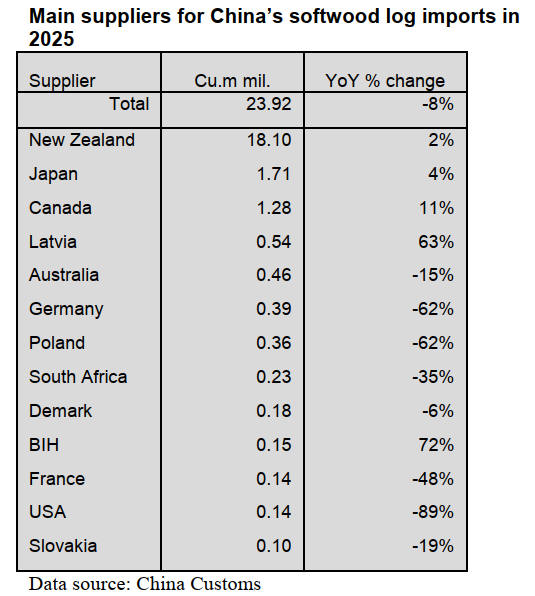
New Zealand, Japan, Canada, Latvia are the top four
countries in terms of China's imports of softwood logs and
China’s softwood imports from these countries rose 2%,
4%, 11% and 63% respectively resulting in increase in the
proportion of China’s softwood log imports.
This is the reason why the decline in the import volume of
softwood logs was smaller compared to the overall decline
in total log import volume. In addition, China’s softwood
log imports from Bosnia and Herzegovina (BIH) surged
72% year on year in 2025.
In contrast, China’s softwood log imports from the US fell
89% and from Germany and Poland both decreased 62%
year on year in 2025.
Hardwood log imports
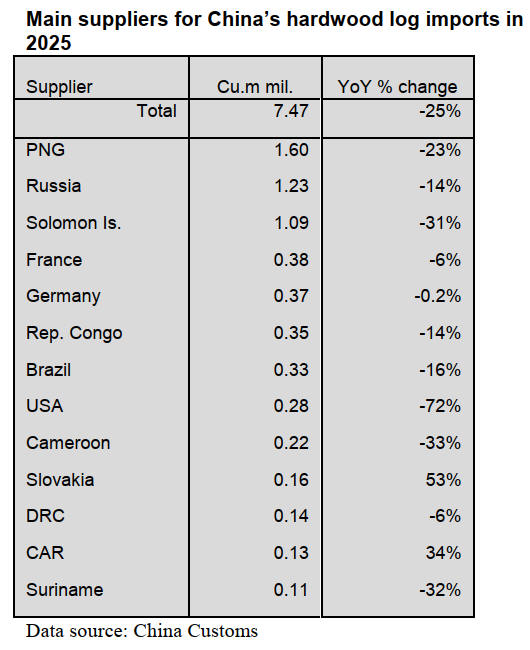
According to China Customs, China’s hardwood log
imports fell 25% to 7.47 million cubic metres in 2025.
This was because China’s imports from the top three
shipping countries, PNG, Russia and the Solomon Is.
dropped significantly by 23%, 14% and 31% respectively
compared to 2024 levels.
In addition, China’s hardwood log imports from the
Republic of Congo, Brazil, US, Cameroon and Suriname
fell 14%, 16%, 72%, 13% and 32% respectively year on
year. In contrast, China’s hardwood log imports from
Slovakia and the CAR rose 53% and 34% respectively on
2024 level.
Decline in tropical log imports
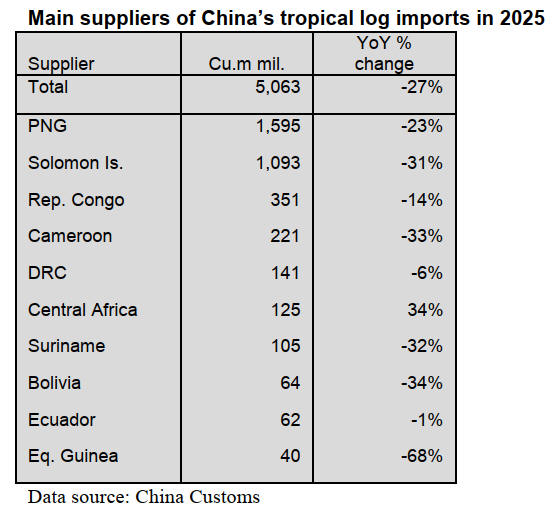
According to China’s Customs, tropical log imports
totalled 5.063 million cubic metres in 2025, down 27%
over 2024 levels.
PNG still was the largest supplier of tropical log imports
in 2025 but China’s tropical log imports from PNG fell
23% to 1.595 million cubic meter on 2024 level. This was
the main reason behind the overall decrease in the tropical
log imports in 2025.
Some time ago the PNG government declared that logging
permits would only be granted to companies that process a
portion of logs domestically. It is anticipated that China’s
tropical log imports will continue to decline.
The Solomon Islands was the second largest supplier of
China’s tropical log imports in 2025 but log imports from
Solomon Islands dropped 31% to 1.093 million cubic
metres year on year. China’s tropical log imports from the
other main suppliers fell at different rates in 2025.
The main reason for the decrease in China’s tropical log
imports was because, internationally, the countries that
supply tropical timber have successively implemented
policies to prohibit or reduce the export of tropical logs.
Another reason is that the real estate and construction
industries in China have been experiencing sluggish
growth in recent years.
Additionally, as the awareness of protecting tropical
forests among Chinese people has increased, the domestic
demand for tropical timber in China has been decreasing
year by year.
GGSC report, December 2025
On 18 December China's Hainan Free Trade Port officially
launched island-wide special customs operations.
Following the implementation, the range of goods exempt
from import tariffs has expanded from 1,900 tariff lines to
approximately 6,600, covering 74% of all tariff lines and
nearly all timber raw materials.
While "zero-tariff" goods entering Chinese mainland from
Hainan are subject to relevant import duty payments,
goods processed in Hainan with a value-added rate of 30%
or higher are exempt from such taxes.
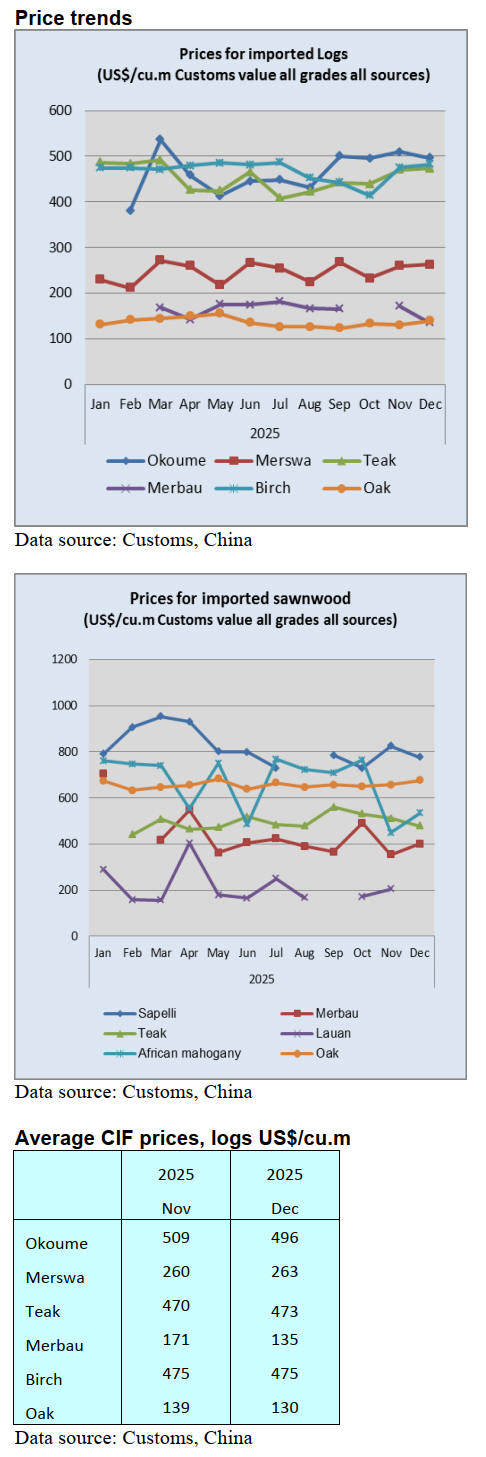
In November 2025, China’s total import value of logs and
sawnwood reached US$914 million, marking a 1.9% year-
on-year increase, with strong growth in imports from
Africa.
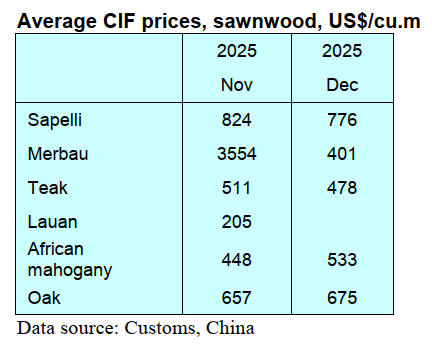
It is worth noting that import prices showed significant
fluctuations: the average unit price of log imports fell by
10.1% year-on-year, while that of sawnwood rose by
12.1%, indicating a five-month consecutive increase.
From 22-23 December the Chinese government held the
National Housing and Urban-Rural Development Work
Conference, at which it emphasised efforts to stabilise the
real estate market and mentioned that the rising proportion
of second-hand housing transactions would be a trend in
the coming period.
In December 2025 the GTI-China index registered 49.9%,
an increase of 0.3 percentage point from the previous
month and below the critical value (50%) for the third
consecutive month indicating that the business prosperity
of the timber enterprises represented by the GTI-China
index shrank from the previous month.
In December the total production volume of Chinese
enterprises increased slightly and supported by domestic
demand, the total volume of new orders also experienced
slight growth.
As for the twelve sub-indices, five indices (production,
new orders, purchase quantity, import and delivery time)
were above the 50% critical value while the remaining
seven indices were all below the critical value.
Compared to the previous month the indices for
production, existing orders, inventory of finished products,
purchase quantity, import, inventory of raw materials and
delivery time increased by 1.4-8.6 percentage points,
whereas the indices for new orders, export orders,
purchase price, employees and market expectation
declined by 1.0-20.5 percentage point(s).
Enterprises main challenges in December; Enterprises
struggled with insufficient orders. the costs of raw
materials rose. demand in the timber market was not
enough and there was intense competition in terms of
product prices. They suggested: break through
homogenised competition. broaden financing channels.
need the government policy support for timber enterprises.
And expand international markets to increase the volume
of orders.
See: https://www.itto-
ggsc.org/static/upload/file/20260119/1768790612819116.pdf
|


