|
Report from
North America
Trade data rollout remains unpredictable
As US federal government agencies work to catch up on
releasing data held back during the 2025 government
shutdown some data reflecting the tropical timber trade is
now available while other data sources are yet to be
released.
For example, the US Census Bureau has not released a
monthly report on housing construction since its August
report released on 17 September. Nor has the Bureau yet
given any indication as to when it may resume issuing
reports.
Trade data reporting has been significantly more available
with the US Department of Agriculture recently releasing
both September and October data. While this period
coincides with the US issuing increased tariff rates for
upholstered furniture, kitchen cabinets and vanities the
numbers do not show any immediate correlations with the
tropical timber trade although imports were certainly more
volatile than normal during September and October.
This is in line with the overall US trade picture. Trade
patterns have whipsawed over the past year as supply
chains bend and flex around a blistering pace of policy
change. A year ago, as the US President was preparing to
take office on an economic agenda built largely around
tariffs the US trade deficit soared in part because domestic
companies raced to boost their inventories of foreign
goods before new duties arrived.
The latest data show the US trade deficit shrank
dramatically in October to its lowest level since 2009, an
unexpected twist in a year of volatile trade flows that have
been buffeted by the US administration’s steep tariffs.
See: https://www.msn.com/en-us/money/markets/us-trade-
deficit-unexpectedly-falls-to-lowest-level-since-2009/ar-
AA1TOLaS?ocid=hpmsn&cvid=695fd67a232c42c48aa4976f43f
dd236&ei=26
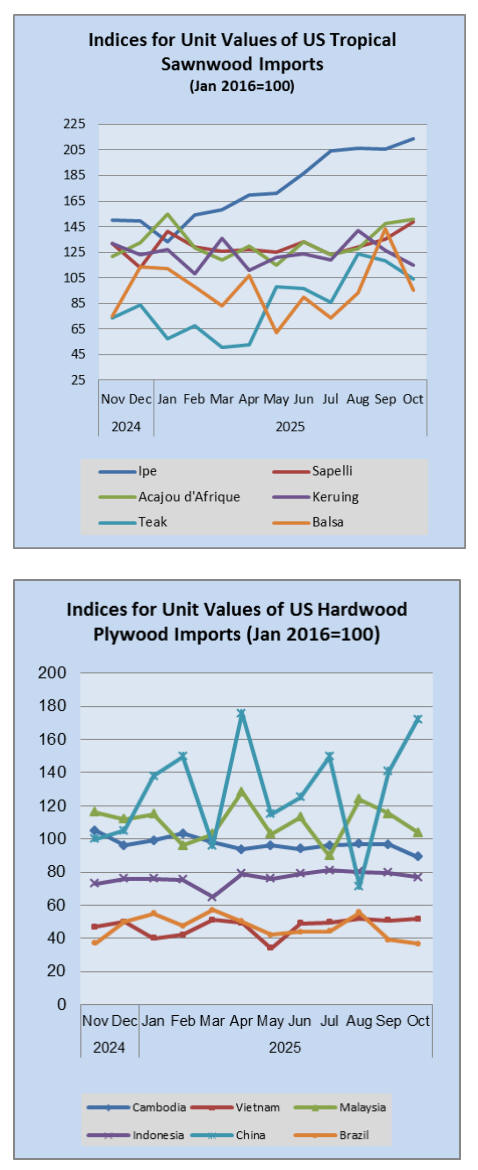
US imports of sawn tropical hardwood surge 25% in
October
US imports of sawn tropical hardwood surged 25% in
October after holding steady in September at an already
strong level. At 19,152 cubic metres this volume was 40%
higher than in October of 2024.
Imports from the top-trading partner Brazil increased by
50% while imports from Ecuador and Peru also made
healthy gains. Imports from Malaysia nearly doubled in
October. Total imports of sawn tropical hardwood were up
5% from October 2024.
In Canada, an 11% fall in October 2025 sawn tropical
hardwood imports followed two months of solid gains.
Imports showed an 18% increase in September following a
19% surge in August. Despite the October decline,
monthly imports were up 16% from the previous October.
Through October 2025 Canadian tropical hardwood
imports were down 1% from 2024.
US hardwood plywood imports jumped in September
US imports of hardwood plywood rose a healthy 6% in
September 2025 but cooled slightly in October, falling
2%. At 283,082 cubic metres, the October volume was
34% higher than in October 2024.
A 22% decrease in imports from top-supplier Vietnam
depressed October numbers as imports from nearly all
other top-suppliers rose. Imports from Russia recovered in
October after a steep September decline. Through October,
imports of hardwood plywood continued to greatly
outpace last year, rising 27% versus 2024.
See: https://apps.fas.usda.gov/gats/default.aspx
Veneer imports plunged, then recovered
US imports of tropical hardwood veneer made a near
complete recovery in October 2025, rising 95% to bounce
back from a plunge of 64% in September. Imports from
Cameroon, Italy and India which all fell more than 90% in
September, all returned in October to levels closer to their
average for the year.
While the month-to-month accounting has been volatile,
total imports of tropical hardwood veneer were up 14% in
2025 through October versus the previous year.
https://apps.fas.usda.gov/gats/default.aspx
See: https://apps.fas.usda.gov/gats/default.aspx
Moulding imports see another double-digit slide
US imports of hardwood mouldings fell more than 10%
for the second straight month in October 2025, decreasing
12% after a 13% dip in September. At US$13.1 million,
imports for the month were 11% lower than in October
2024.
Imports from Brazil fell 74% in September and another
55% in October to hit their lowest level in more than 10
years. Despite the drop, total imports were up 13% versus
2024 through October with year-to-date imports from
nearly all of the leading trading partners up more than
20%.
See: https://apps.fas.usda.gov/gats/default.aspx
Imports of hardwood flooring retreat
After a strong summer, US imports of hardwood flooring
retreated to a more normal level in autumn, falling 19% in
September 2025 but rising 6% in October. At US$6.1
million, October 2025 imports were 5% higher than in
October 2024.
Imports from Malaysia stayed well above 2024 levels,
rising 29% in October 2025 after a September dip. For the
year, imports from Malaysia are more than triple what
they were in 2024, while imports from all other leading
countries have fallen.
For example, imports from Brazil were down 44% up to
Octobe 2025 as imports fell to historically low levels in
September and October. Total imports of hardwood
flooring were down 4% through October 2025 versus
2024.
Imports of assembled flooring panels also stumbled,
falling 14% in October 2025 after a 2% September gain. A
9% October drop in imports from top-supplier, Cananda
and a 29% fall in imports from Indonesia spurred the loss.
Through October 2025, US imports of assembled flooring
panels were down 10% versus 2024.
See: https://apps.fas.usda.gov/gats/default.aspx
US wooden furniture imports continued to slump
US imports of wooden furniture continued to slump,
falling for a third consecutive month in October 2025. The
4% decrease in October follows month-to-month drops of
6% in September and August.
At US$1.44 billion, imports for October 2025 were 24%
below those of October 2024 and were below US$1.5
billion for the first time since March 2023.
Imports from Mexico rose 1% and imports from China
rose 7%, while imports declined from nearly every other
country. Total imports of wooden furniture were down 7%
versus 2024 through October 2025.
See:
https://usatrade.census.gov/data/Perspective60/Dim/dimen
sion.aspx
US delays scheduled tariff increases on furniture and
kitchen cabinets
Increased tariff rates for upholstered furniture, kitchen
cabinets and vanities have been delayed for a year
according to a White House directive.
The US was set to double its tariff rate on kitchen cabinets
and vanities produced outside the US to 50% starting1
January 2026. The import duty on upholstered furniture,
including sofas and armchairs, was set to rise to 30% from
25% on the first day of 2026.
According to the December White House announcement
the current 25% tariff on certain upholstered furniture,
kitchen cabinets and vanities, as imposed under the
September 2025 proclamation, will remain in effect.
While it welcomed the news that US tariffs would not be
raised the Canadian Kitchen Cabinet Association (CKCA)
called for the existing 25% tariffs to be removed entirely
and for coordinated action by both governments to restore
fair and balanced trade. “There is real relief across the
community of Canadian manufacturers and suppliers, but
relief is not resolution”, said Luke Elias, CKCA Vice-
President.
The CKCA also called on the Canadian government to
address the growing volume of imported kitchen cabinets
entering Canada at below fair market value which it says
has increased by 20% annually over the past five years.
See:
https://www.woodworkingnetwork.com/news/woodworking-
industry-news/trump-delays-scheduled-tariff-increases-furniture-
and-kitchen
and
https://www.whitehouse.gov/fact-sheets/2025/12/fact-sheet-
president-donald-j-trump-adjusts-imports-of-timber-lumber-and-
their-derivative-products-into-the-united-states/
US existing home sales edged up in November as
mortgage rates eased
US existing home sales increased a modest 0.5% in
November amid an easing in mortgage rates, but economic
uncertainty is keeping potential buyers on the sidelines. A
report from the National Association of Realtors on Friday
also showed the inventory of previously owned homes fell
from October to an eight-month low, limiting choices for
those looking to buy.
Though housing supply typically decreases heading into
winter, inventory growth has slowed on a year on year
basis, likely in response to sluggish demand. But limited
supply could prevent an outright decline in home prices.
Sales surged 4% in the Northeast, which accounts for a
small share of the housing market. They increased 1% in
the densely populated South, but fell 2% in the Midwest,
regarded as the most affordable region. Sales were
unchanged in the West.
Home sales declined 1% in November 2025 on a year on
year basis.
The interest rate on the popular 30-year fixed-rate
mortgage plunged from 7.04% in mid-January to 6.19% at
the end of November data from mortgage finance agency
Freddie Mac shows. It has, however, made no further
improvement since then.
See: https://www.nar.realtor/newsroom/nar-existing-home-sales-
report-shows-0-5-increase-in-november
and
https://www.reuters.com/world/us/us-existing-home-sales-
increase-moderately-november-2025-12-19/
|


