Japan
Wood Products Prices
Dollar Exchange Rates of 10th
January
2026
Japan Yen 158.46
Reports From Japan
Rising interest rates contribute to higher
debt-serving
costs
The government recently approved a record yen 122.3
trillion (approx. US$783 billion) budget that includes the
issuing of yen29.6 trillion worth of government bonds to
cover the revenue shortfall. The total is yen 7.1 trillion
more than the current fiscal year’s initial budget, which
was prepared by the previous goverment.
Government debt-related costs, covering both principal
redemption and interest payments, are yen 31.3 trillion, the
most ever. Higher interest rates have contributed to the
higher debt-serving costs. On the revenue side, the
government projects a record tax haul of yen83.7 trillion
as high inflation is expected to continue boosting
corporate earnings.
Government support for semiconductors and artificial
intelligence received a significant boost with the Ministry
of Economy, Trade and Industry nearly quadrupling its
commitment to companies and institutions active in the
manufacturing of relevant products and development of
relevant technologies.
See: https://www.nippon.com/en/japan-data/h02652/
and
https://www.japantimes.co.jp/business/2025/12/26/economy/taka
ichi-2026-budget/
Inflation eases slightly
The rate of inflation in Tokyo (taken as a baseline for the
entire country) has slowed more than expected as
pressures from food and energy prices faded triggering
yen weakness on forecasts the Bank of Japan (BoJ) may
delay the timing of its next interest rate increase.
Consumer prices (excluding fresh food) rose 2.3% in
December from a year earlier, slowing from 2.8% in the
previous month according to the Ministry of Internal
Affairs and Communications. The overall inflation gauge
also slowed sharply to 2% from 2.7% in the same period
last year.
The yen weakened to a low of almost 157 per US dollar
after the inflation report was released.
See: https://x.com/japantimes/status/2004388075552506242
2026, the year of the ‘Fire Horse’ - symbol of
transformation and inflection
In its 2026 Japan Economic Outlook ‘Steady
Fundamentals, Policy Risks Ahead’,Goldman Sachs
explores prospects for the Japanese economy. Steady
growth is forecast to continue in 2026 led by domestic
demand. We expect the Japanese economy to continue its
steady growth and expand 0.8% in 2026.
The report says “while external demand is expected to
decelerate slightly due to factors such as Japan-China
diplomatic tensions, we expect solid consumption and
capex, supported by the structural shift to a labour
shortage economy with continued high wage growth”.
Future growth will depend on interest rates developments.
Last month the Bank of Japan (BoJ) raised its policy rate
to around 0.75%, the highest level in 30 years.
2026 is the rare Year of the Fire Horse in the Chinese
zodiac and BoJ Governor Ueda Kazuo referred to the Fire
Horse symbol of transformation and inflection points. He
noted that wages and prices are likely to continue to rise
gradually and he confirmed the BoJ would consider
further rate hikes if needed.
"We will continue to raise the interest rate and adjust the
degree of monetary easing, depending on whether the
economy improves or not," Ueda said.
See:
https://www.gspublishing.com/content/research/en/reports/2026/
01/06/eefdf592-d197-40da-a74b-dd316dbea9ee.html
and
See: https://www3.nhk.or.jp/nhkworld/en/news/backstories/4516/
Lingering economic uncertainties despite government
efforts
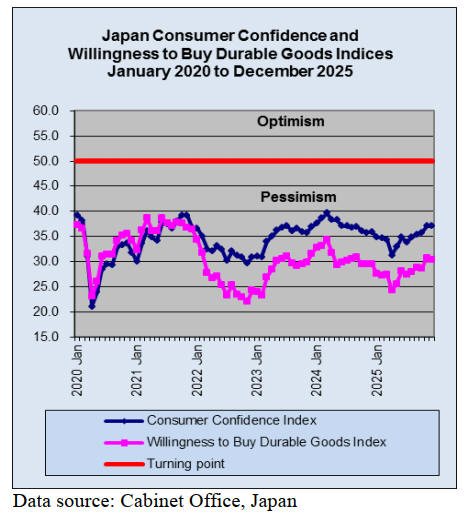
Japan's Consumer Confidence Index over the past decade
shows a general trend of fluctuation but staying below the
neutral 50 mark, reflecting lingering economic
uncertainties despite government efforts.
The index dipped significantly during COVID-19 (April
2020) but recovered, reaching multi-month highs in late
2025 before slightly pulling back indicating cautious
consumer sentiment driven by shifts in income,
employment and durable goods buying intentions. Since
mid 2025 there has been aun upward trend in the
confidence index and the index for willingness to buy
durable goods.
Yen close to historical lows at the end of 2025
Fitch Ratings expects the Japanese yen to appreciate
moderately in 2026, but for it to remain historically weak.
In contrast, strategists at JPMorgan Chase & Co., BNP
Paribas SA and other firms see the yen weakening to 160
per dollar or beyond by the end of 2026 driven by wide
US-Japan yield gaps, negative real rates and persistent
capital outflows.
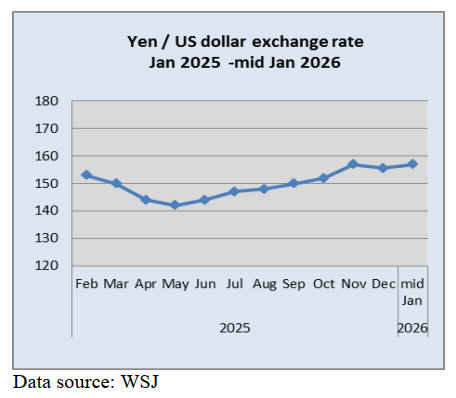
The yen was close to historical lows at the end of 2025
after a roller-coaster year. The yen appreciated in the first
four months of last year in common with other currencies
as the US dollar weakened but then it steadily depreciated
by about 13% from the middle of April to year-end.
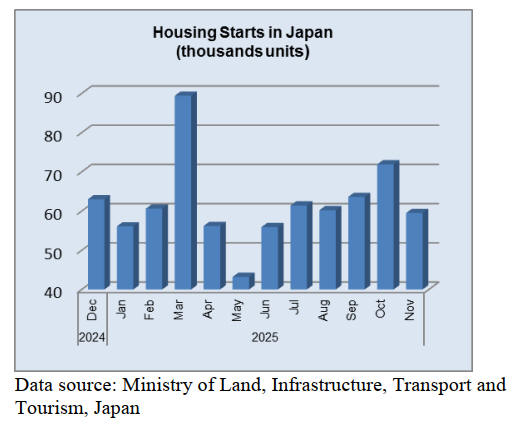
40% of wood demand is tied to construction
Japan's wood consumption is strongly and directly
influenced by housing starts as the residential housing
sector is the largest end-use market for lumber in the
country. Approximately 40-43% of the nation's wood
demand is tied to construction with about 80% of low-rise
residential buildings being wooden structures.
Japan is a construction timber-deficit country and requires
substantial imports to meet its domestic demand. North
America is the primary source for softwood logs and
sawnwood with Canada often holding the largest share
followed by the US. Fluctuations in domestic housing
starts, therefore, also influence the volume and origin of
imported wood products
Speculation continues to real estate drive prices
higher
For years, property prices in urban areas barely changed,
then in 2023 the market awoke as investment money
started pouring into the real estate sector. In many cases
buyers were quickly reselling for profit, a practice that
continues to drive prices higher and pushing house-hunters
toward the second hand homes. The Tokyo municipal
government has developed plans to secure affordable
homes for young people.
In a related article, The Mainichi says Tokyo's Chiyoda
Ward Government has requested the real estate industry to
prohibit the resale of properties for five years after
purchase.
The Kobe Municipal Government is considering imposing
a "vacancy tax" on owners of unoccupied residences, with
high-rise condominiums in mind. However, excessive
government intervention could disrupt market functions
and infringe on property owners' rights.
See: https://www3.nhk.or.jp/nhkworld/en/shows/4002990/
and
https://mainichi.jp/english/articles/20250922/p2a/00m/0op/00700
0c
Wooden furniture imports
Online shopping now accounts for nearly a third of interior
Household item sales, a major shift in purchasing
behavior. To remain competitive manufacturers are adding
features like wireless chargers and focusing on multi-
functional pieces, especially for indoor use.
The weak yen continues to raise import costs pressuring
smaller manufacturers and leading to interest in domestic
wood substitution.

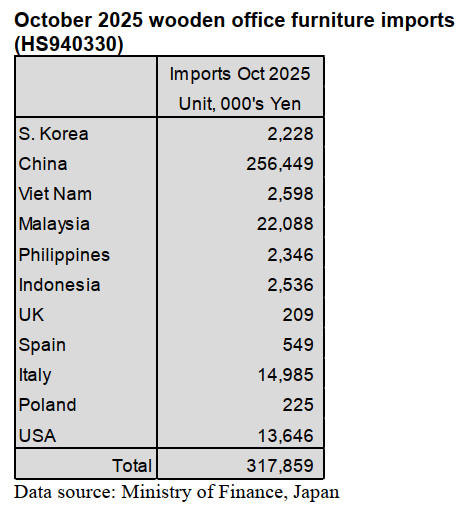
October 2025 wooden office furniture imports
(HS940330)
In October three suppliers accounted for over 90% of
imports of wooden office furniture: China (81%),
Malaysia (7%) and Italy (5%). October shipments of
HS940330 from Malaysia were up significantly compared
to the value shipped in September and Malaysia took the
second spot in terms of value. The other significant source
of wooden office furniture in October was the US.
Year on year, the value of Japan’s imports of wooden
office furniture (HS940330) in October rose around 10%
and compared to the value of September arrivals there was
an over 50% increase in the value of arrivals.
October 2025 wooden kitchen furniture imports
(HS940340)
As in previous months the value of October imports of
wooden kitchen furniture (HS940340) were dominated by
shippers in the Philippines (55% of imports) and Viet Nam
(29% of imports). The value of October imports from both
the Philippines and Viet Nam extended the recovery from
the August downturn with the value of imports for each
supplier rising around 20%.
The value of September arrivals of HS940340 from China
(5% of the total) was around the same level as in
September.
Year on year, the value of October wooden kitchen
furniture imports were little changed from a month earlier
but compared to the value of September arrivals there was
a 13% rise in October.

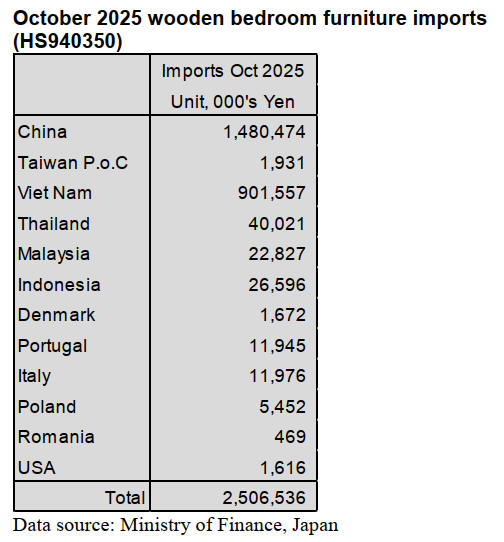
October 2025 wooden bedroom furniture imports
(HS940350)
After the volatile trend in the value of imports in the early
part of 2025, imports steadied in the third quarter of 2025.
September saw a slight dip in the value of imports
compare to a month earlier but this was reversed in
October as the value of imports rose.
The top two shippers of HS940350 to Japan in October
remained China, 59% (63% in September) and Viet Nam
36% (29% in September).
The other top source of October imports of wooden
bedroom furniture was Thailand (2% of the total for
HS940350). Italy was a major supplier in September but in
October the value of imports dropped, at the same time the
value of imports from Portugal rose significantly.
Year on year there was a decline in the value of October
imports but compared to a month earlier October 2025
imports rose slightly.
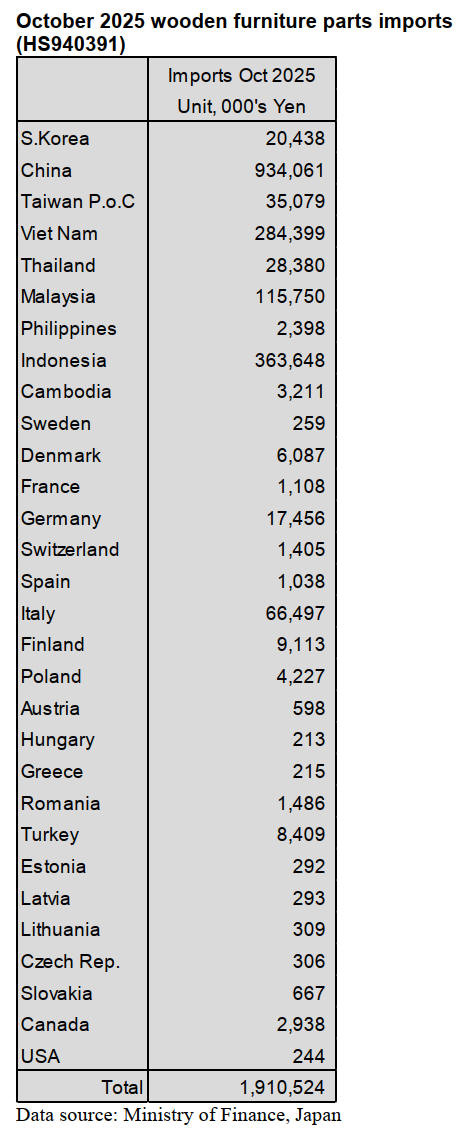
October 2025 wooden furniture parts imports (HS
940391)
The value of wooden furniture parts imported into Japan
up to October 2025 remained remarkably consistent except
for the peak in January. As in previous months shippers in
China and Indonesia dominated October imports with Viet
Nam contributing just 15% of the value of October
arrivals.
Of the total value of HS940391 imports in October 49%
was delivered from China (47% in September), 19% from
Indonesia (21% in September) and 15% from Viet Nam
(14% in September). Malaysia, once again, secured a 6%
share of the value of October imports.
Of the value of Imports of HS940391 from shippers
in
Europe (6% of the October total) more than half was from
Italy.
Year on year the value of October imports of HS940391
was down around 6% and there was an 8% decline in
value compared to September.
Trade news from the Japan Lumber Reports (JLR)
The Japan Lumber Reports (JLR), a subscription trade
journal published every two weeks in English, is
generously allowing the ITTO Tropical Timber Market
Report to reproduce news on the Japanese market
precisely as it appears in the JLR. For the JLR report
please see: https://jfpj.jp/japan_lumber_reports/
Yamaha teams up with Indian sawmill
Yamaha Corporation has signed a cooperation agreement
with Overseas Traders, an Indian sawmilling company
supplying Indian rosewood, to promote sustainable forest
conservation and management of the species.
Over the next three years, Yamaha will work with local
research institutes and government agencies on initiatives
such as rosewood reforestation and studies on material
utilization efficiency for acoustic and electric guitars,
aiming to develop a sustainable forest conservation model.
Indian rosewood, used for the sides and backs of guitars, is
mainly harvested from state-owned forests in southern
India, but the lack of natural regeneration within these
forests has become a pressing issue.
Responding to rising inventories, higher costs, and weak
prices
The Södra Group has decided to temporarily reduce
production by 20% at its Värö and Mönsterås mills by the
end of the year.
The company has already implemented production
adjustments this year, including temporary suspensions,
but as inventories at several mills currently exceed
planned levels and the imbalance of rising production
costs—such as higher log prices—not being passed on to
product prices persists, it will carry out production cuts in
response.
The company operates six sawmills in Sweden and one in
Finland, a total of seven, making it a major supplier in
Northern Europe. It is a major supplier of whitewood 2x4
lumber to the Japanese market.
Of the two mills where a 20% production cut has been
decided, the Värö mill has obtained JAS certification and
handles supply to Japan.
In its second quarter results this year, the company
reported that its performance deteriorated due to sharp
exchange rate fluctuations, geopolitical risks, and
persistently high raw material prices.
To strengthen its long-term position, the company has also
begun implementing competitiveness measures based on a
reduction of 200 employees across both operational and
administrative divisions.
South Sea logs and products
Due to rising prices and higher labor costs, there is no
room for price reductions in tropical hardwood products;
on the contrary, some items are even seeing moves to
explore price increases.
Producers are inclined to pursue more active sales as
market conditions outside Japan have also deteriorated.
However, with various production costs rising or
remaining high, significant price reductions are extremely
difficult.
Moreover, in the case of shipments to Japan, the continued
depreciation of the yen could force substantial price cuts in
order to align with local market levels.
Given these difficulties, sellers have no choice but to
proceed cautiously. In the domestic market, with no
prospect of the yen’s weakness being resolved in the short
term, expectations for price cuts from producers are
fading, and buyers are limiting procurement to the
minimum necessary for immediate work. As for tropical
hardwood logs, major arrivals were largely completed by
October, and demand has been covered through around
March of the new year.
North American logs
Concerns have been raised that rising domestic log prices
in the U.S. may push up prices for Japan as well, but the
December shipment price of U.S. Douglas fir logs bound
for Japan was settled at around USD 970 per 1,000 board
feet (FAS, Scribner scale) for IS-grade.
Import costs are about ¥2,000 higher than the previous
month, and ocean freight rates are rising toward the year-
end. The Japan-bound price of Canadian logs is USD
1,260 per 1,000 board feet (C&F, Scribner scale) for
Douglas fir IS-grade, and USD 1,300 per 1,000 board feet
(C&F, Scribner
scale) for SS-grade. Canadian hemlock logs are priced at
around USD 1,100 (C&F, per 1,000 board feet, Scribner
scale), about USD 50 higher than those from Alaska, but
still considered inexpensive for the Asian market.
|


