|
1.
CENTRAL AND WEST AFRICA
Cameroon – reports of a tax incentive in its 2026
finance law to encourage SFM
The Cameroon timber sector differs significantly from that
in Gabon experience. The country is considered by
operators to be expensive to operate in but benefits from a
high population and a workforce that is inventive,
motivated and willing to work.
Several companies operate extremely large forest areas,
ranging from 200- 600,000 hectares, a scale that would be
impossible in Gabon, where the legal maximum per UFA
is 200,000 hectares.
Cameroon has introduced a tax incentive in its 2026
finance law to encourage sustainable forest management
aimed at reducing illegal activities. As of 1 January 2026 a
reduction of between 25% and 35% will apply to the
annual forestry fee paid to the State by logging companies
Finance Minister, Louis Paul Motazé, said in a circular on
budget execution.
Prices for most timbers in Cameroon are rising. For Azobé
strict cutting limits are in place. Thickness is restricted to
15 cm while production of 20 cm thickness requires
special authorisation. However, unusually large
dimensions of Afzelia (40 × 40 cm and 50 × 50 cm) were
observed for export to Vietnam. This was explained
locally as a “special species only for Vietnam.”
Vietnam became the second-largest market for Cameroon
timbers after China. From 2016 to 2019 Cameroon logs
accounted for about 25% of Vietnam’s tropical log
imports according to a recent article.
See: https://www.ecofinagency.com/news-agriculture/1001-
51822-cameroon-cuts-forestry-taxes-to-promote-sustainable-
logging
Over recent weeks no rainfall was recorded. According to
local foresters rainfall levels were lower than last year
with heavy but short and late rains. Cameroon is now
entering its six-month dry season which should improve
forest access and transport conditions.
A major operational limitation remains the trucking
regulation that restricts log trucks to a maximum of 25
cu.m per load. As a result, trucks often carry only two or
three logs per journey, increasing transport costs and
reducing efficiency.
Gabon – reports suggest export duties raised
2026 began with several major focus area’s affecting
forestry operations and exports. These include the
introduction of EUTR compliance, carbon regulations, log
bans, and new CITES measures. In addition, the Finance
Law 2026 has now been passed and introduces higher
customs export duties for transformed timber products.
Unconfirmed reports suggest export duties effective 1
January 2026 are as follows: First transformation products
such as sawn timber and peeled veneer are taxed at 15%
(previously 7.5%). Second transformation products such
as plywood and kiln-dried timber are taxed at 10%
(previously 5%). Third transformation products such as
furniture and finished goods remain taxed at 3.5%.
These increases come at a time when international markets
are weak, placing strong pressure on margins and pricing.
No major policy or operational challenges have been
reported, however, heavy rains continue in eastern Gabon
causing delays in trucking operations to Libreville Port
(Owendo). These weather-related disruptions remain the
main logistical constraint for timber transport.
The domestic media has reported Gabon’s President Brice
Clotaire Nguema has announced the establishment of a
new government line up. The Minister of Water and
Forests, Environment and Climate, in charge of Human-
Wildlife Conflict is Maurice Allogho Ntossui.
See: https://www.ecofinagency.com/news/0301-51747-gabon-
unveils-new-government-cabinet-expands-to-31-members
Upcountry areas continue to experience light rainfall.
Harvesting remains at a low level due to weak market
demand in Asia and Europe. The main harvested species
continue to be Okoume, Okan, Azobé and redwoods.
Transport remains affected by the previous rainy period,
particularly in the south and east of the country where
trucking times can still reach two to three days. However,
road conditions are improving steadily due to ongoing
rehabilitation works.
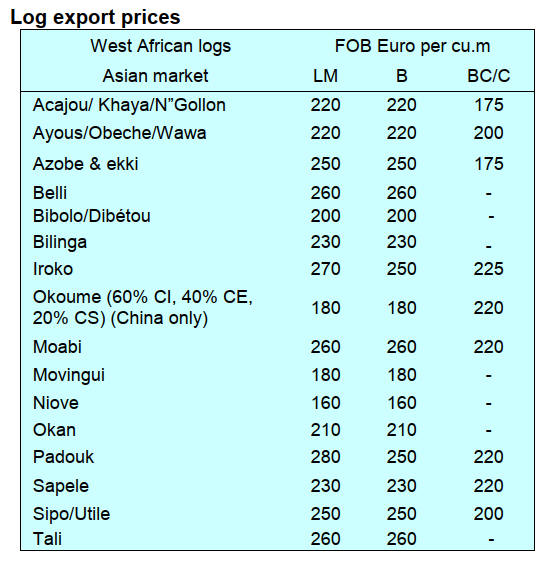
Log supply and industrial operations
The GSEZ log park in the Nkok Special Economic Zone
has been rebuilding Okoume stocks following the
conclusion of investigations by the government Task
Force. Current log stocks at GSEZ are estimated at
approximately 3,000 cu.m, consisting mainly of Bosse,
Sapelli, Padouk, some Azobé and Okan and limited
volumes of Okoume.
Peeling mills in Nkok are currently operating one shift.
India and China remain steady buyers although overall,
Chinese demand for Gabonese sawnwood remains very
weak.
Road rehabilitation is progressing under a four-year
government programme covering 3,000 km of concrete
and tarmac roads, financed by the Islamic Bank and the
African Development Bank (BAD). Central regions
including Lastourville, Lopé, Makokou, Okondja and
Makoukou are now benefiting from improved all-weather
laterite roads. Transport time from Makokou and Okondja
to Owendo Port has been reduced to one to two days.
A second railway corridor is again under study linking the
Belinga mining site to the planned Mayumba deep-water
port. This project is being reactivated under joint
Chinese/Australian management.
A further iron and manganese port between Port-Gentil
and Mayumba is also under study.
Port operations in Owendo remain stable. Container
availability is sufficient. Ships are waiting a few days
before berthing but port operations are otherwise
functioning normally.
Electricity supply remains unstable. Power cuts continued
into the New Year with multiple outages per day.
Although additional Turkish power ships are planned
reliability remains a major concern for industrial
operators.
Market demand and trade flows
China remains the weakest market for Gabonese sawmills.
Philippines demand is said to be declining. Vietnam
remains strong for Tali, Padouk and Niove. The Middle
East market is improving as Brazilian softwood prices
have started to increase.
Brazil remains Gabon’s main competitive threat at present.
A large automated sawmill in Brazil is producing
approximately 5,000 cu.m of sawn pine with only 40
employees and offering prices around €210–220 per cu.m
CIF Middle East. This pricing has severely impacted
Okoume demand. However, recent information suggests
Brazilian prices are now rising.
European demand remains weak with orders limited to
supply-on-demand due to high stock levels.
Republic of the Congo
Rainfall has declined across the country allowing
harvesting activities to continue under more stable
conditions. However, production remains below capacity
due to weak international markets.
The main commercial species remain Sapelli, Ayous,
Iroko, Padouk, Azobé and Okoumé in the northern
regions. Harvesting activity has slowed due to weak
Chinese demand. Sawmills are increasingly turning toward
European markets creating a risk of oversupply similar to
the situation previously experienced with Padouk.
The Philippines has reduced demand for Okoumé while
Vietnam remains active for Tali, Padouk and Niové.
Demand in Middle East countries for Okoumé sawnwood
remains weak. European demand is limited with operators
cautious about oversupplying red species.
The Republic of the Congo is a large and logistically
complex country. For many northern operators transport to
Douala Port in Cameroon is preferred over Pointe-Noire in
the south, which is approximately 1,400 km away.
Transport from northern Congo and the Central African
Republic to Douala continues to face challenges due to the
lack of surfaced roads over the 1,200 km route from
Bangui to Douala.
Conditions in the Likouala region are improving,
supported by reduced rainfall and ongoing repairs to
laterite roads. Timber from this region is increasingly
shipped by container through Kribi Port in Cameroon
while logs continue to move through Douala.
Reports suggest sawmills currently hold log stocks
sufficient for approximately two to three months of
operation. However, production remains cautious due to
subdued demand and uncertainty in export markets.
Operators observe that the forestry administration remains
well organised and maintains strict control over forest
operations and exports. Congo continues to enforce CITES
regulations and applies EUTR requirements for exports to
Europe. Only southern Congo produces Okoumé, which is
largely absent in northern Congo and Cameroon. Northern
Congo production is dominated by Sapelli, Sipo and other
red species.
The Republic of the Congo enters 2026 with improving
weather conditions and stable forest operations but
production remains constrained by weak demand from
China and subdued European markets. Logistics remain
challenging due to long transport distances although
conditions are slowly improving in key production
regions.
2.
GHANA
Parliament bans mining in forest reserves
Parliament has reinstated a full ban on mining in forest
reserves as part of broad environmental reforms aimed at
safeguarding water resources, reversing deforestation and
strengthening protection against illegal mining.
The Environmental Protection (Mining in Forest Reserves)
Revocation Instrument 2025 which nullifies L.I. 2462 was
put before parliament by the Acting Minister for
Environment, Science and Technology and Minister for
Lands and Natural Resources in October 2025.
According to the Ministry of Environment, Science and
Technology (MEST) the repeal of the June 2022
Environmental Protection (Mining in Forest Reserves)
Regulations became law effective in December 2025 after
the mandatory 21-day constitutional period. The decision
marks a decisive shift in Ghana’s environmental policy
framework restoring blanket protection for forest reserves.
Environmental civil society organisations and public
interest groups, including A Rocha Ghana, OXFAM and
the Christian Council hailed the Government for the
revocation of Legislative Instrument (L.I.) 2462,
describing it as a major victory for forest protection and
environmental governance.
They argued that L.I 2462 undermined sustainable forest
management, contradicted the Forest Development Master
Plan (2016–2036) and conflicted with Ghana’s
international commitments under the Paris Agreement and
Convention on Biological Diversity.
While praising the move they criticised the long delay in
revoking the law which faced months of widespread
criticism and urged the Legislature to avoid politicising
the fight against galamsey. They also called on
government for a review of Act 703 to explicitly ban
mining in reserves.
Awula Serwaa of Eco Conscious Citizen stressed that
repealing the law alone is insufficient, urging government
to adequately resource the Forestry Commission to enforce
protection. Data shows that over 50 of the country’s 288
reserves came under mining pressure leaving 80%
vulnerable even after a 2025 amendment.
See: https://gna.org.gh/2025/12/ghana-revokes-controversial-
mining-law-paving-way-for-forest-conservation/
and
https://www.myjoyonline.com/csos-commend-govt-for-
revoking-l-i-2462-call-for-stronger-forest-protection-measures/
Primary products accounted for 66% of wood exports
ending October 2025
Ghana’s timber and wood product exports in November
2025 generated Eur7.03 million from a volume of 14,999
cu.m, reflecting declines of 25% in value and 27% in
volume compared with November 2024.
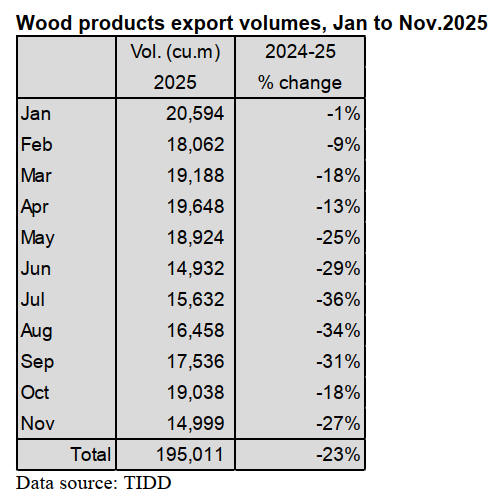
From January–November 2025 cumulative exports totalled
Eur89.39 million from 195,011 cu.m, marking declines of
21% in value and 23% in volume compared with the same
period in 2024. Despite reduced trade, the average unit
price rose slightly by around 2%, from €450 to €458 per
cu.m.
Primary products contributed 53% of the export value
while secondary and tertiary products accounted for 42%
and 5%, respectively. Asia remained Ghana’s largest
market (52%), followed by Europe (25%), Africa (10%),
America (10%) and the Middle East (3%) with Oceania
showing modest growth (0.1%).
The data showed that fifty-six exporters traded. Shipments
comprised 13 product types across 45 species reaching 36
countries and 82 buyers.
Top products were sawnwood (Air Dried/Kiln Dried),
Plywood (Overland/Overseas) and billets, with Teak,
Wawa, Denya, Cedrela and Ceiba as leading species.
India, Vietnam, USA, Germany and Togo were the main
market destinations for Ghana’s wood products.
According to the Indian High Commissioner, Manish
Gupta, bilateral trade between Ghana and India, which
includes wood products, has surpassed US$3 billion
annually with ambitions to double this within five years
under Ghana’s 24-Hour Economy Initiative.
Strengthening forest governance
The Forestry Commission (FC) has reinforced its
leadership in sustainable forest governance with the
signing of a new Memorandum of Understanding (MoU)
between the Governments of Ghana and the United
Kingdom.
The Agreement marks a significant milestone in deepening
collaboration on forest legality, climate resilience and
responsible forest management, reaffirming the
Commission’s central role in driving reforms that protect
forest resources while promoting sustainable trade and
livelihoods.
The event brought together the leadership of the Forestry
Commission (FC), representatives of the UK Government,
stakeholders from the private sector, civil society
organisations and development partners underscoring the
shared commitment of both countries to protecting forest
resources and promoting responsible forest-based trade.
The renewed UK support under the MoU, is aimed at
strengthening governance and enforcement and advancing
sustainable financing mechanisms, including the
exploration of payments for ecosystem services.
The Chief Executive of FC, Dr Hugh C.A. Brown,
highlighted the long-standing partnership between Ghana
and the United Kingdom which spans more than two
decades of collaboration in forest law enforcement,
governance and trade.
Christian Rogg, British High Commissioner to Ghana,
described the signing of the MoU as a significant
milestone in the evolving partnership between Ghana and
the United Kingdom.
See: https://mlnr.gov.gh/forestry-commission-strengthens-forest-
governance-through-renewed-uk-ghana-partnership/
Economic recovery gaining momentum
Ghana’s economic recovery gained momentum in late
2025 with the International Monetary Fund approving a
US$380 million disbursement under the Extended Credit
Facility, part of a US$3 billion bailout package. The
decision followed the Fifth Review of Ghana’s programme
performance and reflects progress in restoring stability and
investor confidence.
The country’s inflation dropped sharply to 5.4% in
December 2025, down from 24% a year earlier marking
twelve consecutive months of disinflation. The Ghana cedi
achieved a historic 32% appreciation against the US dollar
last year, its first annual gain in over three decades.
While fiscal discipline was reinforced by the early
settlement of a US$709 million Eurobond, bringing total
repayments to US$1.4 billion for the year. This reaffirms
Ghana’s credibility as a sovereign borrower and
underscores Government’s commitment to restoring
investor confidence through transparent, predictable and
disciplined debt-service practices.
In related news, the Bank of Ghana reduced its policy rate
to 18% urging banks to expand credit to SMEs to spur
economic growth. Looking ahead, the Governor of the
Bank of Ghana, Johnson Asiama, announced plans to roll
out a National Remittance Strategy and Remittance
Roadshow initiative with the Ministry of Finance in 2026
to boost foreign exchange inflows.
See: https://theheraldghana.com/imf-approves-380m-for-ghana-
after-latest-programme-review/
and
https://statsghana.gov.gh/gssmain/storage/img/marqueeupdater/D
ecember%202025CPI-Bulletin.pdf
and
https://www.mofep.gov.gh/news-and-events/2025-12-
31/%20government-of-ghana-settles-us709-million-eurobond-
obligation
3. MALAYSIA
Delayed tariff hike offers limited relief
The decision by the United States to delay higher tariffs on
selected furniture products offers limited relief to
Malaysian manufacturers amid rising domestic costs and
weak demand especially in the US, say exporters.
The US has postponed planned tariff increases on
upholstered furniture, kitchen cabinets and vanities,
keeping the current 25% rate in place. Tariffs on certain
upholstered wooden products were previously set to rise to
30% 1 January, while duties on kitchen cabinets and
vanities were due to increase to 50%.
In April last year, the United States announced sweeping -
tariffs on imports from nearly all countries around the
world, including Malaysia. Malaysian exports were
initially subjected to a 25% tariff but an Executive Order
signed by the US President in August 2025 reduced these
to 19%. However, new 25% tariffs which affected kitchen
cabinets and upholstered furniture were imposed in
September and took effect in October.
Malaysian Furniture Council president, Desmond Tan
Boon Hai, said the change does not significantly improve
Malaysia’s competitiveness as the same tariff rate was
imposed on many other countries. For some local
manufacturers, Tan said, the extension of the 25% tariff
would have only a modest impact as it mainly affects
kitchen cabinets, vanities and upholstered furniture.
Tan added the industry hopes the government can
renegotiate tariffs on Malaysian-made furniture with
Washington though such efforts ultimately depend on a
bilateral agreement. On domestic challenges he said the
government could provide more immediate support by
reviewing policies that have significantly raised operating
costs for furniture makers.
“These include the expansion of the sales and service tax
(SST), mandatory EPF contributions (a national retirement
fund) for foreign workers, minimum wage adjustments,
recalibrated petrol and electricity tariffs and the multi-tier
levy on foreign workers due to take effect this year,” he
said.
Tan warned that the multi-tier levy, introduced to
encourage the hiring of local workers by making foreign
labour more expensive may not achieve its intended
outcome. “The reality is that the industry may not be able
to afford the new levy while locals continue to shun jobs
in timber sector,” he said, warning that prolonged pressure
could put the wider furniture, timber and export industries
at risk. He urged the government to consider exemptions
from costly policies and provide fast-track financial
assistance to companies badly affected.
“These measures would give firms time to adjust,
including expanding their design offerings, improving
their manufacturing processes, and speeding up delivery
times to remain competitive globally,” he said.
Kuala Lumpur and Selangor Furniture Association
honorary president, Matthew Law, said weak US
consumer demand continues to impact the industry. “The
residential sector shows no improvement” he said.
See: https://www.thestar.com.my/news/nation/2026/01/03/little-
joy-for-local-furniture-players
Sabah Guidelines for plantations
The Sabah Forestry Department has released three new
publications aimed at enhancing forest plantation
development and strengthening the management of tree
genetic resources in the State. The publications are titled
‘Guidelines for Selecting Candidate Plus Trees (CPT) for
Forest Plantation Species’,’ Photo Collection of Candidate
Plus Trees (CPT) of Local Forest Plantation Species in
Sabah’ and ‘Photo Collection of Candidate Plus Trees
(CPT) of Exotic Forest Plantation Species in Sabah’.
Chief Conservator of Forests, Frederick Kugan, said the
forest plantation industry remains an essential pillar of
Sabah’s timber sector providing a sustainable supply of
raw materials while driving economic growth and
improving community well-being.
“The selection of Candidate Plus Trees (CPT) is a vital
scientific approach in tree breeding programmes. This
method evaluates superior characteristics such as growth
performance, stem form, disease resistance and fruit
production to ensure high genetic quality of planting
materials,” he said.
The publications serve as comprehensive references for
researchers, estate managers and stakeholders,
underscoring the department’s commitment to
strengthening tree genetic resource development through
sustainable and impactful strategies.
See: https://www.dailyexpress.com.my/news/273521/undefined/
Technology-driven methods to address forest crimes
Sarawak is ramping up its forest enforcement framework
through more strategic, integrated and technology-driven
methods to address increasingly complex forest crimes,
said Sarawak Forest Department Director, Hamden
Mohamad.
He said conventional approaches are no longer sufficient
as the nature of forestry offences has evolved significantly
over the past decade. “The world is changing rapidly and
the enforcement challenges of today are not the same as
those of a decade ago.
Hamden said enforcement officers must progressively
shift from relying solely on physical patrols to
incorporating technology, data analytics and intelligence-
led operations. These enhancements include the use of
drones and satellite imagery for wide-area monitoring,
Geographic Information Systems, digital mapping, data
analysis and crime intelligence, real-time detection
systems as well as smart cameras and forest forensics
technology.
The Sarawak Forest Department and the Enforcement
Leadership Management University (Elmu) signed a
memorandum of understanding to strengthen the capacity
of enforcement officers statewide and bolster forest
protection. Hamden said the collaboration will allow
officers to undergo training and further studies at Elmu.
“We will also look into establishing a training scheme for
the university to assist enforcement personnel, not only in
Sarawak but also throughout Malaysia,” he said.
He added that continuous upskilling is essential as officers
must keep pace with current legislation, new enforcement
techniques and evolving technologies to safeguard the
state’s forest heritage.
See: https://www.theborneopost.com/2025/12/12/sarawak-
boosts-forest-protection-with-drones-satellite-monitoring-and-
data-analytics/
Ensuring industry’s survival and long-term alignment
with global sustainability expectations
The Sabah Timber Industries Association (STIA) has
called on the State Government to introduce measures
which are deemed necessary to ensure the industry’s
survival and long-term alignment with global
sustainability expectations. The measures are:
Enhance investment incentives to attract both
local and foreign investors into modern,
technology-driven wood-based manufacturing.
Accelerate industrial tree plantation development
and expansion to reduce dependence on natural
forests and to secure long-term raw material
supply.
Introduce targeted financing schemes and
incentives to support industry upgrading and
sustainability compliance.
Strengthen cross-agency cooperation to
streamline approvals and reduce red tape and
regulatory processes for plantation and
downstream industry development, while
promoting digitalisation systems across
government agencies to enhance inter-agency
coordination and ensure a faster, more efficient
delivery system in Sabah.
Support skills development programmes to
prepare young Sabahan workers for a modernised
timber ecosystem.
See: https://www.dailyexpress.com.my/news/272251/sabah-
timber-industries-association-urges-urgent-measures-to-stabilise-
industry/
4.
INDONESIA
Processed Wood
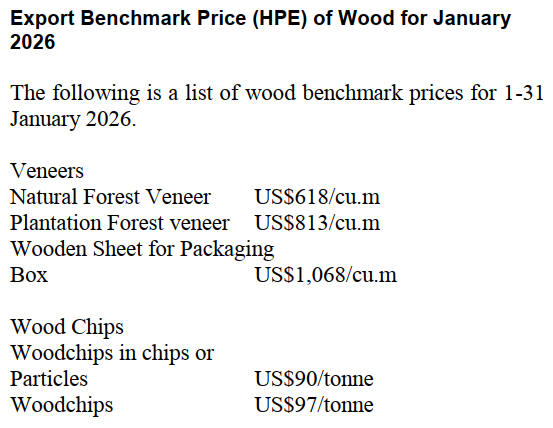
Processed wood products which are leveled on all four
sides so that the surface becomes even and smooth with
the provisions of a cross-sectional area of 1,000 sq.mm to
4,000 sq.mm (ex 4407.11.00 to ex 4407.99.90)

Processed wood products which are leveled on all four
sides so that the surface becomes even and smooth of
Merbau wood with the provisions of a cross-sectional area
of 4,000 sq.mm to 10,000 sq.mm (ex 4407.11.00 to ex
407.99.90) US$1,500/cu.m.
See: https://jdih.kemendag.go.id/peraturan/keputusan-menteri-
perdagangan-republik-indonesia-nomor-2139-tahun-2025-
tentang-harga-patokan-ekspor-dan-harga-referensi-atas-produk-
pertanian-dan-kehutanan-yang-dikenakan-bea-keluar-dan-tarif-
layanan-badan-layanan-umum
Review of national forest governance
President Prabowo Subianto instructed the Minister of
Forestry, Raja Juli Antoni, to conduct a review of national
forest governance as part of broader structural reforms in
the forestry sector. The directive follows a series of
ecological disasters in several regions which the
government believes are linked to weak governance.
The Ministry of Forestry has proposed establishing a
Regional Forestry Office Head in each province to reduce
the wide gap in control between the ministry and its
technical units which it is believed contributed to not
identifying problems that led to severe flooding. The
minister said this new structure would strengthen policy
implementation at the local level.
See: https://www.metrotvnews.com/read/kWDCze4w-prabowo-
perintahkan-menhut-evaluasi-total-tata-kelola-hutan-nasional
Forest permits covering over 1 million hectares
revoked
The government has revoked 22 forest-use permits
covering a total of more than 1 million hectares
nationwide according to Forestry Minister, Raja Juli
Antoni. The decision follows a directive from the
President and is part of the government’s broader effort to
maitain order in the forestry sector. With this latest action,
the government has now addressed around 1.5 million
hectares of problematic forest land.
The government is also taking legal steps through the
Forest Area Order Task Force, particularly in Aceh, North
Sumatra and West Sumatra targeting cases linked to illegal
logging.
See: https://en.antaranews.com/news/396613/indonesia-revokes-
22-forest-permits-covering-over-1-million-hectares
and
https://hijau.bisnis.com/read/20251215/651/1936900/pemerintah-
cabut-22-izin-pemanfaatan-hutan-seluas-lebih-dari-1-juta-hektare
Chamber of Commerce proposes furniture industry
incentives
The Indonesian Chamber of Commerce and Industry
(Kadin) met with Finance Minister, Purbaya Yudhi
Sadewa, to discuss deregulation and incentives for the
national furniture industry.
Kadin Chairperson, Anindya Novyan Bakrie, highlighted
that while the global furniture market is worth around
US$300 billion Indonesia contributes only about US$2.5
billion. Although the industry’s growth remains healthy he
noted that Indonesia’s trade surplus is shrinking due to
rising imports. The proposed incentives include access to
financing with more competitive interest rates and support
for resource-based industrialisation, such as for the rattan
sector.
Anindya also stressed the need to diversify export markets
as nearly 60% of Indonesia’s furniture exporters still rely
on the United States while there is potential for expansion
to Canada and the European Union.
HIMKI Chairperson, Ahmad Sobur, urged the government
to provide financial support pointing out that exporters
currently access loans at around 6% interest through the
Indonesian Export Financing Institution (LPEI). In
response, Finance Minister Purbaya said the government
would review LPEI’s internal condition before expanding
incentive support for the furniture industry through the
institution.
See: https://en.tempo.co/read/2074881/kadin-indonesia-pushes-
furniture-industry-incentives-in-meeting-with-finance-
minister?tracking_page_direct
and
https://en.antaranews.com/news/397513/indonesia-allocates-rp2-
trillion-to-boost-textile-furniture-exports
and
https://www.cnnindonesia.com/ekonomi/20251219192114-92-
1308816/purbaya-siap-dukung-pelaku-industri-furnitur-ri
Furniture and craft industries anticipate a rebound in
export demand
Indonesia’s furniture and handicraft industry is optimistic
about an export market rebound in 2026 supported by
expectations of global monetary policy easing and
improving consumer sentiment.
Industry leaders anticipate that growth will be led by
value-added, sustainable and design-driven products
following a relatively stable and consolidative
performance in 2025. While prospects are improving the
recovery is expected to unfold gradually and selectively
across markets.
Despite the positive outlook, the industry continues to face
internal challenges such as high financing costs, efficiency
pressures, inconsistent raw material supplies and rising
compliance costs linked to sustainability certifications,
particularly for MSMEs.
External risks include volatile logistics costs, intense
competition from Vietnam and China and stricter trade
policies including the EU’s deforestation regulation and
US tariffs. To address these challenges, HIMKI is
prioritising a green industry strategy focused on
sustainability, productivity, product differentiation and
stronger branding while emphasising the need for
supportive government policies to maintain
competitiveness.
See: https://www.msn.com/id-id/berita/other/pelaku-industri-
mebel-dan-kerajinan-optimistis-pasar-ekspor-pulih-di-tahun-
2026/ar-AA1SThiv?ocid=BingNewsVerp
and
https://www.antaranews.com/berita/5325943/himki-yakini-2026-
penuh-peluang-bagi-industri-furnitur-kerajinan
Opportunities for performance-based REDD+ financing
in regions
Indonesia’s Ministry of Forestry has created opportunities
for performance-based financing for the implementation of
the REDD+ scheme at the regional level emphasising the
importance of strong collaboration between the central and
regional governments.
Forestry Minister, Raja Juli Antoni, highlighted that
national success in reducing emissions depends heavily on
forest management performance in the regions.
One key financing mechanism is the ART-TREES scheme
which applies a jurisdictional, performance-based
approach while maintaining environmental integrity and
international accountability.
The ministry praised regional leaders for their
commitment to forest and environmental protection. The
ministry encourages regional governments to further
strengthen forest conservation, reduce deforestation and
degradation, improve data and monitoring systems and
ensure fair and sustainable participation of indigenous
peoples and local communities.
According to an October 2025 report, Indonesia’s REDD+
implementation has successfully reduced emissions in the
forestry and land-use sector and gained international
recognition through Result-Based Payments totaling
US$499.8 million, with US$340.7 million already
disbursed. This includes US$103.8 million in support from
the Green Climate Fund through UNDP.
See:https://www.antaranews.com/berita/5327518/kemenhut-
buka-peluang-pendanaan-redd-berbasis-kinerja-di-daerah
and
https://www.kehutanan.go.id/news/kemenhut-buka-peluang-
pendanaan-redd-berbasis-kinerja-bagi-daerah
FTA with EAEU signed, Indonesia eyes wider Eurasian
market access
Indonesia has signed a free trade agreement (FTA) with
the Eurasian Economic Union (EAEU) to reduce trade
tariffs and expand access for Indonesian products to non-
traditional Eurasian markets. The agreement was signed
on December 21, 2025, at the EAEU Summit in Saint
Petersburg, Russia, with Trade Minister Budi Santoso
representing Indonesia.
The FTA is expected to help Indonesia penetrate a market
of around 180 million people with a combined GDP of
US$2.56 trillion while supporting the country’s strategy to
diversify export destinations and attract new investment,
particularly in manufacturing and agriculture.
The pact consists of 15 chapters covering market access,
trade facilitation and economic cooperation and includes
the EAEU’s commitment to apply preferential tariffs on
90.5% of tariff lines for Indonesian products. This is
projected to boost exports of palm oil and its derivatives,
textiles, footwear, fishery products, natural rubber,
furniture and electronics.
In return, Indonesia offers EAEU members access to its
large and growing domestic market of 281.6 million
people and a GDP of US$1.4 trillion, marking the
Agreement as a strategic step toward deeper and balanced
economic partnership.
See: https://en.antaranews.com/news/397396/indonesia-seals-fta-
with-eaeu-eyes-wider-eurasian-market-access
Indonesia accelerates tariff negotiations
with US
Indonesia is accelerating its trade and tariff negotiations
with the United States aiming to finalise an agreement in
early 2026. The US is Indonesia’s second-largest trading
partner with trade valued at US$28.14 billion from
January to November 2025, following China at US$58.24
billion.
A negotiating team is scheduled to travel to the US for
drafting an agreement expected to be signed by President
Prabowo Subianto and US President by the end of
January.
Coordinating Minister for Economic Affairs, Airlangga
Hartarto, confirmed that all major issues have been agreed
in principle. Under the Agreement Indonesia will expand
market access for US products, reduce non-tariff barriers
and enhance cooperation in digital technology and national
security. In exchange, the US will grant tariff exemptions
for key Indonesian exports, including palm oil, cocoa,
coffee and tea.
See: https://kalsel.antaranews.com/berita/499061/indonesia-
speeds-up-tariff-negotiations-with-us
5.
MYANMAR
6.
INDIA
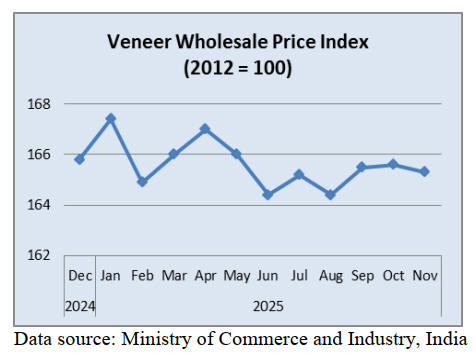
Price indices for wood products tilt lower
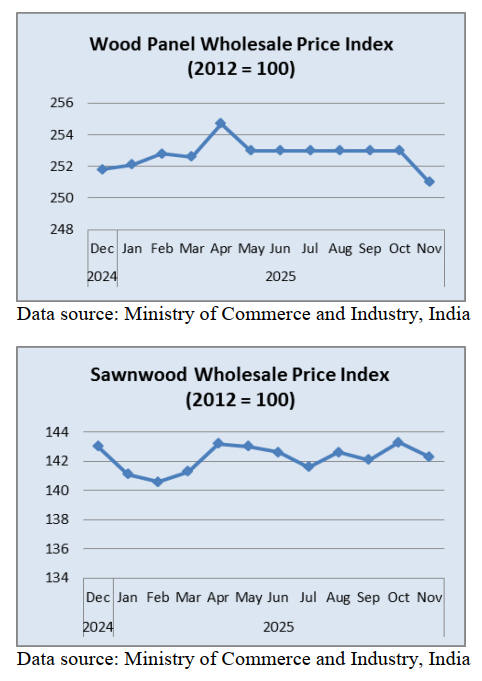
The annual rate of inflation based on the all India
Wholesale Price Index (WPI) was -0.32% for November
2025 (over November 2024). The negative rate of inflation
in November 2025 was primarily due to decreased prices
for food articles, mineral oils, crude petroleum and natural
gas, manufacture of basic metals and electricity.
The index for this major group decreased by (-) 0.07%
from 145.1 for October 2025 to 145.0 in November 2025.
Out of the 22 NIC two-digit groups for manufactured
products 14 groups witnessed a decrease in prices, 7
groups witnessed an increase in prices and 1 group
witnessed no change in price.
Some of the important groups that showed month on
month decreased prices were manufacture of fabricated
metal products (except machinery and equipment) food
products, other non-metallic mineral products, computer,
electronic and optical products and chemicals and
chemical products. There was a marked decline in the
index for wood panels and sawnwood in November
compared to a month earlier.
Some of the groups that witnessed an increase in prices
were other manufacturing; machinery and equipment,
textiles, electrical equipment and wearing apparel.
See: https://eaindustry.nic.in/
and
file:///C:/Users/Owner/Documents/2026-
MIS/Jan%20a%202026/cmonthly.pdf
Core veneer supply from Vietnam and Nepal
PlyReporter indicates that core veneer supply from
Vietnam and Nepal has improved significantly for Indian
plywood manufacturers, offering relief from domestic raw
material shortages and high timber costs, with Vietnam
becoming a major supplier of cost-effective
eucalyptus/acacia core veneer and Nepal supplying more
finished plywood, though quality and pricing remain key
factors for Indian buyers.
The number of core veneer containers from Vietnam
increased 25% in October 2025 compared to a month
earlier and was distributed to mills in Gujarat, Rajasthan
and Tamil Nadu. Core veneer importers view that over the
next few months quantity would improve.
Plywood mills located close to the ports in Gujarat, Tamil
Nadu have mostly shifted production using imported core
veneer and logs. Kandla, Vishakhapatnam, Cochin Ports
have received sizeable volumes of logs from Brazil,
Argentina, Uruguay and Australia for core veneer.
There is a report of an increasing number of containers of
core veneers from Nepal to Indian plywood mills in Uttar
Pradesh, Bihar and Jharkhand.
See: https://www.plyreporter.com/article/153812/increasing-
core-veneer-import-from-nepal-vietnam
Decision on commercial plantations in forests attracts
criticism
According to the Downtoearth website
(https://www.downtoearth.org.in/) the central government
has amended forest conservation rules to allow private
entities to undertake commercial plantations in forest areas
without paying long-standing environmental levies, a
move that has raised concerns among former forest
officials, environmentalists and tribal rights groups.
The amendment was triggered by India’s growing
dependence on imports of paper and paperboard, which
have nearly doubled over the past five years.
The change, notified by the Union Ministry of
Environment, Forests and Climate Change allows assisted
natural regeneration, afforestation and plantations carried
out by government or non-government entities to be
treated as “forestry activities”.
As a result such projects will no longer require payment of
Net Present Value (NPV) and the creation of
compensatory afforestation plots.
Downtoearth says “NPV is a one-time charge levied on
users diverting forest land, based on a scientific
calculation of the value of ecosystem goods and services
such as clean air, water, and biodiversity. The value is
compensated through artificial regeneration, protection
and the prevention of pests and diseases, among other
activities. Such plantations will now be considered as
forestry activity.
The amendment has been made under the Van
(Sanrakshan Evam Samvardhan) Adhiniyam, 2023,
formerly the Forest Conservation Act, through changes to
the consolidated guidelines originally notified on
November 29, 2023. The revised provision was approved
by theMministry on 2 January 2026”.
See: https://www.downtoearth.org.in/forests/union-government-
removes-financial-and-ecological-obligations-on-private-
plantations-in-forest-areas#google_vignette
and
https://www.newslaundry.com/2026/01/07/disastrous-modi-govt-
allows-commercial-plantations-in-forests-drops-safeguards
India - promising real estate investment opportunities
India is emerging as one of Asia Pacific’s most promising
real estate investment opportunities as fresh capital
platforms, deeper institutional participation and broader
asset-class expansion reshape the market.
Japanese property developers like Mitsui Fudosan and
Sumitomo Realty are significantly increasing investment
in India‘s booming real estate market and are expanding
beyond traditional segments into logistics and data centres
according to Reuters.
Other Japanese developers in the Indian market include
Daibiru Corp, which started with investments in office
deals in two cities last year. Japanese investors are not the
only ones seeking gains in the Indian property market. US
investment firm Blackstone is India‘s biggest commercial
landlord and roughly half of its US$50 billion in Indian
assets are in real estate.
The Economic Times article suggests foreign investors are
deploying large amounts of capital into Indian real estate“
because India offers a rare combination of high growth
potential, rising demand across residential, commercial
and logistics segments and real-asset stability all wrapped
in a maturing but still under-penetrated real-estate
market“.
See:
https://economictimes.indiatimes.com/industry/services/property-
/-cstruction/why-are-foreigners-betting-big-on-indian-real-
estate/articleshow/125690210.cms?from=mdr
and
https://realestateasia.com/commercial-other/in-focus/how-global-
capital-pivoting-apac-real-estate
7.
VIETNAM
Viet Nam's W&WP exports - US$16.5 billion
in 11
months
A conference to address difficulties, remove trade barriers
and expand the market for wood and forest product
exports was held in November. The Forestry and Forest
Protection Department under the Ministry of Agriculture
and Environment, in coordination with the Ho Chi Minh
City Department of Agriculture and Environment and the
Handicraft and Wood Industry Association of Ho Chi
Minh City (HAWA), hosted this event.
The Deputy Director of the Department of Forestry and
Forest Protection, Nguyen Van Dien, stated that although
exports over 11 months reached US$16.5 billion, growth
is below expectations at only 5.4% below the projected
6%. The main reasons are challenges in exporting to key
markets, technical barriers related to legal wood origin,
transparency requirements and ongoing pressures on
businesses.
Domestic production also faces difficulties due to
extreme
weather which disrupted raw material supply thus
reducing processing output.
Mr. Ho Truc Thanh, Deputy Director of the Ho Chi
Minh
City Department of Agriculture and Environment, noted
that the City currently has over 5,120 enterprises
participating in the wood processing chain and is
promoting green transformation and digitalisation to meet
international standards.
Meanwhile, Deputy Director of the Trade Remedies
Authority under the Ministry of Industry and Trade,
Truong Thuy Linh, reported that by October 2025 Viet
Namese goods faced 297 trade remedy investigations with
the U.S. leading at 77 cases. Authorities recommend that
businesses fully comply with investigation requests,
maintain transparent documentation and proactively
diversify markets.
The conference concluded that the wood industry is
at a
critical stage and requires close coordination between
regulatory agencies and enterprises to sustain export
growth in the coming period.
See:https://en.sggp.org.vn/Viet Nams-wood-exports-
reach-us165-billion-in-11-months-post121945.html
W&WP imports first 11 months 2025
As of 11/15/2025 W&WP imports were valued US$2.76
billion, up 15% over the same period in 2024.
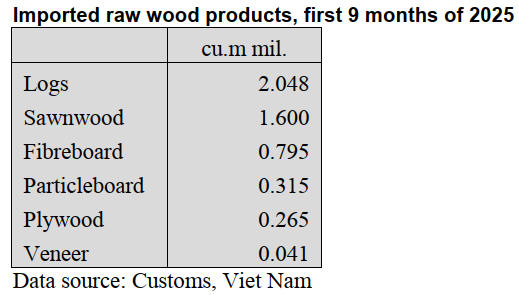
According to preliminary statistics, imports of raw
wood
(sawnwood and logs) in October 2025 reached 530,600
cu.m, worth US$164.5 million, down 5% in volume and
5% in value compared to September 2025 but compared to
October 2024 imports were up 4% in volume and 5% in
value.
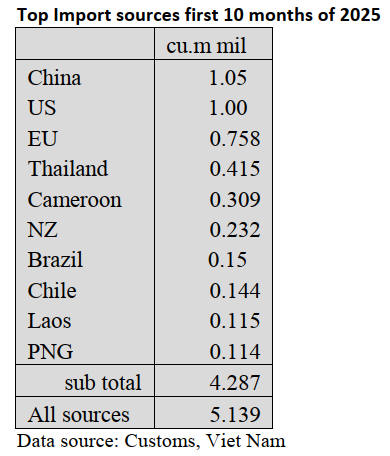
In the first 10 months of 2025, raw wood imports were
5.67 million cu.m, worth US$1.79 billion, up 23% in
volume and 20% in value over the same period in 2024.
Import prices
In the first 9 months of 2025 the average import price of
raw wood to Viet Nam stood at US$316.7 US$/cu.m,
down 3% over the same period in 2024.
The import price of raw wood from China decreased by
23% over the same period in 2024 to US$304.8 per cu.m;
from the US the price decreased by 3% to US$419.2 per
cu.m; from the EU the average price increased by 0.5%
over the same period in 2024.
W&WP imports from the United States in the first 10
months of 2025
W&WP imports from the US in the first 10 months of
2025 reached US$489.74 million, up 82% over the same
period in 2024 and accounted for nearly 19% of the total
10-month W&WP imports.
In the first 9 months of the year the US held the position as
the second largest supplier of raw wood to Viet Nam with
an import volume of 1.0 million cu.m, worth US$420.5
million, up 94% in volume and 88% in value over the
same period in 2024 and accounted for 19.5% of total
imports in the first 9 months of 2025.
It is forecast that for 2025 imports of raw wood from the
US will total 1.3 million cu.m, at a value of US$543
million.
Trade highlights
W&WP exports to the Dutch market in October 2025
earned US$8.8 million, down 23% compared to October
2024. In the first 10 months of 2025 W&WP exports to the
Dutch market totalled US$82.9 million, up 33% over the
same period in 2024. W&WP exports to the Spanish
market in October 2025 were valued US$4.8 million, up
5% compared to October 2024. In the first 10 months of
2025 W&WP exports to the Spanish market totalled
US$60.1 million, up 25% over the same period in 2024.
Viet Nam's W&WP imports in October 2025 were valued
US$248.4 million, down 6% compared to September
2025, however, compared to October 2024, imports
increased by almost 6%. In the first 10 months of 2025
W&WP imports reached US$2.62 billion, up 16% over the
same period in 2024.
Viet Nam's pine timber imports in October 2025 were
89,900 cu.m, worth US$16.4 million, down 7% in volume
and 6% in value compared to September 2025. Compared
to October 2024 imports were down 13% in volume and
31% in value.
In the first 10 months of 2025, imports of pine
timber
amounted to 874,000 cu.m, worth US$172.3 million, up
6% in volume and down 7% in value over the same period
in 2024.
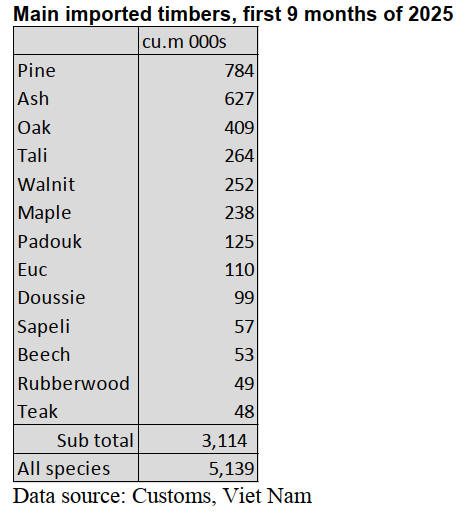
In the first 9 months of 2025 wood imports from
Cameroon reached 309,090 cu.m, with a value of
US$121.33 million, up 109% in volume and 3% in value
over the same period in 2024.
Sustainable softwood trends stand out at
VietNamWood 2025
In November the 16th International Exhibition on
Machinery and Equipment for the Wood Processing
Industry in Viet Nam (VietnamWood 2025) opened at the
Saigon Exhibition and Convention Center (SECC)
attracting more than 320 domestic and foreign units and
enterprises to participate.
With a scale of 13,500 sq.m and gathering more than
320
enterprises from 28 countries, VietnamWood affirmed its
position as one of the leading events in the wood
processing sector in Viet Nam specialising in machinery,
technology and consumables. The exhibition attracts a
large number of domestic and foreign manufacturers.
At VietnamWood 2025, Canada Wood Viet Nam had an
impressive display space with a variety of interior
applications from Canadian wood. The special highlight of
the booth was the wood colour palette with shades from
light to dark helping visitors easily visualise the practical
application of Canadian wood. In addition, the company’s
technical experts were present at the booth to provide
direct consultation and introduce the Canadian Wood
Experience Program – an initiative that provides free
wood samples, as well as in-depth technical support to
help factories in Viet Nam verify quality, optimise
production and expand supply sources.
According to the General Department of Viet Nam
Customs and the Viet Nam Wood and Furniture Export
Report 2024 – 2025, Viet Nam’s wood and wood products
exports reached US$16.25 billion in 2024, up 20% over
the previous year.
In 2025 the industry aims to increase this figure to
US$18
billion and is shifting its focus towards sustainability, legal
origin and supply chain transparency.
See: https://baotintuc.vn/kinh-te/xu-huong-go-mem-ben-vung-
noi-bat-tai-Viet Namwood-2025-20251119194112259.htm
8. BRAZIL
Despite tough conditions wood products
sector
demonstrats high level of resilience
2025 was a period of intense tension for the Brazilian
forest sector marked by an abrupt shift in the challenges
throughout the year.
After a promising start, supported by expectations of
productive expansion, new investments and stability in
international trade, the sector was directly affected by an
increase in tariffs imposed by the United States, initially at
10% in April and subsequently raised to 50% in August.
As a result, the tariff reduced export competitiveness
leading to trade imbalances and significant socioeconomic
impacts such as temporary shutdowns of operations, the
adoption of forced vacations, layoffs and projections of up
to 10,000 job losses. These impacts particularly affected
States where forest-based activities are a significant
component of the economy, such as Paraná State.
Despite the tough conditions, the wood products sector
demonstrated a high level of resilience. The State of
Paraná maintained its position as the second-largest
contributor nationwide in terms of forest production value.
Paraná also concentrates approximately 1.17 million
hectares of planted forests comprising 710,836 hectares of
pine, 438,721 hectares of eucalyptus, and 6,486 hectares
of araucaria.
At the same time, international recognition of the role of
forests as a driver of sustainable development, together
with advances in innovation, the bioeconomy and the use
of wood as a strategic material helped consolidate a long-
term vision grounded in competitiveness, legal certainty
and sustainable socioeconomic development.
2026 is viewed with responsibility and confidence marked
by the 120th anniversary of the introduction of pine in
Brazil, a symbol of the development of forest production
chains and an invitation to reflect on the past and the
future paths of the sector.
See: https://apreflorestas.com.br/noticias/2025-um-ano-que-
colocou-a-prova-a-resiliencia-do-setor-florestal/
Timber hub in the State of Amazonas
The timber sector in the State of Amazonas was the
fastest-growing segment within the Manaus Industrial Pole
(PIM) in 2025, with a major increase in revenue through
September.
According to the Manaus Free Trade Zone
Superintendency (Suframa), this performance nearly offset
the accumulated losses of 48% recorded over the previous
two years and in relative terms outpaced the growth of
other industrial sectors. The Federation of Industries of the
State of Amazonas (Fieam) has said despite the positive
result revenue remains below the levels reached in 2021
and 2022 when the sector recorded BRL64.1 million and
BRL70.3 million, respectively.
Nevertheless, the current growth signals a recovery in
activity with all industries in the timber hub being certified
and complying with strict environmental standards,
essential requirements for access to incentives under the
Manaus Free Trade Zone.
The hub currently employs 758 direct workers and focuses
its production on processed items, sawnwood as well as
components for the civil construction sector.
The Civil Construction Industry Union of Amazonas
(Sinduscon-AM) attributes the expansion of the sector
directly to the strengthening of the State’s construction
industry which grew by around 43% over the past 12
months. This expansion increased demand for certified
timber and strengthened integration between the forest-
based value chain and the real estate sector.
The timber value chain is increasingly integrated with civil
construction particularly among companies investing in
technology and chain-of-custody certification. Raw
material is sourced primarily from legally approved forest
management areas in the Amazonas State, notably in
Itacoatiara, Manicoré and Maués municipalities, as well as
from suppliers in Pará and other States holding
environmental authorisation.
However, significant structural challenges persist
including high logistics costs, dependence on river and
road transportation and the need to expand land tenure and
environmental regularisation, factors considered critical to
ensuring competitiveness and legal compliance across the
entire timber production chain in the state.
See: https://www.portaldocaubi.com.br/polo-madeireiro-do-
amazonas-cresce-387-e-lidera-expansao-da-industria-em-2025
Mato Grosso SFM model presented as an international
reference
During the recnt International Tropical Timber Council
(ITTC-61) held in October 2025 in Panama the Center of
Timber Producers and Exporters Industries of the State of
Mato Grosso (Cipem) presented the Mato Grosso State
sustainable forest management model as an international
reference for the responsible production of tropical timber.
Representing the Brazilian forest sector, Cipem
highlighted Brazil’s capacity to reconcile environmental
conservation, the rational use of forest resources and
income generation as well as emphasising the strategic
role of timber as a renewable, low-carbon material,
particularly in the context of decarbonising the
construction sector.
During a panel dedicated to Latin America, Cipem
underscored Brazil’s leadership in sustainable forest
production noting that approximately 19 million hectares
of forest plantations are located in the country with
increasing diversification of industrial applications such as
pulp and paper, wood-based panels, furniture and
construction.
It was also highlighted that Brazilian forest-based exports
reached US$17 billion in 2024, with projections of
US$25-35 billion in the coming years. To reach this
potential, however, significant investments are required,
estimated at US$220 billion in infrastructure, logistics and
industrial capacity.
Finally, Cipem emphasied the importance of sustainable
forest management as a key instrument to ensure
international competitiveness, the long-term responsible
supply of tropical timber and the maintenance of standing
forests, balancing environmental conservation, job
creation and socioeconomic development.
See: https://cipem.org.br/cipem-apresenta-modelo-mato-
grossense-de-manejo-florestal-em-evento-no-panama/
Brazilian furniture industry redirects exports
The Brazilian furniture industry has been implementing
strategic adjustments in its export markets following the
imposition of tariffs of up to 50% by the United States. On
a year-to-date basis the sector shows a positive
performance (+4.4% compared to 2024) but there has been
a slowdown reflecting logistical and commercial
adjustments in response to reduced competitiveness in the
US market.
Although the US remains the main export destination
accounting for 25% of total exports year to date, this
represents a decline from the 29% recorded in 2024. The
reduction in shipments to the US has encouraged market
diversification with Uruguay increasing its imports to
11%, Chile maintaining 7% and Argentina rising to 6%
more than three times the share observed in the previous
year (2%).
Alongside this geographic reorientation of exports the
sector has intensified international promotion efforts,
focusing on Latin America, Europe, Asia and the Middle
East supported by initiatives from Abimóvel and
ApexBrasil (the Brazilian Trade and Investment
Promotion Agency). On the regulatory front, however,
uncertainties persist in the US as the removal of the
additional tariff benefited only agricultural products while
barriers and high costs for industrial goods (including
furniture and processed wood) remain in place.
These factors continue to constrain furniture exports to the
sector’s main market. As a result, the outlook for furniture
exports will depend on progress in tariff negotiations, the
consolidation of alternative markets.
See: https://emobile.com.br/site/industria/industria-moveleira-
ajusta-rotas-de-exportacao-diante-de-tarifas-dos-eua/
9. PERU
Exports exceeded US$57.6 million through October
2025
Shipments of wood products for finishing and construction
totalled US$57.6 million during the first eight months of
2025 reflecting a 21% decrease compared to the same
period in 2024 (US$72.7 million) according to the Center
for Research on Global Economics and Business of the
Association of Exporters (CIEN-ADEX).
According to data from the ADEX Data Trade Business
Intelligence System, exports included sawn timber
(US$19.8 million), semi-finished products (US$21.1
million), firewood and charcoal (US$5.0 million),
furniture and furniture parts (US$3.8 million) and
construction products (US$3.6 million).
The leading destination was the Dominican Republic, with
exports totalling US$9.0 million, a 1% increase compared
to the previous year. The US followed with US$8.8
million, a decrease of 22% compared to 2024; France with
US$8.5 million, a decrease of 30%; China with US$5.9
million, a decrease of 39% and Mexico rounding out the
top five with sales of US$5.6 million, a decrease of 36%.
FSC certification concentrated in Madre de Dios,
Loreto and Ucayali
As of 30 November 2025, according to information
provided by FSC Peru, the country has 964,2377 hectares
of FSC-certified forest. There are 96 initiatives from the
private sector, eleven of which are related to forest
management and 83 to chain of custody (CoC). The
regions of the country with the largest certified areas are,
in the following order: Madre de Dios, Loreto, and
Ucayali.
SERFOR recorded production of 2 million cubic meters
in 2025
To strengthen efforts to promote the proper use of the
Forest Transport Guide (GTF) for 2025 the National
Forest and Wildlife Service (SERFOR) registered the
production of over 2 million cubic metres of timber,
including information on its origin and traceability in the
Control Module of SERFOR's National Forest and
Wildlife Information System (SNIFFS).
This confirms the importance of the GTF in promoting the
competitiveness of forest products in national and
international trade. Information resources were developed
explaining the responsible use of the GTF as well as the
administrative and criminal consequences of its improper
or fraudulent use.
Through the SNIFFS Control Module, 80,145 digital
GTFs were issued in 21 Departments of the country.
According to the records 38,470 correspond to products
from Enabling Titles, 35,814 were issued by Primary
Processing Centres and 5,861 correspond to plantation
products.
See:
https://www.gob.pe/institucion/serfor/noticias/1314702-
serfor-registro-mas-de-2-millones-de-metros-cubicos-de-
productos-forestales-en-lo-que-va-del-ano-2025
Legal origin of 500,000 cubic metres certified in 2025
The Supervisory Agency for Forest Resources and
Wildlife (OSINFOR) certified the legal origin of
504,292.06 cu.m of timber harvested in Peruvian forests
during 2025. These results were achieved through the
monitoring of 1,024,095 hectares of forests with forestry
permits or concessions, known as enabling titles.
Through 840 monitoring actions in Amazonian, dry and
high Andean forests OSINFOR verified the sustainable
harvesting of 110,659 authorised trees and the existence of
32,027 standing seed trees essential for the natural
regeneration of these ecosystems.
Among the species with the highest number of monitored
individuals are shihuahuaco (Dipteryx micrantha) with
8,472 trees, tornillo (Cedrelinga cateniformis) with 8,167,
bolaina (Guazuma crinita) with 7,347 and capinuri
(Maquira coriacea) with 4,561 individuals.
Furthermore, during the monitoring process, which
included field supervision and monitoring using satellite
technologies and artificial intelligence, OSINFOR
detected the unauthorised extraction of 63,050 cu.m of
timber.
See: https://www.gob.pe/institucion/osinfor/noticias/1329815-
peru-acredito-el-origen-legal-de-mas-de-500-000-metros-
cubicos-de-madera-durante-el-2025
|