|
1.
CENTRAL AND WEST AFRICA
EU demand quiet and subdued
Demand for tropical timber in the European Union (EU) is
currently quiet and subdued, a trend consistent over recent
years. This general quietness follows a period of volatility
and strong demand in early 2022 which was subsequently
impacted by economic headwinds and geopolitical issues
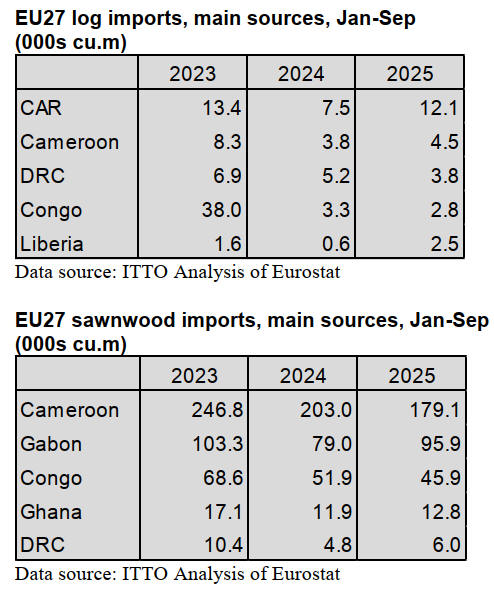
African sawnwood imports into the EU 27 were down in
the first nine months of 2025 compared to 2024. The
EU27 imported 32,500 cu.m of tropical logs from all
sources in the first nine months of 2025 respectively 21%
and 12% more than the same period in 2024.
Regional round-up
Gabon
December marks the peak of the rain season with heavy
daily rainfall across inland regions. These conditions
continue to restrict movement and slow harvesting
operations but given the subdued international demand
industries are content to maintain moderate output levels.
The GSEZ log park at Nkok was reportedly short of
Okoume logs, though the situation is now improving as
the main supplier has secured Task Force approval to
resume operations. Mills requiring peeler and saw logs
have been relying on GSEZ stocks which currently include
approximately 1,500 cu.m of mixed red species (Bosse,
Sapelli, Padouk, limited Azobe and Okan) but still very
little Okoume.
The Task Force was initially very aggressive in its
inspections and enforcement but has become more
accommodating due to widespread complaints and layoffs.
All companies that were told by the Task Force to suspend
activities are now back in operation,
Government pressure on industries to reduce expatriate
labour is causing concern for those companies that rely
heavily on foreign technicians. The policy is now being
softened, permitting an estimated 10% expatriate
workforce allowing companies to rehire essential foreign
expertise.
Electricity disruptions remain a significant operational
burden. Despite the presence of two Turkish power ships
and a third vessel expected to raise total output. Libreville
and surrounding areas continue to experience 2–3 power
cuts per day each lasting 1–2 hours. On 11 December parts
of Libreville faced a full-day blackout.
Operations at Owendo Port remain functional with normal
traffic flows to and from the terminals. However, vessels
often have to wait to berth due to congestion.
Millers in Gabon have welcomed a recent improvement in
the number of orders from Middle East buyers but say the
volumes are not large. Enquiries from Europe remain low
as buyers limit purchasing strictly on an immediate needs-
only basis. No change has been reported on demand from
China.
The government is pursuing a new Finance Law for 2026
proposing an increase in Customs export duties on
processed timber from 8.6% to 12.5% (effective 1 January
2026). This has not yet been signed into law but operators
are already warning clients of potential price increases.
Concerns are being expressed that an increase in duties
will put operators in the country at a disadvantage in
international markets.
Cameroon
Harvesting activities continue but at a reduced pace
despite the unusually favourable weather for this time of
year. Operators reported that, unlike last year when heavy
rains persisted well into mid-January, rainfall has been
lighter and less disruptive this year.
Many Chinese-operated mills remain closed due to both
forestry and financial controls introduced by the
government in recent months. This has contributed to a
general slowdown in overall sawnwood production. In the
quiet market environment many mills are operating single
shifts.
Trucking operations have largely returned to normal,
supported by functioning rail connections and the
reopening of key road segments. Laterite roads remain
under rain barriers, meaning traffic is restricted during wet
conditions.
The strategically important Sangmelima road has been
fully repaired. This route is particularly relevant for North
Congo operators who transport sawnwood to Kribi Port.
Log shipments are regularly arriving in Douala Port,
including from Congo and the CAR.
Sawnwood stocks in Douala are said to be approximately
4,000 cu.m across all species. Some exporters apparently
prefer to hold stocks locally rather than ship to Europe
during the winter due to seasonal slowdowns and port
congestion.
Exporters in Cameroon are experiencing increased
scrutiny under the European Timber Regulation with EU
authorities tightening controls and requiring sound proof
of legality. The sentiment among operators in Cameroon is
that demand in major markets remains subdued with slow
demand in Europe, low demand in China and stable
demand in Middle Eastern countries. Operators remain
cautious and are focusing on maintaining basic operations
rather than investing or expanding.
Analysts observe that the operating environment in
Cameroon is markedly different to that in Gabon. The
country benefits from a large and active labour force
generally described as inventive. Most timber companies
are managed by Lebanese operators with the notable
exception of SFIL (Décolvenaere), a Belgian-owned
company appreciated for its operational efficiency.
However, operators say administrative transparency in
forestry operations remains an issue. Forest management
through the coupe de vente, coupe communautaire and
private concession (UFA) systems complicates overall
transparency. Some companies in Cameroon are said to
have very large concession areas (over 500,000 ha in
Gabon 200,000 ha. is the maximum permitted.
Republic of the Congo
Rain is gradually slowing across the country and
harvesting continues at a reduced level largely because of
weak markets in Asia and Europe. Many operators
continue directing their output toward Douala as this is
shorter and more practical compared to Pointe Noire
which is approximately 1,400 km from the northern
production zones.
Timber from the northern regions and from the Central
African Republic continues to move toward Douala
despite the absence of tarmac roads over the roughly 1,200
km route between Bangui and Douala.
In the Likouala region, transport conditions are improving
with easing rains, allowing increased flow of timber
toward Kribi (containers) and Douala (logs).
No major issues are reported concerning spare parts
imports or other production inputs. No significant new
fees or toll changes have been reported. In Pointe Noire,
container availability is stable and no major shortages
have been observed. Dispatch remains normal, with no
specific disturbances beyond the general slowdown in
export activity driven by weak international demand.
Attention throughout the country is shifting towards the
upcoming national elections next year creating a general
atmosphere of caution among operators and investors.
2.
GHANA
TUC calls on government to absorb part of the new
tariff increases
The Trade Union Congress (TUC) has called on the
government to absorb part of the recently announced
Public Utilities Regulatory Commission (PURC) tariff
increases. The Union’s Vice Chairperson, Dr. Ken
Tweneboa Kodua, made this statement following an
emergency meeting of a TUC steering committee held to
determine the next steps after the PURC press release on
the tariff increases.
According to Dr. Kodua the TUC is advocating for a
process that reviews the operational costs of the utility
companies to determine which PURC variables and
expenses should go to the State and which should
legitimately fall to consumers.
The Vice Chairperson said this approach would bring
some level of fairness to households and businesses which
are already under economic pressure. He indicated that the
consumer must have the ability to pay and emphasised that
the Union’s concerns relate to fairness and due process,
not opposition to tariff adjustments when they are
justified.
Ghanaian workers recently secured a 9% wage increase
from January 2026 but just last week the PURC
announced 15% rise in water charges and a 9% increase
for electricity which the TUC anticipates would wipe out
the wage gain.
Meanwhile, the Food and Beverages Association of Ghana
(FABAG) has also criticised the PURC tariff increases
describing the changes as economically harmful,
unjustified and major blow to Ghana’s economy.
In past development, the Association of Ghana Industries
(AGI) and the Ghana Union of Traders Association
(GUTA) have jointly sounded the alarm, warning PURC
tariff increases could undermine the success of the
government’s flagship 24-hour economy policy.
The variables PURC considered during its quarterly
reviews include inflation, the exchange rate, fuel costs and
the energy mix.
According to the latest Ghana Statistical Service (GSS)
Consumer Price Index (CPI) report Ghana’s inflation rate
dropped for the eleventh consecutive month, easing to
6.3% in November 2025 from 8.0% in October 2025.
See: https://ghanatuc.com/
and
https://www.graphic.com.gh/news/general-news/tuc-demands-
government-subsidy-to-cushion-ghanaians-from-new-tariff-
hikes.html
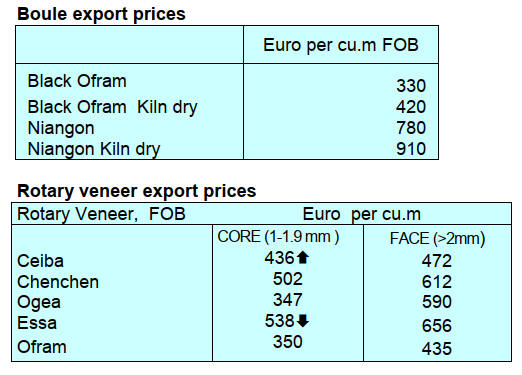
Primary products account for most wood products
exports
According to data published by the Timber Industry
Development Division (TIDD) of the Forestry
Commission (FC) Ghana earned Eur2.37million from the
export of 180,012 cu.m wood product exports during the
period January to October 2025 as against Eur103.93
million from 231,419 cu.m in the same period in 2024.
The year on year growth for the period showed a decrease
of 20% in value and a decrease of 22% in volume with the
details are tabulated below.
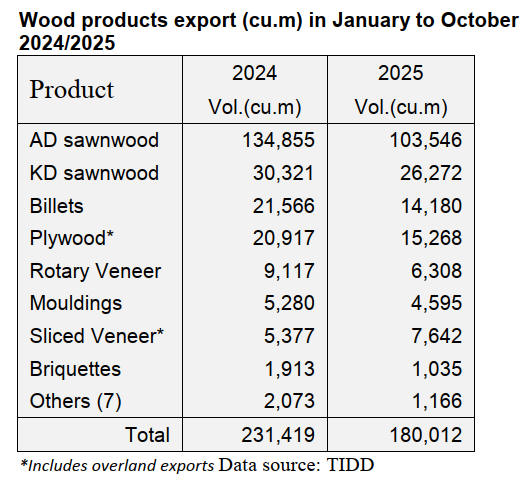
A total of eighteen different products were exported
during the period, of which air-dried sawnwood, kiln-dried
sawnwood, billets and plywood contributed the largest
share, accounting for 88% of the total export volume in
2025 dropping from almost 90% in the same period in
2024.
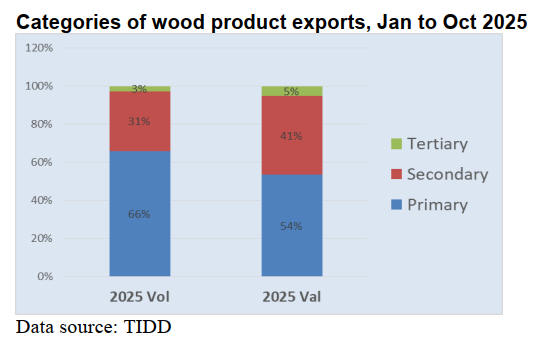
The demand for primary products which included kindling
and poles accounted for 118,701cu.m worth Eur44.08
million of the total exports in 2025. Exports of secondary
and tertiary wood products earned Eur34.14 million and
Eur4.14 million respectively.
There were more than 100 exporting companies during the
10-months period with the first top five accounting for
53% of the total export volume.
Kindling and poles (primary products category) recorded
volume increases in the first 10 months of 2025. The
kindling products were shipped to Saudi Arabia, UK,
Ireland and Greece while the poles went to Senegal.
CSOs scorecard on extractive sector promises
The Alliance of Civil Society Organisations (CSOs)
working on extractive governance, forestry, the
environment and anti-corruption measures has rated the
government’s performance in fulfilling its extractive
sector manifesto promises as satisfactory.
It noted that at the current rate of implementation 25% the
government is on track to achieve full delivery of its
commitments within four years.
These findings were presented in the Alliance’s latest
CSOs Assessment Scorecard on Government
Performance, which covers Mining, Petroleum,
Climate/Energy Transition, Forests and the Environment
and Anti-Corruption.
However, the Alliance urged the government to intensify
efforts toward its anti-corruption commitments, warning
that delays could hinder successful implementation and
leave behind key promises by 2028.
See: https://ghanaiantimes.com.gh/govt-on-track-to-meet-
extractive-sector-promises-csos-scorecard/
BII supports MSMEs with loan facility
British International Investment (BII), the UK’s
development finance institution, has extended a US$20
million loan facility to First National Bank Ghana (FNBG)
to expand financing opportunities for micro, small, and
medium-sized enterprises (MSMEs) across the country.
The signed agreement is expected to deepen support for
businesses that form the backbone of Ghana’s economy.
MSMEs account for over 90% of all enterprises in the
country contributing 60% to the GDP and provide 80% of
jobs yet many struggle to access long-term and affordable
capital.
The Chief Executive of First National Bank, Warren
Adams, described the five-year loan as a timely
intervention that will allow the Bank to scale up lending to
small businesses navigating economic uncertainties,
particularly in the commerce sector.
See: https://www.myjoyonline.com/bii-provides-20m-boost-to-
first-national-bank-to-strengthen-msme-financing-in-ghana/
and
https://www.gov.uk/government/news/bii-backs-msmes-with-
20m-loan-to-first-national-bank
3. MALAYSIA
Sabah timber industries call for support to remain
competitive
The Sabah Timber Industries Association (STIA) has
called on the State Government to strengthen support for
the timber sector amid rising structural challenges and
mounting pressure to remain competitive and sustainable.
STIA president, Tan Peng Juan, said the industry is at a
critical crossroads. “Industry players are concerned that
without decisive action the timber sector, which supports
thousands of livelihoods and contributes significantly to
the national economy, may struggle to sustain itself in the
years ahead”.
He emphasised that Sabah’s timber industry remains a
vital economic contributor generating employment,
supporting rural communities and producing significant
export revenue. “In 2024, Sabah’s forest product exports
generated RM1.13 bil, underscoring the sector’s continued
relevance”
The road ahead for industrial tree plantations will not be
easy and the industry cannot overcome the challenges
without strong and sustained government support, he said.
Another major concern is the industry’s changing
workforce landscape. “There are critical labour gaps in
both upstream and in specialised downstream areas,” he
said, noting that the sector still relies heavily on foreign
workers. Tan added that the industry urgently needs major
investments in both upstream and downstream segments to
introduce new technology and automation that can offset
workforce challenges.
In a related development the Sabah Forestry Department
has announced the publication of three new books related
to forest plantation development, Guidelines for Selecting
Candidate Plus Trees (CPT) for Forest Plantation Species,
Photo Collection of Candidate Plus Trees (CPT) of Local
Forest Plantation Species in Sabah and Photo Collection of
Candidate Plus Trees (CPT) of Exotic Forest Plantation
Species in Sabah.
These publications mark another significant step in
strengthening the management of tree genetic resources to
support the advancement of the state’s forest plantation
sector.
See:
http://theborneopost.pressreader.com/article/281539412280432
and
http://theborneopost.pressreader.com/article/281590951887984
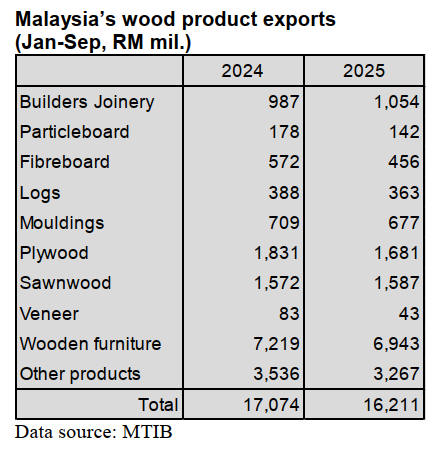
Sarawak wood pellet exports up 60%
Sarawak’s timber industry recorded exports valued at
RM1.87 bil as of the third quarter of 2025 according to
Deputy Minister of Natural Resources and Urban
Development, Len Talif Salleh. He highlighted the growth
in the timber sector compared to the same period last year
pointing out that logs contributed RM310 mil., an increase
of 3% compared to the same period in 2024 while wood
pellet exports also rose 60% to RM97 mil., up from RM60
mil. during the same period in 2024.
He added that Japan remained the top importer with a
value of RM1.17 bil, followed by India (RM 299 mil),
Middle East countries (RM 105 mil), Taiwan P.o.C (RM
77 mil) and the Philippines (RM 65 mil).
On sustainable environmental management, Len Talif said
up to the third quarter of this year the Natural Resources
and Environment Board (NREB) had received 61
Environmental Impact Assessment (EIA) reports and 15
Environmental Management Plans (EMP). “Of these, 46
EIA reports and 15 EMPs have been approved, while 15
EIA reports are still at various stages of assessment.”
For context, EIA is a legal requirement and a key
instrument to ensure sustainable development in Sarawak.
To ensure compliance with EIA approval terms and
conditions, Len said the NREB had conducted 918 post-
EIA monitoring activities and received 1,857
Environmental Monitoring Reports (EMR) between
January and October 2025.“Monitoring results identified
87 cases of non-compliance, for which notices were
issued. During the same period, 14 investigation papers
were opened, while eight cases were compounded,
amounting to RM 150,000.”
In response, Len Talif said the NREB is enhancing the
standard operating procedures for post-EIA monitoring
and the Guidelines for EMR Submission and Evaluation to
strengthen monitoring and compliance processes.
See:
https://theborneopost.pressreader.com/article/281659671348184
Customary rights and carbon
Owners of Native Customary Rights (NCR) land that has
been gazetted can apply for a Forest Carbon Study Permit
to participate in carbon credit and reforestation initiatives
in Sarawak. According to Deputy Minister for Natural
Resources and Urban Development this initiative forms
part of the state’s efforts to reduce carbon emissions
through Nature-based Solutions (NbS).
“In Sarawak, this initiative has been strengthened through
the enactment of the Environment (Reduction of
Greenhouse Gases Emission) Ordinance 2023 and the
Forests (Forest Carbon Activity) Rules 2022. These
regulations require all carbon projects to comply with
internationally recognised carbon standards including
Verra and the Gold Standard to ensure integrity,
transparency and effective implementation,” he said.
Following the introduction of the Ordinance and its
regulations, Len Talif said several initiatives had been
implemented, including nine Forest Carbon Study Permits
covering 231,983 ha of forested land with seven new
applications currently under consideration.
In addition, a Forest Carbon Licence covering 25,675
hectares had been issued and a memorandum of
understanding (MoU) between Sarawak Forestry
Corporation (SFC) and Mubadala Energy, Abu Dhabi, on
NbS and blue carbon potential was signed last year.
See:
http://theborneopost.pressreader.com/article/281586656898821
Launch of an e-Removal Pass System
The Sabah Forestry Department launched the e-Removal
Pass System, a new digital platform designed to strengthen
the management, monitoring and transparency of the
State’s forest produce transfer process, particularly for
logs.
Chief Conservator of Forests, Frederick Kugan, said the
new system replaces the existing manual process with a
fully digital method enabling all applications, approvals
and monitoring of Removal Passes to be conducted online.
He said the system was developed to, provide more
accurate and auditable reporting and ensure complete
traceability. He noted that the development of the e-
Removal Pass System aligns with the State Government’s
aspirations under the 12th Malaysia Plan (RMK-12),
which emphasises digital technology adoption, enhanced
integrity and sustainable forest management.
See: https://www.dailyexpress.com.my/news/271745/forestry-
department-launches-e-removal-pass-system/
4.
INDONESIA
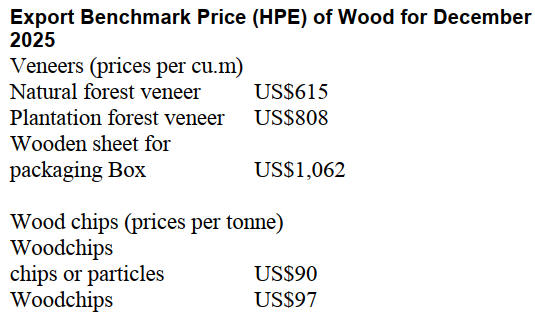
Processed wood (prices per cu.m)
Processed wood products which are leveled on all four
sides so that the surface becomes even and smooth with
the provisions of a cross-sectional area of 1,000 sq.mm to
4,000 sq.mm (ex 4407.11.00 to ex 4407.99.90)
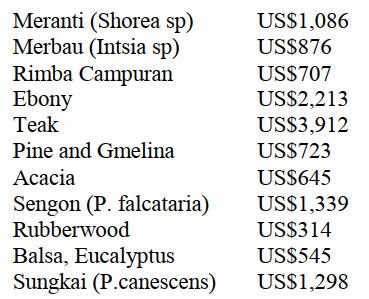
Processed wood products which are levelled on all four
sides so that the surface becomes even and smooth of
Merbau wood with the provisions of a cross-sectional area
of 4,000 sq.mm to 10,000 sq.mm (ex 4407.11.00 to ex
4407.99.90) = US$1,500/cu.m
See: https://jdih.kemendag.go.id/peraturan/keputusan-menteri-
perdagangan-republik-indonesia-nomor-2241-tahun-2025-
tentang-harga-patokan-ekspor-dan-harga-referensi-atas-produk-
pertanian-dan-kehutanan-yang-dikenakan-bea-keluar-dan-tarif-
layanan-badan-umum
Forest product exports have stagnated
The Ministry of Forestry has reported that forest product
exports remain flat at around US$12 billion annually
despite expectations of 3% yearly growth. Laksmi
Wijayanti, Director General of Sustainable Forest
Management, noted that the stagnation is influenced not
only by production challenges but also by negative public
narratives surrounding forestry policies.
Issues such as carbon, forest rehabilitation and
international trade politics often dominate public attention
affecting perceptions of the sector. She emphasised that
Indonesia already has strong sustainability regulations
including the Timber Legality and Sustainability
Assurance Program (SVLK).
To stimulate growth the ministry is now focusing on
downstream processing and increasing the value added to
of forest products. Current major exports include timber,
pulp and paper but the government aims to shift from
exporting mostly semi-processed materials to producing
premium-quality goods.
Laksmi stated that efforts will expand beyond timber to
promote non-timber forest products as well, ensuring that
Indonesia’s forest-based commodities can compete in
higher-value international markets.
In related news, it has been reported that the contribution
of the forestry sector to national economic growth in 2025
experienced a noticeable decline compared to previous
years. The Minister of Forestry, Raja Juli Antonnei,
reported that the sector’s contribution to GDP reached
Rp97.22 trillion, down from Rp129.57 trillion in 2024 and
Rp130.12 trillion in 2023. Data trends show steady growth
from 2020 to 2023, followed by a significant drop in 2025,
highlighting a slowdown in the sector’s overall economic
impact.
Investment in the forestry sector also fell sharply with
upstream forestry investment declining to Rp13.6 trillion
in 2025 from Rp34.7 trillion in 2024 while downstream
investment in industrialisation reached Rp 36.6 trillion.
Non-tax state revenue from forestry also decreased to
Rp6.53 trillion from Rp8.12 trillion in 2024. However, the
furniture industry, as a labour-intensive downstream
sector, delivers significant added value to the national
economy.
In the third quarter of 2025 the industry contributed 0.92%
to the non-oil and gas GDP while the export performance
remained slightly better than the previous year. The United
States continues to be the main export destination
accounting for more than half of Indonesia’s furniture
exports. The handicraft sector also showed solid growth,
supported by the country’s rich natural resources and
creative craftsmanship.
Indonesia’s furniture and craft industry, which employs
more than 2.1 million workers and supports millions of
SMEs, is facing growing pressure from global competition
and increasingly strict international regulations.
In response, the Indonesian Furniture and Craft Industry
Association (HIMKI) has urgied the government to
strengthen industry protection, improve product
traceability and reinforce the “Made in Indonesia” brand.
HIMKI Chairman Abdul Sobur highlighted the heavy
compliance burden posed by measures such as the EUDR
and called for differentiated requirements and stronger
government support to ensure local businesses remain
competitive.
To safeguard the sector, HIMKI recommends creating a
national traceability and single-documentation system,
offering financing and certification assistance and
harmonising timber regulations to reduce bureaucratic
overlap.
The Association is also pushing for preferential export
tariffs, strict enforcement of anti-dumping measures and
action against the influx of cheap imported products.
Despite current challenges Sobur expressed confidence in
the industry’s future, citing Indonesia’s unique cultural
creativity as a lasting competitive advantage.
See: https://katadata.co.id/ekonomi-hijau/ekonomi-
sirkular/69253136c82f3/kontribusi-sektor-kehutanan-terhadap-
pertumbuhan-ekonomi-ri-turun
and
https://lestari.kompas.com/read/2025/11/25/134035086/ekspor-
produk-hasil-hutan-stagnan-kemenhut-genjot-hilirisasi.
and
https://wartaekonomi.co.id/read591149/industri-furnitur-beri-
nilai-tambah-tinggi-bagi-perekonomian-ri
and
https://rri.co.id/en/business/2022154/indonesia-urges-stronger-
protection-for-furniture-industry
Strengthening forest-certification to meet evolving
global regulations
Indonesia is intensifying efforts to strengthen the global
competitiveness of its forest products by enhancing policy
synergies with internationally recognised certification.
Officials emphasised that, while Indonesia has strong
regulatory frameworks and sustainable forest management
practices, reputational challenges persist making credible,
data-driven, communication increasingly important.
A newly signed MoU between the Ministry’s Directorate
General of Sustainable Forest Management, the
Association of Indonesia Forest Concession Holders
(APHI) and the Indonesian Forestry Certification
Cooperation (IFCC) aims to promote both mandatory
certification and the voluntary IFCC/PEFC scheme as
tools to demonstrate traceability and responsible resource
management.
The IFCC highlighted the growing relevance of
international standards as Indonesia prepares for stricter
global regulations such as the EU Deforestation
Regulation (EUDR).
See: https://mediaindonesia.com/humaniora/834212/indonesia-
perkuat-sinergi-sertifikasi-hutan-demi-hadapi-persepsi-negatif-
global
and
https://forestinsights.id/indonesia-perkuat-sinergi-sertifikasi-
hutan-untuk-hadapi-regulasi-global-dan-eudr/
Companies continue readiness for EUDR despite delay
Indonesian forestry businesses are preparing to comply
with the European Union Deforestation Regulation
(EUDR), even though its introduction has been delayed by
one year. APHI Chairman Soewarso said the
postponement provides valuable time for companies to
study the requirements and improve their systems to meet
the regulation’s strict sustainability and traceability
standards.
To support this effort APHI is collaborating with the
Indonesian Forestry Certification Cooperation (IFCC) to
expand the adoption of PEFC certification which can help
Indonesian forestry products gain wider acceptance in the
European market. Currently, only 93 of APHI’s more than
400 members hold such certification but the number
continues to grow.
See:
https://lestari.kompas.com/read/2025/11/25/160318886/pengusah
a-siap-siap-meski-penerapan-deforestasi-eudr-ditunda-setahun.
Papua ships processed wood products to China
Papua Governor, Matius Fakhiri, was present when 10
containers of processed wood were shipped from Jayapura
to Shanghai marking the fifth batch of exports this year.
According to the Papua Trade and Industry Office these
exports represent significant progress in strengthening the
regional economy and boosting value-added production
within the province’s wood-processing sector.
The Governor praised industry players for maintaining
legal compliance, practicing sustainable resource
management and fostering strong partnerships with
Indigenous communities.
See: https://rri.co.id/papua/daerah/1998283/gubernur-fakhiri-
lepas-ekspor-kayu-olahan-ke-china
Accurate of statistics will support food security
strategy
The Ministry of Forestry highlighted the need for accurate,
standardised and integrated forestry data as a foundation
for optimising and sustainably managing forests. During a
multi-sector dialogue on One-Data Governance officials
emphasised that unified forestry data is essential for
shaping food security strategies, including agroforestry
development, strengthening non-timber forest products
and identifying potential areas for social forestry.
The initiative aims to enhance policy planning and ensure
that forestry-based food security programs are supported
by reliable and comprehensive information.
Strengthening data interoperability, aligning metadata with
the One Data Indonesia policy and enhancing data-sharing
mechanisms were identified as key priorities.
The Ministry committed to accelerating field verification
and integrating geospatial data into the national forestry
information system expressing optimism that robust
unified data governance will reinforce national food
security while promoting sustainable forest management.
See: https://news.detik.com/berita/d-8227986/kemenhut-perkuat-
akurasi-data-kehutanan-untuk-strategi-ketahanan-pangan.
IEU-CEPA could lift exports to EU by over 50%
Indonesia’s Coordinating Ministry for Economic Affairs
anticipates the Indonesia–European Union Comprehensive
Economic Partnership Agreement (IEU-CEPA) could
increase the country’s exports to the EU by over 50%.
Secretary, Susiwijono Moegiarso, highlighted the
significant impact while the Minister of Trade, Budi
Santoso, noted that ratification is targeted for January
2026 paving the way for the agreement’s implementation.
The ministry views IEU-CEPA as a strategic tool to help
Indonesia achieve its goal of eight percent economic
growth by 2029.
The agreement will provide wider market access for
Indonesian products in the EU and offer several
advantages, including tariff reductions for most exports.
See: https://en.antaranews.com/news/394841/indonesia-says-ieu-
cepa-to-lift-exports-to-eu-by-over-50-percent
5.
MYANMAR
Forest legality framework faces prolonged
uncertainty
Myanmar’s forest legality and sustainability framework,
developed over a decade with international technical
support, is facing prolonged uncertainty amid ongoing
instability despite the fact that large-scale timber
harvesting has been minimal in recent years according to
forestry sector observers.
The challenge now lies less in current forest operations but
in the handling of existing timber stocks whose legal
documentation is no longer readily accepted in
international markets.
Between roughly 2011 and 2021 the Forest Department,
together with the Myanmar Timber Enterprise (MTE) and
the Myanmar Forest Certification Committee (MFCC)
established key technical pillars required for legal timber
trade. These included the development of the Myanmar
Timber Legality Assurance System (MTLAS), formally
launched in 2018, which provided a nationally defined
benchmark for “legal timber.”
In parallel, the Myanmar Forest Certification Scheme
(MFCS) was developed and MFCC became a member of
the Programme for the Endorsement of Forest
Certification (PEFC) in 2019 signaling moves to
alignment with internationally recognised sustainable
forest management principles.
However, there was a significant setback when the
Endorsement process of MFCS was suspended by PEFC
in 2021.
Transparency tools such as the Chain of Custody (CoC)
Dossier documented step-by-step verification points from
harvesting authorisation and marking systems to transport
and sale enabling operators to meet international due-
diligence expectations. These efforts were reinforced by
conservation-oriented measures including logging
moratoriums, reductions in the Annual Allowable Cut
(AAC) and the promulgation of a updated Forest Law in
2018.
Collectively, these initiatives positioned Myanmar to
progressively engage with international legality
frameworks including the possibility of future dialogue
under the EU FLEGT process. The suspension of EITI-
related processes and the reduced operational engagement
of civil society organisations have significantly weakened
the transparency framework that previously supported
independent oversight and public confidence in the forest
sector.
Since early 2021 forest harvesting activities have been
extremely limited and in many areas effectively
suspended. As a result, current legality concerns are not
primarily linked to new extraction but rather to existing
stocks of logs and processed timber harvested prior to or
around that period.
The MTE and the Forest Department continue to hold
complete and structured documentation including Delivery
Orders, Harvesting Permits, Marking Records and Sales
Contracts that would normally support legality
verification. However, due to evolving external constraints
these documents no longer provide practical support for
market access despite remaining technically valid within
the national system.
This situation has resulted in a growing disconnect
between documented legality and market recognition
leaving legally documented timber effectively
immobilised in yards, mills and storage facilities.
While core forestry institutions and procedures remain in
place their operational effectiveness has been constrained,
particularly in relation to data updating, field monitoring,
and long-term planning. Forest management plans and
AAC-related monitoring, which depend on continuous
field engagement, have not progressed as originally
designed.
Importantly, this does not represent a collapse of technical
systems but rather a pause and accumulation of unresolved
legality questions, especially regarding the temporal
linkage between harvest dates, stock records and future
market claims.
Analysts conclude that the conflict has done more than
pause reform. It has created a long-term legality crisis that
could burden Myanmar’s timber trade for decades forcing
the sector to rebuild its governance and assurance systems
almost entirely from scratch.
Analysts emphasise that Myanmar’s challenge is
therefore not the absence of legality systems, but
the temporary loss of international credibility in those
systems. Addressing this gap through technical dialogue,
transparency measures and confidence-building
mechanisms will be essential to restoring long-term
market access for Myanmar’s timber sector.
World Bank forecast moderate signs of recovery
Myanmar’s economy is showing moderate signs of
recovery despite major setbacks as a result of the March
2025 earthquake and ongoing conflict according to the
World Bank in its latest Myanmar Economic Monitor.
The report notes modest improvements in business activity
and currency stability as firms operated at higher capacity
in October and the kyat strengthened after last year’s steep
decline. Inflation has eased slightly, although prices
remain high and continue to strain households. Freight
transport volumes have also increased reflecting partial
easing of supply disruptions.
However, growth remains constrained by weak domestic
demand, labour shortages, frequent power outages and
limited reconstruction financing combined with the
persistent insecurity from the civil conflict.
The World Bank projects a 2.0% contraction in real
GDP for the fiscal year ending March 2026, an
improvement from earlier estimates of -2.5%. Looking
ahead it forecasts a moderate rebound of about 3% in
FY2026/27 largely driven by post-quake reconstruction
and targeted support for affected communities.
Inflation is expected to stay above 20% and fiscal
pressures are likely to persist, with the deficit forecast at
around 5% of GDP.
The agrifood sector continues to be a resilient contributor
to economic activity and employment, even as frequent
shocks such as flooding and earthquake effects linger.
See: https://www.devdiscourse.com/article/business/3724346-
world-bank-reports-modest-recovery-for-myanmar-despite-
conflict-and-quake-impacts?utm_source=chatgpt.com
and
https://www.worldbank.org/en/news/press-
release/2025/12/08/myanmar-s-economy-shows-moderate-signs-
of-recovery-amid-earthquake-and-conflict-impacts
6.
INDIA
Trees Outside Forests provide 85% of
industrial wood
demand
Timber production from government managed forests has
steadily declined from 10 million cubic metres in the
1970s to 4 million in the 1990, 3 million in 2017, 1.75
million in 2019 and 1.56 million in 2020. It is against this
backdrop that the significance of Trees Outside Forests
has grown.
TOF are found in diverse formations in the rural and urban
land-scapes from small woodlots, block plantations, strip
plantations, along roads, canals and bunds and scattered
trees on farmlands, homesteads and community land.
TOFs plays a significant role in the livelihood of people in
the country both economically and evironmentally. They
make critical contributions to sustainable agriculture, food
security and diversification of household economies.
The Forest Survey of India (FSI) has broadly divided TOF
into two categories. TOF (Rural) and TOF (Urban). Block
plantations of one ha. or more are categorised as under
forest cover while block plantations of less than one ha.
and scattered trees are counted as tree cover.
According to the India State Forest Report (ISFR) 2023
the total extent of area under TOF in India is estimated at
30.7 million hectares of which 12.8 million hectares are
under agroforestry constituting about 42% of the TOF.
According to ISFR-2023, between 2013 and 2023 the area
under TOF in India increased by 3.7 million hectares, a
14% rise, while agroforestry alone expanded by 2.1
million hectares marking a 20% increase. The overall
increase in TOF area has been significant in Maharashtra,
Karnataka and Odisha. In Gujarat the decline of 120,000
ha of TOF area during this period is a matter of concern.
ISFRs have been consistently reporting the potential
industrial wood production from TOF in their biennial
assessments. These reports show a steady upward trend
from 69 million cu.m in 2011 to 91.5 million cu.m in
2023. This marks an increase of 22.5 million cu.m and
accounts for approximately 85% of India’s industrial wood
demand.
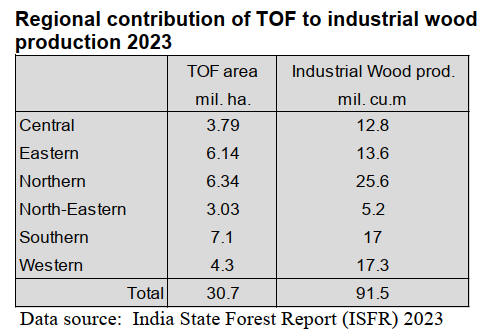
The highest industrial wood production is recorded in the
Northern region (25.6 million cu.m) attributed to high soil
fertility, progressive farming practices and widespread
adoption of clonal forestry.
Conversely, the North-Eastern region reports the lowest
production (5.2 million cu.m) mainly due to shifting
cultivation practices.
Interestingly, the Western and Southern regions show
comparable wood production levels despite the Southern
region having significantly larger TOF area. This disparity
may be explained by this region’s focus on tree
conservation a higher proportion of urbanised areas,
prevalence of longer rotation crops, harsher climatic
conditions and relatively lower soil fertility.
According to ISFR 2023 the top three States in terms of
industrial wood production from TOF are Maharashtra,
Uttar Pradesh and Madhya Pradesh.
Agroforestry is primarily practiced for commercial
purposes and thus constitutes the major source of
industrial wood. However, due to small landholding sizes
most farmers grow only small-diameter timber.
Consequently medium and larger diameter timber is often
imported to meet domestic requirement. India remains a
net importer of wood and wood-based products with
imports valued at around US$9 billion.
To promote TOF the Ministry of Environment, Forest and
Climate Change (MoEFCC) along with various State
Forest Departments (SFD) has undertaken several
initiatives. State Forest Departments have implemented
various plantation schemes on Panchayat/Community
land, farmland across the country. The private sector has
contributed by promoting commercial tree crops to meet
their raw material needs.
A key component of vision ‘Viksit Bharat@2047’
involves doubling wood production by enhancing the
productivity of commercial tree crops and expanding the
area under TOF as this will support the growth of wood-
based industries and help meet the country’s increasing
demand for timber and wood products. ThePply Insight
article outlines recommendations for the Central and State
government.
In related news, a renewed call for stronger community-
driven forest governance was the focus at a National Book
Trust book launch attended by the Dalai Lama. The
book,”Forest Resources in India: Integrative Governance
and Community Participation for Sustainable Future”
examines how India can strengthen sustainable forest
management at a time of rising pressure on natural
resourcessay the authors,Sushil Kumar Singla, Rakesh B
Sinha and Krishan Kumar Raina.
The authors say that India’s forest future depends on
governance models that actively involve women, tribal
communities and local institutions, noting that traditional
conservation practices remain relevant to modern
environmental challenges.
See: https://plyinsight.com/beyond-forest-boundaries-significant-
role-of-trees-outside-forest/
and
https://www.indiatodayne.in/lifestyle/story/dalai-lama-unveils-
national-book-trust-title-on-future-of-indias-forest-governance-
1313258-2025-12-05
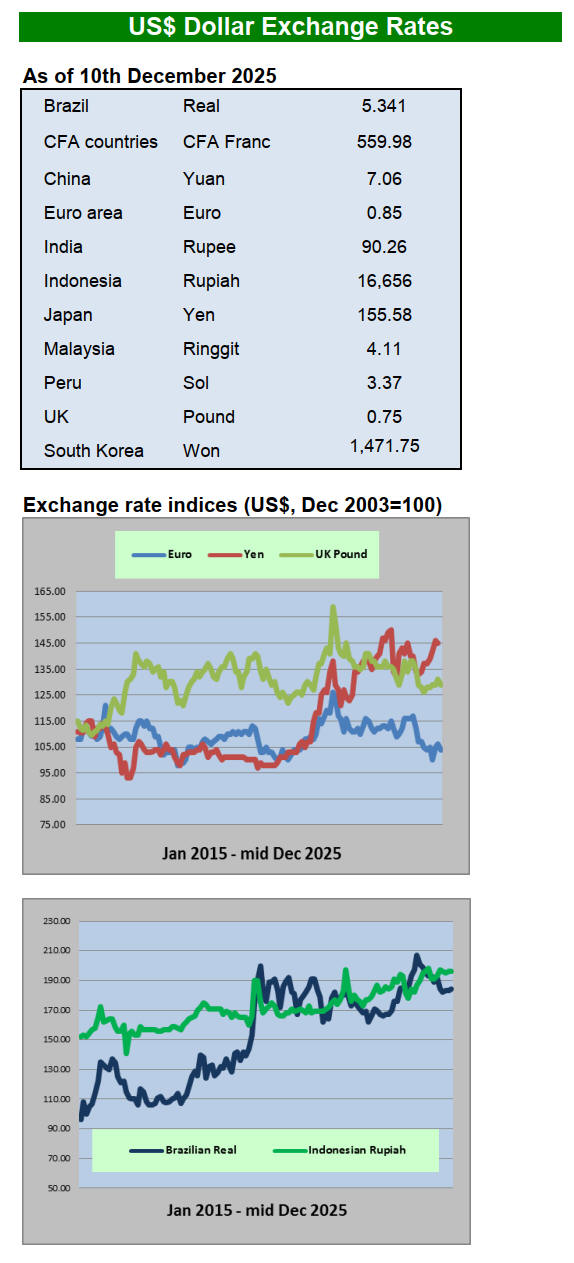
Indian rupee weakening while economy strengthens
These seemingly diametrically opposite economic
observations are puzzling timber importers.
In early December it was reported that the economy
recorded a six-quarter high growth of 8% in the third
quarter, a result that exceeded the expectations of most
economists. At the same time the Indian Rupee dropped to
an all-time low against the US dollar-breaching the Rs90
at one point. Economists have pointed out that the drivers
of GDP are widely different from the forces that drive the
value of a currency saying tariffs imposed by the US are a
force behind the depreciating Indian rupee.
Reserve Bank of India Governor, Sanjay Malhotra ,
dismissed concerns of the falling rupee value stating this
was just a side effect of tariffs. He believes when India
and US finalise their trade deal the pressure on the
currency will be relived.
In related news, the RBI recently cut its policy rate by 25
basis points to 5.25%.The monetary policy committee
delivered a unanimous reduction, citing “weakness in
some key economic indicators,” even as headline inflation
has eased significantly.
Anubhuti Sahay, Head of India Economics Research at
Standard Chartered Bank said the rate cut is timely given
that the economy is doing well but the outlook remains
uncertain. She added that the rate cut is even more
significant given the rupee’s weakness.
See: https://www.indiatoday.in/business/story/indian-economy-
gdp-growing-why-is-rupee-falling-currency-crisis-explained-
2830631-2025-12-04
and
https://www.cnbc.com/2025/12/05/india-cuts-rates-to-as-
expected-as-central-bank-rbi-warns-of-further-reductions.html
Turbulent times
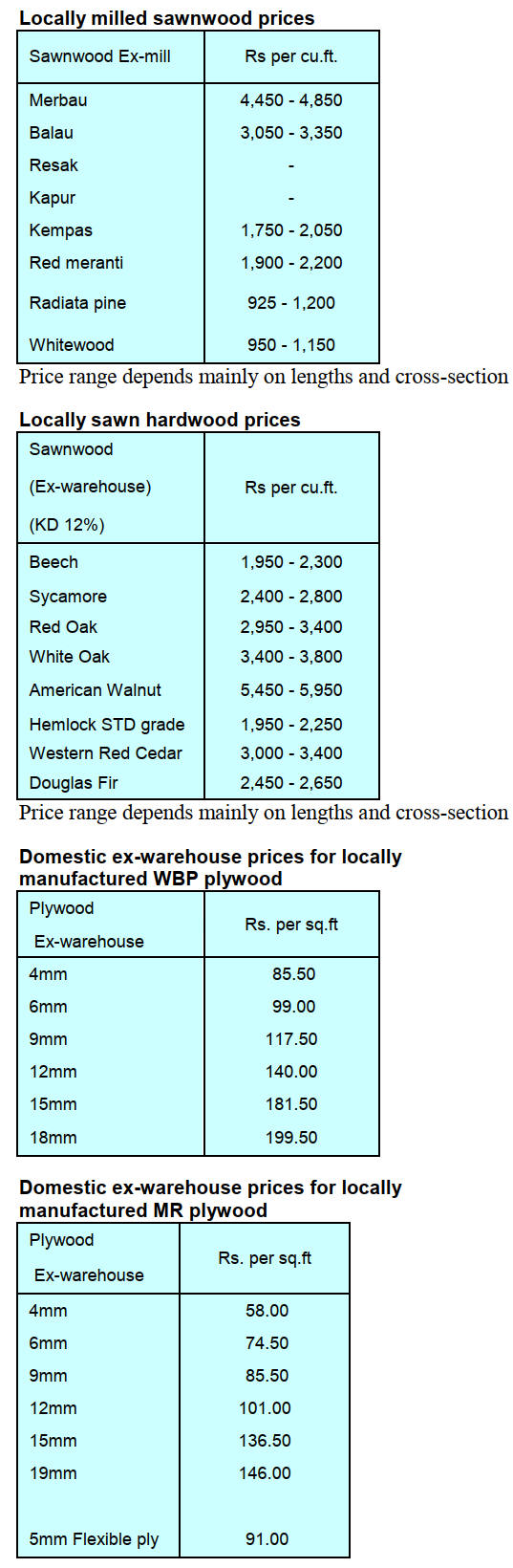
The correspondent writes “demand is reasonably good but
costs are going up in the panel industry mainly because of
the Rupee exchange rate as well as rising phenol prices.
Overall, 2025 has been a rollercoaster ride. Firstly, BIS
implementation in January, then the US tariffs issue and
thirdly the extended monsoon and finally the Rupee
exchange rate at an all-time low. However, the good thing
is that India is a promising market and our domestic
consumption is high hence we can sail thru this turbulent
time”.
7.
VIETNAM
Wood and Wood Product (W&P) trade
highlights
According to the Viet Nam Customs Office W&WP
exports in November 2025 reached US$1.55 billion, up
5% compared to November 2024. The WP export share
was US$1.06 billion, up 3% compared to November 2024.
In the first 11 months of 2025 W&WP exports were
recorded at US$15.6 billion up 6% over the same period in
2024 of which WP exports earned US$10.67 billion, up
5% over the same period in 2024.
Viet Nam’s W&WP imports in November 2025 were at
483,200 cu.m, worth US$154.6 million, down 3% in
volume and 2.5% in value compared to October 2025.
Compared to November 2024 there was an increase of 3%
in volume and 3% in value. In the first 11 months of 2025
imports accumulated at 6.12 million cu.m, worth US$1.94
billion, up 21% in volume and 18% in value over the same
period in 2024.
Viet Nam's NTFP exports in October 2025 fetched
US$74.59 million, up 12% compared to September 2025
and 22% over the same period in 2024. In the first 10
months of 2025, NTFP exports generated US$ 715.18
million, up 9% over the same period in 2024.
The W&WP exports to the US in November 2025 earned
US$819 million, down 1% compared to November 2024.
In the first 11 months of 2025 W&WP exports to the US
are expected to reach US$ US$8.6 billion, up almost 6%
over the same period in 2024.
The exports of bedroom and dining room furniture in
November 2025 earned US$202 million, down 15%
compared to November 2024. In the first 11 months of
2025 exports of living room and dining room furniture are
estimated at US$2.3 billion, down 5% over the same
period in 2024.
According to preliminary statistics, Viet Nam's imports of
wood and wood products in November 2025 will reach
US$290.0 million, up 17% compared to October 2025.
Compared to November 2024 an increase of 26% was
observed. In the first 11 months of 2025 imports of wood
products have been estimated at US$2.91 billion, up 16%
in value compared to 2024.
Digital transformation challenges even billion-dollar
firms in Viet Nam
Despite high revenues, many Vietnamese wood product
manufacturers admit to confusion and setbacks when
embracing digital transformation.
Representatives of wood manufacturing and processing
enterprises have voiced concern and offered proposals
aimed at enhancing the role of the Viet Nam Timber and
Forest Products Association (Viforest) in supporting
business connectivity, trade promotion and policy
advocacy.
During the 5th Congress (2025–2030) of Viforest held
on
1 December in Ho Chi Minh City leading figures in the
industry shared their experiences and frustrations in
adapting to new market demands, particularly around
digitisation and governance.
Le Duc Nghia, Chairman of the Board of Directors at An
Cuong Wood JSC, emphasised the importance of direct
engagement among businesses. He believes such forums
offer clearer perspectives on the industry and help
companies identify solutions for sustainable growth.
According to Nghia, domestic wood companies benefit
from a highly skilled labour force and are capable of
producing goods competitive with foreign brands. Yet, he
admits that managerial capacity remains a major
challenge.
“Digitisation has helped An Cuong streamline operations
and gain full process control over the past five years,” he
stated.
At the congress, Vu Quang Huy, CEO of Tekcom JSC,
noted his company sales are around US$100 million
annually but has found the wood product and plywood
industries are evolving rapidly and face mounting
pressures from tariffs, origin traceability, and transparency
standards.
Huy highlighted several systemic challenges: rising input
costs amid falling product prices, legal risks tied to
sourcing, and supply chain disruptions as more firms
resort to importing raw materials themselves.
To navigate these issues, Huy proposed three key
strategies: increasing transparency in sourcing, promoting
collaboration and specialisation, and transforming supply
and value chains.
Sharing deep concerns about the future of woodworking as
a craft, Nguyen Thi En, Standing Vice President of the
Van Diem Craft Village Association, stated that traditional
woodworking villages are facing immense pressures in
today’s market.
According to En, traditional handicrafts, once celebrated
for their cultural value, are being squeezed out by mass-
produced goods and shifting consumer tastes.
Moreover, many traditional designs no longer match
modern consumer needs, limiting access to younger
audiences and high-end markets. Although artisanal
products receive praise in Europe, craft villages still
struggle to meet international standards.
En also pointed to digital transformation and e-commerce
as major challenges. Most workshop households still
operate independently, lack digital marketing strategies
and have limited adaptability to rapid market changes and
higher digitisation demands.
For long-term sustainability, En believes craft villages
must be restructured into larger models that allow
collaborative production to boost competitiveness.
“Authorities and Viforest need to strengthen support in
trade promotion, product design innovation and digital
training for producers. Only by preserving traditional
values while adapting to modern needs can woodworking
villages truly thrive,” she said.
Deputy Minister of Agriculture and Environment Nguyen
Quoc Tri, speaking at the congress, praised Viforest’s
contributions to wood processing and exports.
To help businesses meet stricter standards - especially
regarding legal timber, product origin and carbon
emissions - he urged the association to adopt new
mindsets, reform operations, and accelerate the
implementation of key plans.
For the 2025–2030 term the Deputy Minister outlined core
goals for Viforest: to continue helping businesses
overcome challenges, actively participate in policymaking,
expand markets and promote the development of high-
value products. He emphasised the need for a transparent,
eco-friendly production model that meets the growing
expectations of international markets and called on
Viforest to strengthen its role in building a legal wood
supply chain.
See: https://vietnamnet.vn/en/digital-transformation-puzzles-
billion-dollar-wood-firms-in-vietnam-2472051.html
Timber sector seeks solutions to VAT refunds
The Viet Nam Timber and Forest Products Association
(VIFOREST) has alerted the authorities that billions of
VND in delayed VAT refunds are leaving Viet Nam's
timber enterprises short of capital for reinvestment,
stalling production and directly threatening the livelihoods
of millions of people across the country.
VIFOREST has petitioned the Ministry of Finance and
relevant agencies to eliminate VAT on primary wood
products and recognise them as agricultural outputs
exempt from VAT. It has also called for consistent
application of Decree 209/2013/ND-CP, which clearly
stipulates that ordinarily processed plantation timber
should not be subject to VAT.
According to the Association, this proposal would allow
processing and exporting firms to avoid burdensome
deductions and refund procedures, reducing compliance
costs and freeing up working capital. “Our goal is to ease
administrative bottlenecks, mitigate legal risks, and
prevent losses to the state budget from invoice fraud,”
VIFOREST stated in its report.
The move, it argued, would also protect the incomes of
millions of rural household engaged in afforestation.The
sector's achievements underscore what is at stake.
Viet Nam today maintains more than 4.6 million hectares
of planted forests, producing an annual harvest of 35-40
million cubic metres of timber, sufficient to meet 75–80
per cent of processing demand.
Exports of wood products is forecast to reach US$16.9
billion in 2025, ranking sixth among Viet Nam's export
categories. The industry provides direct jobs for over
500,000 workers and sustains millions of smallholder tree
growers.
These numbers point to an acute liquidity challenge.
Preliminary figures from VIFOREST indicate that timber
enterprises are still waiting for VAT refunds worth around
VND6.1 trillion ($250 million). The delay is linked to
current procedures that require refunds to be processed
only after thorough review.
On paper, the system is meant to secure the state budget.
In practice, it has stalled refund approvals for compliant
businesses. “Many companies have complete and
legitimate dossiers, yet they are still asked to provide
additional clarifications over and over again,” noted Cao
Xuan Thanh, chief of office at VIFOREST. He stressed
that refund processing often exceeded the statutory
deadline, causing serious cash flow disruption.
Thanh pointed out that the requirement to trace raw
material origins back to individual households is
especially unrealistic.
“A single export shipment may be sourced from dozens of
growers across multiple provinces,” he explained. “The
verification process becomes unworkable, and that is
where enterprises get stuck.”
The consequences are immediate. Exporters are forced
to
advance 10%t VAT on input materials while awaiting
refunds, eroding their capacity to rotate capital.
This hits small- and medium-sized firms the hardest. With
industry-wide profit margins averaging only 5-7 per cent,
the sector loses an estimated VND500-600 billion ($20-25
million) annually due to refund
Nguyen Liem, Vice Chairman of VIFOREST, added that
product classification is another barrier. He observed that
plantation timber after harvest, such as logs, sawn timber,
peeled veneer or woodchips has not been clearly
recognised as “primary processed” goods. “Because of this
ambiguity, exporters accumulate large VAT credits that
cannot be refunded on time,” he said.
Liem further noted that both enterprises and small traders
are still obliged to declare and pay VAT even on
minimally processed timber, increasing costs and
paperwork. In his words, “These procedures consume
enormous time and resources, but the refunds remain out
of reach. This has paralyzed business cash flows and put
many companies at risk.”
These obstacles are driving a troubling shift. Some
companies now prefer to import timber rather than
purchase from domestic plantations to avoid VAT refund
complications. This undermines demand for local wood,
stripping millions of farmers of stable income and is a dis-
incentive for reforestation. Thanh cautioned that the
government might ultimately face the paradox of bailing
out commercial plantation forests, a scenario entirely at
odds with Viet Nam's sustainable forestry goals.
VIFOREST's message is clear: resolving VAT refund
issues is not merely about tax administration. It is about
preserving national reputation, protecting farmers'
livelihoods, and securing the industry's competitiveness in
a global market increasingly focused on sustainability. “If
these obstructions are not lifted, we risk losing both
domestic and international trust,” Thanh emphasised.
In its petition, the Association stresses that timely VAT
reform will immediately free up liquidity, reduce exposure
to legal risks, and enhance compliance with international
traceability standards.
See: https://vir.com.vn/timber-sector-seeks-solutions-to-vat-
refunds-138610.html
Wood, forestry sectors targets US$25 billion exports
For the 2025–2030 term, Viforest aims to reinforce its role
as a hub for innovation, build long-term development
plans and expand cooperation with ministries and
international partners to support the sector’s green
transition.
According to Viforest’s report the sector maintained solid
expansion over the past five years despite global trade
fluctuations. Export revenue from wood and wood
products rose from US$10.33 billion to US$16.2 billion
and is forecast to exceed US$18 billion in 2025.
These results were attributed to strong coordination among
enterprises, forest growers and state agencies, along with
Viforest’s role in assisting firms with technical
regulations, market information and trade-remedy
responses. The gradual strengthening of the legal timber
supply chain has also helped the industry meet stricter
requirements in major markets.
However, Viforest noted that the sector continues to face
structural challenges, including rising political and trade
competition, origin fraud risks and tariff pressure.
Limited management capacity and weak information
coordination in some enterprises have slowed their
reaction to market changes. Increasingly demanding
standards on green production and emission reduction,
particularly under the EU’s new deforestation regulation
(EUDR) pose added difficulties for small and medium-
sized firms. For the 2025–2030 Viforest aims to reinforce
its role as a hub for innovation, build long-term
development plans and expand cooperation with ministries
and international partners to support the sector’s green
transition.
The Association identified five priorities, helping
enterprises expand markets, strengthening branding,
developing high-value products, promoting deeper
processing and improving system-wide coordination and
trade promotion.
The congress elected a 31-member Executive Committee
for the new term, with Nguyen Quoc Khanh, Chairman of
AA Corporation, chosen as Viforest President. He said the
sector aims not only to expand export scale but also to
increase added value, bringing greater benefits to forest
growers.
To achieve the export target of US$25 billion by 2030, he
emphasised three directions: enhancing competitiveness
through stronger linkages; building a national brand for
Vietnamese wooden products; and diversifying markets,
product lines and distribution channels. He stressed the
need for a resilient supply chain, improved production
capacity, investment in green manufacturing and a data
system aligned with international standards.
Viforest also encouraged enterprises to increase their
presence at major global trade fairs, deepen connections
with foreign partners and make better use of Viet Nam’s
overseas trade offices. Domestically, upgrading
specialised exhibitions would help position Viet Nam as a
key destination for international buyers./.
See: https://en.vietnamplus.vn/wood-forestry-sector-targets-25-
billion-usd-in-exports-post334173.vnp
8. BRAZIL
Forest concessions an instrument for
restoration,
conservation and carbon
During COP30 in Belém the Brazilian Forest Service
(SFB) moderated the Panel “Forest Concessions:
Conservation, Restoration and Carbon” and highlighted
the strategic role of forest concessions as public policy
instruments which can combine conservation, ecological
restoration, carbon credit generation and socioeconomic
development.
The discussion brought together representatives from
Petrobras, Brazil NBS Alliance, National Bank for
Economic and Social Development (BNDES) and
Mombak, which emphasised the need to align public
policy, financial instruments and private initiatives to
expand nature-based solutions (NBS) in the Amazon.
The SFB opened the session noting that the climate agenda
goes beyond reducing deforestation and requires restoring
degraded areas and reorganising the use of public forests
with legal security and socio-environmental safeguards.
In this context the concept of a ‘new generation’ of forest
concessions focused on restoration and carbon was
presented and illustrated by the Bom Futuro National
Forest Concession located in the Amazon.
This is the first federal model dedicated to restoring
degraded areas through carbon credit generated funds and
commercial production.
According to SFB this initiative raises the standard of
forest concessions by combining large-scale restoration,
carbon revenues and direct benefits for local communities
and this reinforces Brazil’s contribution to global climate
goals.
The Panel consolidated the view that a forest concession
structure and the sustainable use of public forests provide
predictability for investors and promote biodiversity-based
development connecting conservation, restoration and the
low-carbon economy into an integrated agenda for a
sustainable Amazon.
See: https://www.gov.br/florestal/pt-
br/assuntos/noticias/2025/novembro/concessoes-florestais-
aproximam-conservacao-restauracao-e-carbono-na-amazonia-
durante-a-cop30
Partnership to boosts native species silviculture
The Chico Mendes Institute for Biodiversity Conservation
(ICMBio) and the Brazil Climate, Forests and Agriculture
Coalition have formalised a Technical Cooperation
Agreement aimed at expanding native timber species
silviculture at a national scale with an emphasis on
enhancing the value of Protected Areas (Unidades de
Conservação - UCs) and integrating these areas into the
productive sector.
The initiative establishes structured actions including
mapping degraded areas, installing demonstration plots in
Federal Protected Areas and providing technical training
for ecological restoration and native species management.
The agreement also includes assessing environmental
liabilities within protected areas to guide recovery projects
and the sustainable use of the territory.
According to the National Center for Biodiversity
Conservation (CBC) the partnership addresses the
challenge of connecting Protected Areas, currently
surrounded by degraded landscapes, to sustainable
production practices thus strengthening interactions with
agribusiness.
The strategy includes initiating native timber species
plantations in National Forests and expanding them to
surrounding rural properties. The partnership has also
contributed to advancing the National Plan for Native
Vegetation Recovery (Planaveg).
See: https://www.maisfloresta.com.br/icmbio-e-coalizao-brasil-
firmam-parceria-para-ampliar-silvicultura-de-nativas-no-pais/
Postponement of EUDR
The European Parliament has approved a broad package of
amendments to the European Union Regulation on
Deforestation-Free Products (EUDR) confirming its
second implementation postponement and redefining the
roles, responsibilities and obligations of operators along
the supply chain.
The changes introduce new categories of operators (micro
and small primary and downstream operators) and
simplify due diligence obligations for micro and small
operators while downstream operators further along the
chain are largely exempt from the regulation´s main
requirements.
The amendments aim to reduce the burden on the EUDR
information system, lower administrative costs and
making compliance more proportionate without altering
the core objectives of the regulation.
The Parliament also instructed the Commission to propose
further adjustments by 30 April 2026 maintaining the
focus on geolocation of production areas, proof of legality
and verification of deforestation-free origin. For Brazil,
the postponement represents an opportunity to strengthen
internal organisation and ensure continued access to the
European market. Technical compliance remains essential
to ensure access and turn the additional time into a
competitive advantage.
See: https://www.maisfloresta.com.br/o-eudr-foi-adiado-o-que-
realmente-muda-para-quem-exporta/
Mato Grosso - a model for sustainable forest
management
The Secretaria de Comunicação Social (SECOM-MT) has
indicated the Mato Grosso State Secretariat for the
Environment (Sema-MT) has consolidated an advanced
forest management model based on strict control,
monitoring and traceability of timber from natural forests.
This, says SECOM-MT, has made the State a national
reference and led to its invitation to present the initiative at
the 5th edition of the event “Sustainable Timber: The
Future of the Market,” at a Federation of Industries event
in the State of Bahia.
The Mato Grosso system integrates forest cover
monitoring, enforcement actions and the System for the
Commercialisation and Transport of Forest Products
(Sisflora) which ensure the traceability of each tree
harvested under forest management plans thus
guaranteeing environmental compliance and transparency
throughout the supply chain.
In managed forest areas tree harvesting is conducted
selectively, respecting each tree’s life cycle. Trees that
have fulfilled their ecological role are strategically
harvested minimising the environmental impact and
allowing the regeneration of younger trees.
During the event State authorities emphasised that
sustainable forest management is strategic for keeping the
forest standing, increasing the supply of legal timber,
strengthening the bioeconomy and monetising ecosystem
services thus contributing to job creation, income
generation and regional development.
See: https://www.secom.mt.gov.br/w/modelo-implementado-em-
mt-para-garantir-produ%C3%A7%C3%A3o-regular-de-madeira-
nativa-%C3%A9-refer%C3%AAncia-em-n%C3%ADvel-
nacional#f9331d53-89f6-4e10-b532-d85982a3be84
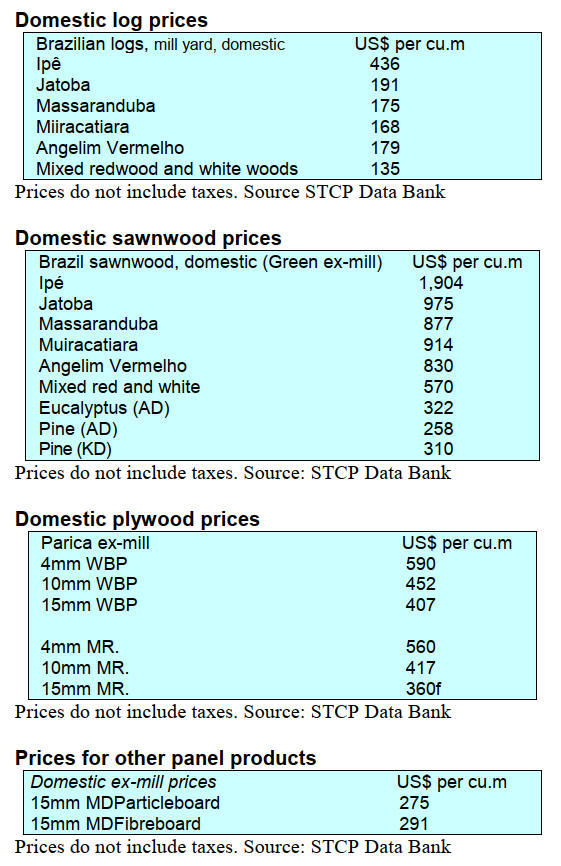
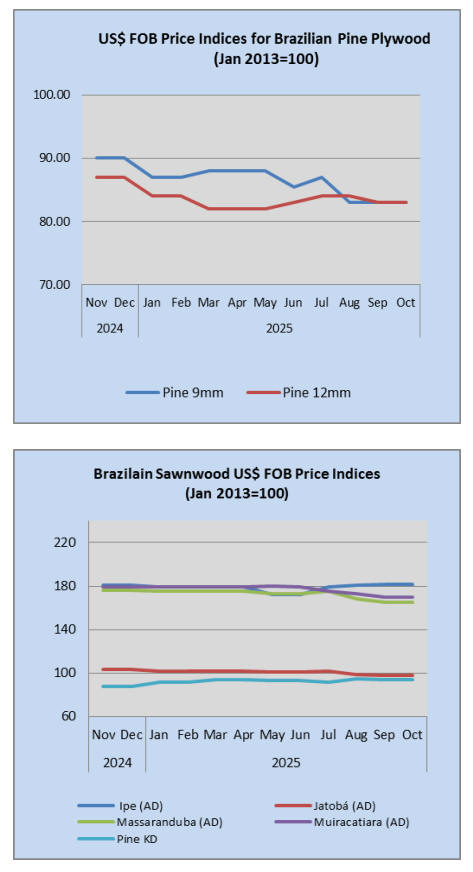
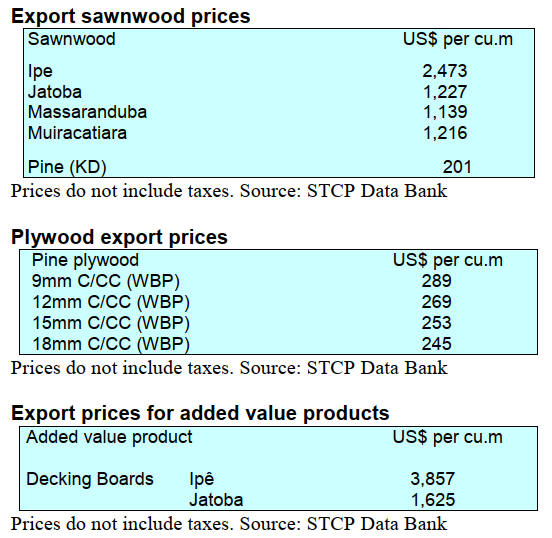
Export prices
Average FOB prices Belém/PA, Paranaguá/PR,
Navegantes/SC and Itajaí/SC Ports.
9. PERU
Timber harvested under permits predominantly legal
At the IX Latin American Forestry Congress OSINFOR
presented the results of its 2023 assessment of illegal
logging revealing that 88% of the timber extracted under
permits is legal. The report confirms that sustainable
management continues to deliver an opportunity to
conserve forests and promote development in Peru.
Currently, more than 7 million hectares of the country's
forests are managed under management plans. "In these
areas, legality is strengthened. The greatest risk lies in
unmanaged territories where forest loss is concentrated,"
stated Williams Arellano Olano the Head of OSINFOR.
The study also demonstrated sustained progress. Illegality
under permits decreased from 80% in 2015 to 12% in
2023 a result of the monitoring, training and technology
implementation efforts undertaken by OSINFOR.
See: https://www.gob.pe/institucion/osinfor/noticias/1293751-el-
88-de-la-madera-de-los-titulos-habilitantes-es-legal
Madre de Dios, Loreto and Ucayali – centres for FSC
certification in Peru
Peru has 1,022,175 hectares of forest certified by FSC
according to information provided by FSC Peru. There are
98 initiatives from the private sector, twelve of which are
related to forest management and 86 to chain of custody
(CoC). The regions of the country with the largest certified
areas are: Madre de Dios with 52%, Loreto with 35% and
Ucayali with 13%.
Strengthen forest regeneration and conservation
The Yamino native community, a Kakataibo indigenous
group recognised for its sound management of timber
resources, is the site of the study “A Look Towards
Conservation: Potential of Seed Trees in Native
Communities and Forest Concessions of the Ucayali
Region.”
This initiative is led by the Supervisory Agency for Forest
Resources and Wildlife (OSINFOR), the National
Agrarian University of the Jungle (UNAS) and the
Association for Research and Integral Development
(AIDER) with the goal of contributing to forest
conservation.
To understand the forest's natural regeneration capacity
and identify the productive potential of the seeds, the
technical team entered the community's forest
management area to evaluate the seed trees declared in its
management plan and collect information on species such
as ana caspi, mashonaste, copaiba, and cachimbo.
The results of the fieldwork will be used in the preparation
of a book that will highlight the role of seed trees in the
conservation and natural regeneration of forests.
See: https://www.gob.pe/institucion/osinfor/noticias/1244472-
ucayali-impulsa-estudio-de-arboles-semilleros-para-fortalecer-la-
regeneracion-y-conservacion-de-los-bosques
Pilot study to accurately identify timber species
With the aim of strengthening the traceability of timber
resources and ensuring their legal origin the Supervisory
Agency for Forest Resources and Wildlife (OSINFOR)
and the Technological Institute of Production, through the
CITEmadera y del Mueble (Wood and Furniture
Technology Center) and the CITE Forestal Maynas
(Maynas Forestry Technology Center) collected botanical
and wood samples of fifteen forest species as part of the
first pilot collection project carried out in Loreto.
Samples will allow researchers to analyse their cellular
structure, pore patterns and growth rings, essential
information for accurately identifying each tree species.
See :https://www.gob.pe/institucion/osinfor/noticias/1304312-
loreto-inicia-estudio-piloto-para-identificar-con-precision-
especies-maderables
|